dailynewsnblog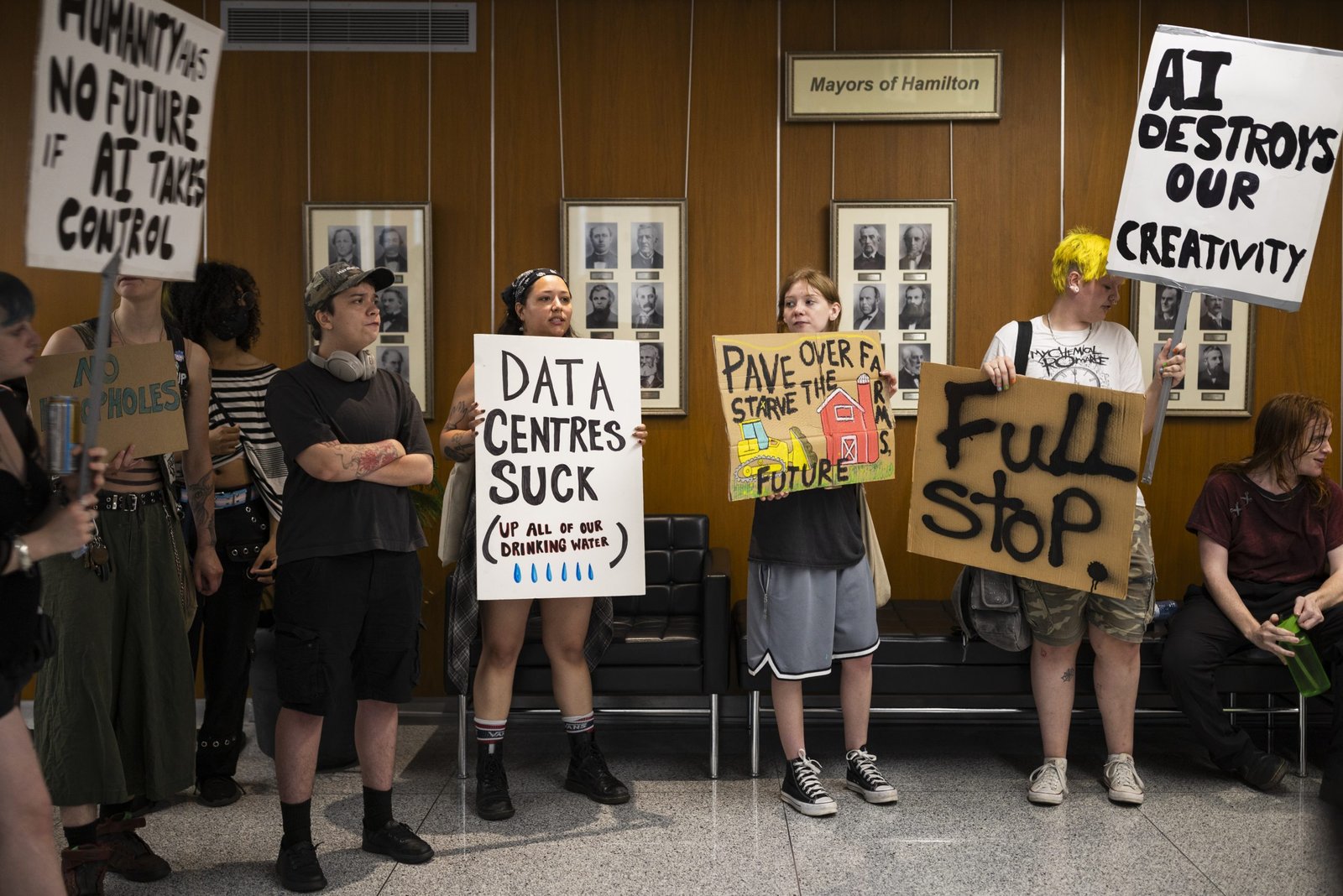
Several councillors who voted against the pause suggested it could threaten new investments in a city with a flagging industrial sector and put in jeopardy smaller data centre proposals with research components.
Hamilton city councillors rejected on Wednesday a temporary pause on new data centres that was eyed as a possible model for other municipalities amid the artificial intelligence boom.
The city would have been the first in Canada to pass a data centre moratorium as lawmakers across the country wrestle with the noise, energy and water concerns surrounding the new wave of facilities powering AI services.
Instead, several councillors who voted against the pause suggested it could threaten new investments in a city with a flagging industrial sector and put in jeopardy smaller data centre proposals with research components.
“I think it will hold back Hamilton and reduce opportunity for many, many Hamiltonians and for generations to come,” Mayor Andrea Horwath said before voting against the moratorium.
The 10-6 vote came after councillors held a lengthy closed-door session with the city’s legal team that advised a data centre project led by McMaster University would have been exempt under the proposed pause. Several councillors who emerged from the private meeting also suggested the moratorium was vulnerable to legal challenge.
Having heard the same advice, Coun. Nrinder Nann, the moratorium sponsor, said she was proud to support the proposed pause. Nann said it was “regrettable” the proposal had been misconstrued by its critics as a disinterest in investment.
“This is about enabling the City of Hamilton to upgrade our zoning and land use planning tools and criteria given that AI data centres have not ever been contemplated as a land use,” she said, before appealing to residents to keep up the debate.
“Good projects do not need to be afraid of good rules.”
City staff will continue a study of potential issues around data centres, as previously directed by council. But it’s unlikely to appease the hundreds of residents who wrote public letters to council in support of a blanket temporary ban on data centres, regardless of their size or use.
Despite the outcome, some moratorium supporters said Hamilton had still changed the conversation around AI data centres in Canada. Several other cities, including Mississauga and Vancouver, were set to debate their own moratorium proposals this month.
“Those questions about electricity, water, noise, land use, emergency planning and public benefit don’t disappear because a vote went a certain way,” said Nick Tsergas, a resident whose website and social media campaign have been a locus of information for moratorium-backing residents.
“We’ll continue participating constructively in the conversation, which doesn’t end today. Far from it.”
Wednesday’s rejection clears a potential hurdle for two known data centre proposals in Hamilton, one led by McMaster University and the other from the Digital Research Alliance of Canada. Both have said they would include a public research component and be smaller than the hyperscale facilities built by big AI firms, such as Meta and OpenAI.
“I was delighted to see that the city council went in the direction that they did. I think they were in a very difficult spot, primarily because of misinformation and because issues were being conflated,” said Gianni Parise, McMaster’s vice-president of research.
The university has partnered with s2e Technologies for a data centre at the former Hamilton Spectator building. Parise said they haven’t capped how much space there would be for researchers, but private sector users would be limited to startups and small to medium-sized businesses.
That project is expected to consist of two phases, the first with up to nine megawatts of power and a second with 25 to 30 megawatts, roughly on par with an automaker and well below the biggest AI facilities.
“What we’re talking about is not that generative consumer AI, but we’re about analytical science and predictive,” said Parise.
The other known proposal is from the Digital Research Alliance, a federally funded non-profit tasked with securing computing capacity researchers. It picked Hamilton for its application to Ottawa’s $890-million fund for a new “supercomputing system.”
In a presentation to council, the alliance has said under Ottawa’s rules the selected facility would be 60 per cent public sector with the rest split between private sector and industry-academic partnerships.
It’s the only group that’s publicly signalled interest in a data centre at Steelport, a sprawling redevelopment of a former steelmaking site along Hamilton’s waterfront. The non-profit has said its proposed facility would be about 32,000 square metres, comprising about one per cent of the total industrial redevelopment.
The developer, Slate Asset Management, has previously declined to confirm or deny whether it has also been in talks with large AI firms for the rest of the site. The Steelport project has applied for a 200-megawatt connection to the Ontario power grid. It says that application reflects what had already been set aside for the former steel mill though the company planned to eventually apply for more.
A spokesperson for the company said it had “heard the concerns raised throughout this process and the feedback we’ve received will continue to shape how we move forward,” in a statement reacting to the vote.
In a letter to council, the local utility Alectra said there were 519 megawatts of available capacity in its system in the vicinity, citing reduced industrial demand.
Competition among firms such as OpenAI, Anthropic, Microsoft and Google has fuelled a surge in data centres, warehouses packed with powerful computer chips used to train and operate increasingly complex AI models.
These AI-ready facilities often require vast amounts of electricity and water to both cool and power the computer chips. A recent United Nations University report said the environmental footprint of data centres globally already rivals some of the world’s largest countries.
Canada only has a handful of large hyperscale data centres, but dozens more are in the pipeline. Just last week, Meta announced its plans for an Alberta data centre powered by a new gas plant. The facility will consume roughly as much electricity as three-quarters of nearby Edmonton.
Data centre developers say some impacts can be mitigated with sustainable design choices, such as recycling water in closed-loop cooling systems or capturing excess heat from servers and piping it into homes during winter.
Residents backing Hamilton’s moratorium said they wanted guarantees and transparency, not promises.
Many raised concerns a data centre’s possible noise, water and heat impacts would be most felt by neighbourhoods already bearing the brunt of the city’s industrial burden. Others worried a large data centre could strain the local electricity grid and drive up utility bills, while delivering relatively few long-term jobs.
The moratorium debate also became a forum for broader concerns about the rapid rise of AI, from workforce disruptions to misinformation.
This report by The Canadian Press was first published July 15, 2026.