dailynewsnblog
As for the specter of AI data centers and increased energy costs being passed to customers, Poppe said, “So we’re seeing every gigawatt that we can add to the grid will lower everybody’s rates 1 percent.” Poppe noted that AI could help the company work more efficiently with its current infrastructure. “We’ve initiated a new playbook of doing simultaneous engineering using AI to optimize grid placement, grid utilization, and what the right resources need to be at the right places, so that we can have the lowest cost additions,” Poppe said.
It’s yet to be seen if Poppe’s vision works out for PG&E customers.
Salt of the earth
Credit:
Roberto Baldwin
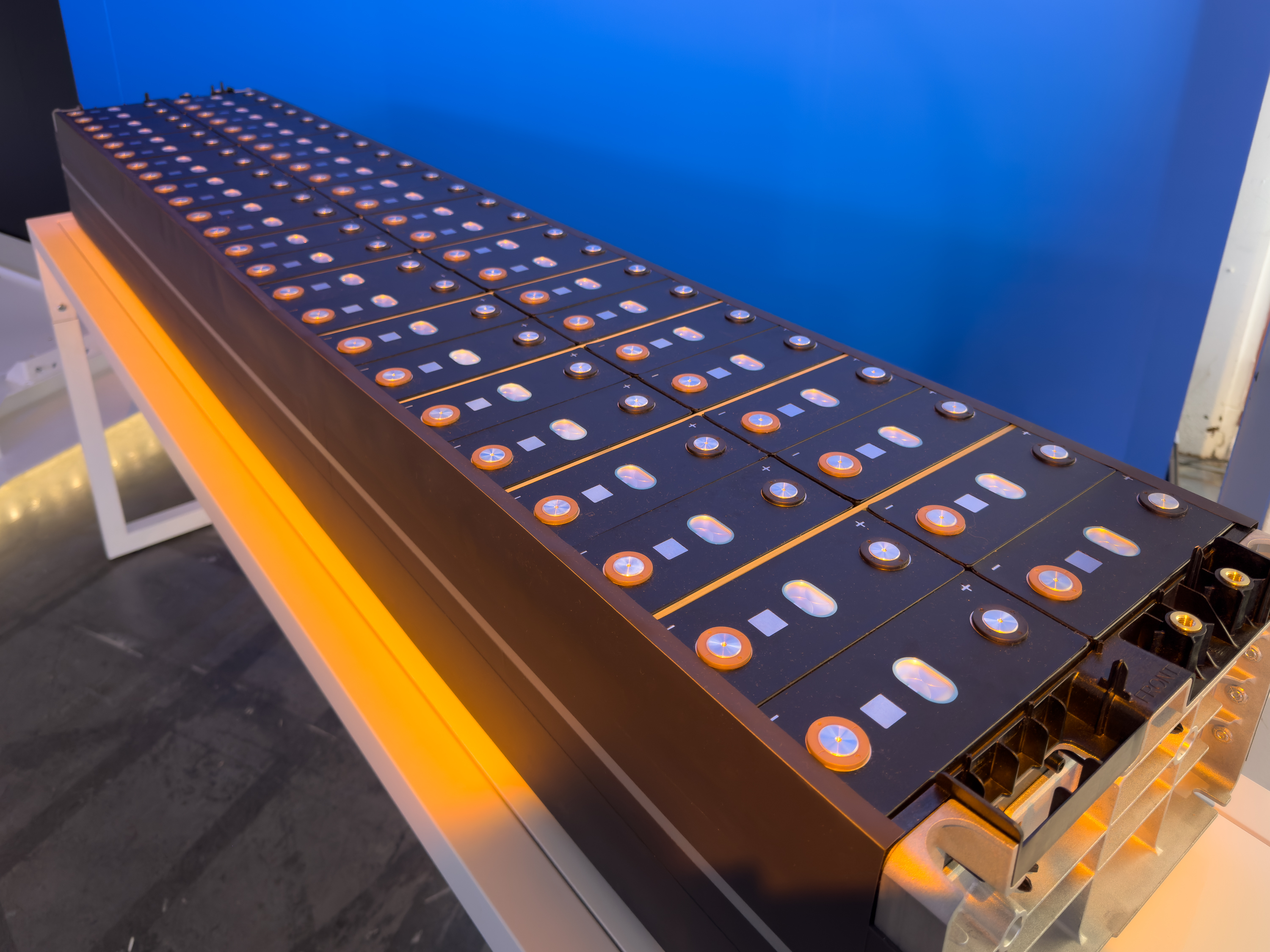
A sodium-ion battery module.
Credit:
Roberto Baldwin
The V2G support and deployment to GM’s lineup is important, but for steady grid support, battery storage is the future.
Recognizing this, GM also announced sodium-ion batteries that are purpose-built specifically for Energy Storage Systems (ESS) to support the electrical grid. While EV traction batteries require robust charge and discharge cycles while engineered to be as lightweight as possible, ESS batteries require a long life and to be as inexpensive as possible.
“Our strategy is simple: develop the right battery for the right application,” Kurt Kelty, GM’s vice president of battery and sustainability, said at the press briefing in San Francisco.
The sodium pyrophosphate (NFPP) batteries being developed in conjunction with Peak Energy, according to Kelty, should be 20 percent less expensive to maintain than currently available ESS batteries. Peak Energy already has sodium-ion NFPP ESS deployed. What GM announced is what it considers the next generation of the battery, and it expects to begin production of its flavor of NFPP in 2028.
GM didn’t share the manufacturing cost or the energy density target of its own batteries. Part of the 20 percent decrease in the cost of running the GM-developed sodium-ion battery pack ESS is that the batteries work within a larger operating temperature zone than LFP and NMC, between -40 °C (-40 F) and 60 °C (140 °F). GM also said that it’s targeting 10,000 to 20,000 cycles, which is more than LFP batteries.