dailynewsnblog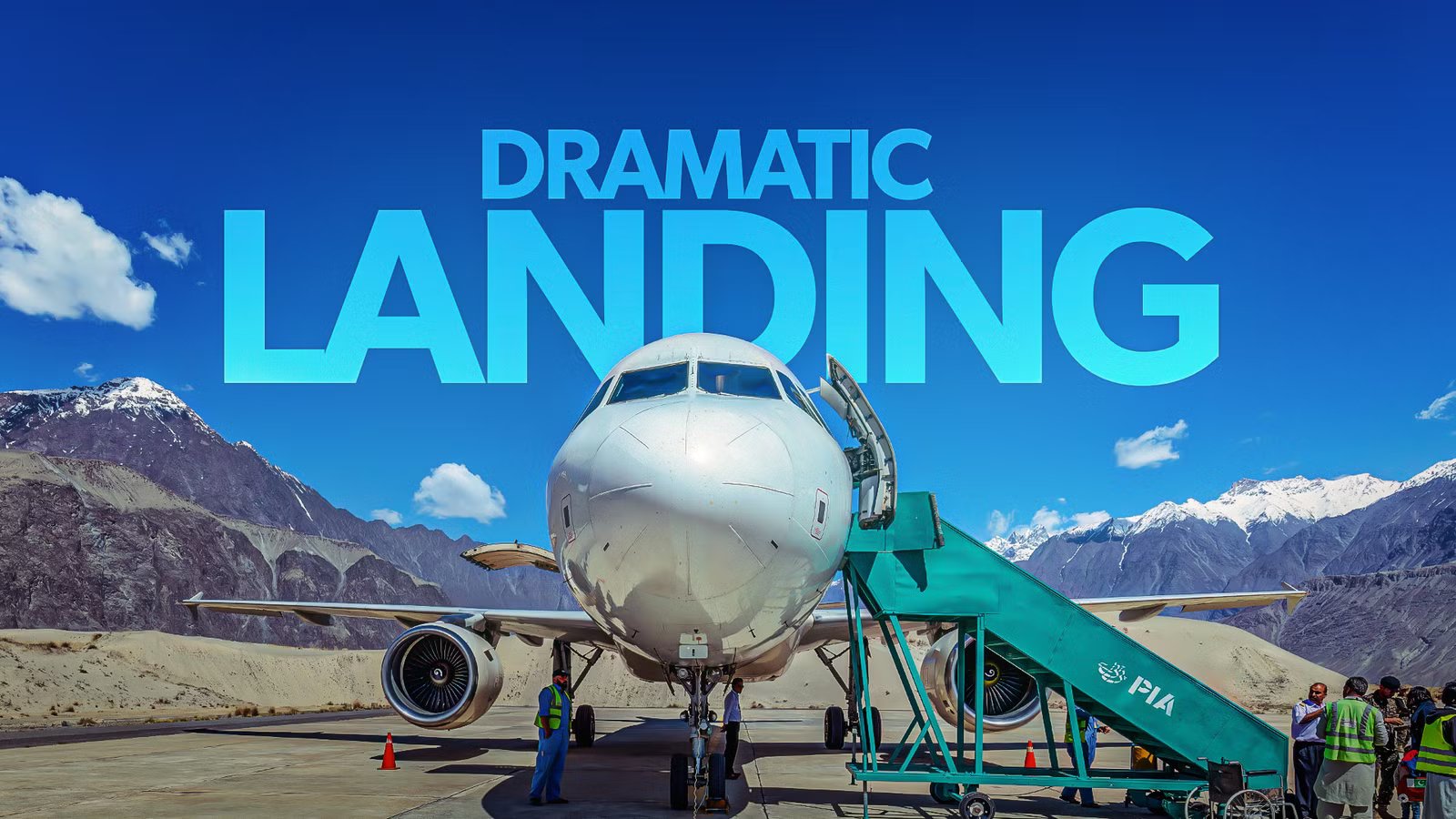
This year I flew through three dramatic airports in the greater Himalayan region: Skardu in the Pakistani-controlled north, Paro in Bhutan (read my review of the airport), and Lhasa in China’s Tibet. Of these, Paro was arguably the most exotic airport and terminal, Lhasa is by far the highest (sitting atop the Tibetan Plateau), and Skardu was the most dramatic in taking off and weaving through the valleys and clearing mountain ridges.
Bhutan and its Paro Airport are nestled in what is essentially the foothills of the Himalayas. By contrast, Tibet is perched on a high but uneven plateau; Skardu is deeply nestled in a valley with some of the world’s most dramatic mountain ranges rising abruptly. The flight from Skardu was one of the few where I have elected to pay to select a window seat. Here is what to know about Pakistan’s dramatic Skardu Airport and why it offers an arguably more dramatic flying experience than Tibet’s Lhasa or Bhutan’s Paro.
Why Lower Elevation Makes Skardu More Dramatic

Lhasa Airport sits at 11,170 feet (3,570 meters), which is considerably higher than Skardu’s elevation of 7,301 feet (2,225 meters). But while that is relevant to the air thickness, the runway length, and the type of aircraft that can be operated, it is disconnected from the mountainous terrain itself. Lhasa is on a plateau, and the mountains that rise from the plateau around the airport are more spaced out and less dramatic.
Skardu sits at a significantly lower absolute elevation than Lhasa but has steeper relative relief in its immediate valley surroundings (taller walls rising from the valley floor). I took public buses and a private taxi to the northern city of Gilgit from the Swat Valley, and from there I hired a motorcycle and drove around the state of Gilgit-Baltistan for ten days before flying out of Skardu.
So, unlike Paro and Lhasa, I did not fly into Skardu, but I did fly out. This is a region that sees the convergence of three of the world’s most dramatic mountain ranges: the Karakoram Range, the Himalayas, and the Hindu Kush. The region is home to five of the world’s fourteen “eight-thousanders” (peaks over 8,000 meters). It is the highest density of these peaks in the world.
The Skardu Airport

Skardu International Airport is located close to the Baltistan city of Skardu, which is the base for exploring the world’s second-tallest mountain, K2 (28,251 feet or 8,611 meters). K2 is remote and hard to access; I couldn’t see the mountain from the ground when taking off. The airport is the busiest in Gilgit-Baltistan (another airport is located in Gilgit). Skardu Airport is also part of one of Pakistan’s most important air force bases (Qadri Air Base).
This airbase typically plays a central role in periodic Indian and Pakistani skirmishes in the region. Skardu Airport was originally built as an airbase in 1949, after Pakistan’s independence and following conflicts with India over the greater Kashmiri region. While designated an international airport, Skardu only has domestic flights to the capital of Islamabad, the major and historic city of Lahore, and the southern megacity of Karachi.
My flight was to Lahore, from where I continued my journey overland to Karachi. According to FlightRadar24, flights to Karachi are around three times a week, the flights to Lahore are a little more than once daily, and the flights to Islamabad are around three times a day. The frequency may vary depending on the season. The Lahore route is served by AirBlue and Pakistan International Airlines (PIA). I flew with AirBlue. According to Planespotters.net, AirBlue operates a fleet of five A320ceos, five A321ceos, and two A321neos. I flew on an A320.
The Skardu Airport Terminal

I flew at the beginning of the tourist season in Gilgit-Baltistan, and there were very few foreigners, with the vast majority of passengers at the airport being urbanites from Islamabad, Lahore, and Karachi. The airport terminal was nothing special, being a small regional airport. Check-in was simple, as was security. Like many airports in the region, there are many porters ready to carry passengers’ luggage, whether asked or not.
The waiting area was for all the gates. In Pakistan, there are few internationally branded restaurants (a few, like McDonald’s, are in the major cities). One terminal restaurant was the local chain “Mr Cod.” Skardu is far from the sea, and the outlet did not actually sell any fish (the Mr Cod in Karachi Airport does); instead, it mostly sold chicken.
Airport shuttle buses take all passengers to the airplanes sitting on the tarmac far from the terminal and across parts of the air base to where the airplanes are parked. Being a regional airport dominated by domestic holidaymakers, many passengers mill about, taking photos of the aircraft and the dramatic snow-capped mountainous backdrop before boarding the aircraft. This is similar to Bhutan, but not Lhasa.
Taking Off From Skardu

Like Paro, as the aircraft takes off from Skardu, it flies down the valley rapidly gaining altitude, but is unable to gain enough altitude and clear the mountains. It banks and makes what feels like a hairpin 180-degree turn for a commercial aircraft and flies back over the airport, gaining altitude. It clears the first mountain ridge by what feels like a few feet (similar to Paro). It’s also worth noting here that after taking off, Paro flights also pass over dramatic snow-capped mountains, although they are generally less dramatic and further away.
I have flown hundreds of times and visited over 100 countries (none in South America), and this was the most dramatic commercial passenger flight. The jagged snow-capped mountainous peaks rise dramatically as near-vertical walls around the aircraft. As with other dramatic alpine airports, it can only operate in fair weather with good visibility.
My flight to Paro was delayed due to poor visibility, although I was fortunate to have good weather at Skardu with no wind and clear skies. As an indication of the importance of weather, almost all Skardu flights are scheduled for the morning and mid-afternoon. The first flight is after sunrise (after 08:00), and the last is generally at around 14:30, although there can be flights after 16:00 before sundown.
The Dramatic Mountains Rising Abruptly From Skardu

In June, I also visited Everest Base Camp in Tibet. That is at an altitude of around 17,060 feet (5,200 meters), meaning the peak is only around 12,000 feet (3,500 meters) from the base. Ironically, the world’s tallest mountain appears less dramatic than some of the mountains in Gilgit-Baltistan. For example, traveling by motorcycle, I stayed at Karimabad, which sits at around 8,000 feet (2,438 meters) above sea level.
Some of the mountain peaks (e.g., Rakaposhi) are 25,551 feet (7,788 meters) above sea level. These mountains are much taller than Everest from the base (around 17,500 feet or 5,300 meters). But it’s not just the height of the mountains from the valley floor; it’s that Skardu and Gilgit are much closer to the mountains than Lhasa is in Tibet from the very tall mountains. Airliners may generally avoid flying over the Himalayas, but aircraft from these airports have no choice.
Select high-altitude airport | Country/region | Elevation (per ICAO) | Runway length |
|---|---|---|---|
Daocheng Yading Airport | Tibetan Plateau | 14,472 feet (4,411 m) | 13,123 feet (4,000 m) |
Qamdo Bamda Airport | Tibetan Plateau | 14,219 feet (4,334 m) | 18,045 feet (5,500 m) |
El Alto International Airport | Bolivia | 13,325 feet (4,061 m) | 13,123 feet (4,000 m) |
Lhasa Gonggar Airport | Tibetan Plateau | 11,710 feet (3,570 m) | 13,123 feet (4,000 m) |
Paro International Airport | Bhutan | 7,332 feet (2,235 m) | 7,431 feet (2,265 m) |
Skardu Airport | Pakistan | 7,316 feet (2,230 m) | 11,998 feet (3,657 m) |
Gilgit Airport | Pakistan | 4,760 feet (1,451 m) | 5,400 feet (1,646 m) |
Lhasa is around 265 miles (425 kilometers) from Everest and its “eight-thousanders.” Gilgit Airport is around 18 miles (29 kilometers) from Rakaposhi and even closer to other major peaks. Skardu Airport is 65 miles (104 kilometers) from K2. Skardu is only 53 miles from the 26,660-feet (8,126-meter) Nanga Parbat (the mountain in the 1997 movie Seven Years in Tibet). The immediate peaks around Skardu (from four miles or seven kilometers) are between 14,750 and 16,500 feet (4,500 to 5,000 meters) tall.
Pakistan Permits Photo-Taking, China Restricts It

Pakistan’s two northern airports, Gilgit and Skardu, lack the dramatic altitude of those on the Tibetan Plateau and those of South America’s Altiplano. This means the air is relatively thicker, and the runways don’t need to be as dramatically long as those in Tibet. Tibet has some of the longest airport runways in the world, with the other longest mostly found in South America’s Altiplano. However, Skardu is more dramatic for sightseeing and the thrill of weaving through the world’s most dramatic mountain ranges in an Airbus.
Only a specific subset of aircraft, like the Boeing 737-700 and the upcoming COMAC C919-600, can operate at those airports. The smaller A319 is also popular in these alpine airports. That said, both Lhasa and Skardu can and do operate the A320 under certain payload and performance limitations. Paro is set to operate the stretched A321neo in the future. Only Lhasa operates widebody airliners in a limited capacity.
There are plenty of other extreme airports in the region; I have also flown through Kyrgyzstan’s Osh Airport, where mountains rise dramatically around the aircraft as it descends. Finally, another reason why Skardu is so dramatic is that there are no restrictions on taking photos and videos. Chinese authorities do not permit passengers to take photos during taxiing, take-off, and landing at Lhasa, with the prohibition announced repeatedly on the aircraft.
Catch what other trackers miss
Emergency squawks, holds, NOTAMs — live signals, no signup.
Open tracker
Catch what other trackers miss
Emergency squawks, holds, NOTAMs — live signals, no signup.
Open tracker