dailynewsnblog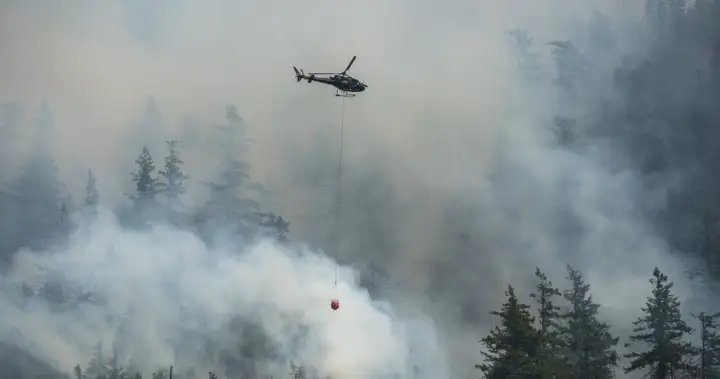
A cluster of wildfires are burning in British Columbia, many of them on land that is already parched, marking the beginning of a season that has some officials planning for how to conserve water.

The couple of dozen fires burning are mostly in the southern and central Interior, a swath of the province that federal drought monitors list from “abnormally dry” to “severe drought.”
The Canadian Drought Monitor says a wet March in B.C. did not result in much improvement, and while drought rankings in several regions were downgraded, “long-term deficits” in the central Interior forced the dry label to be maintained.
Rick van Kesteren, an information officer with the BC Wildfire Service, says the province has seen 93 April fires so far, with area burned slightly below the 10-year average.
But he says drought conditions are an area of concern, noting that there is record-low snow in some valleys in the Interior, which increases the likelihood of early-season grass fires.
B.C. has seen average snowpack at 92 per cent of normal, but there is significant variability across the province, with low snow levels in areas of Vancouver Island, the South Coast and the southern Interior, which could mean water shortages and drought.

Get breaking National news
Get breaking Canada news delivered to your inbox as it happens so you won’t miss a trending story.
Long-range forecasts suggest much of Canada could be hotter than normal over the coming months, while forecasters suggest El Nino, the warming phase of a recurring climate pattern tied to shifting waters in the Pacific Ocean, is expected to take hold this summer.
The Metro Vancouver Regional District, which normally limits lawn watering to once a week starting May 1, has announced residents will be banned from watering their lawns at all.
Linda Parkinson, director of policy, planning and analysis with water services, says the snowpack the district relies on is at about 50 per cent of normal.
She says Metro Vancouver, which has 21 municipalities, including Vancouver, Surrey, Burnaby and Delta, uses about 1.1 billion litres of water a day in the off-season but that can jump up to 1.7 billion during a warm summer.
“That over 50 per cent increase is driven by outdoor water use. And of that outdoor water use, lawn watering is the biggest piece,” she says.
Parkinson says normally the district’s water reservoirs, which are full during the winter, begin to empty just in time for the melting snow to fill them back up.
This year, hotter-than-normal temperatures could melt what’s remaining of the snowpack early, meaning there would not be room for the water to be stored in the reservoirs and it would instead overflow into rivers.
Enforcing lawn watering restrictions is up to bylaw staff in each municipality and the fines for breaking the ban are different depending on where you live.
Van Kesteren says the province saw a record 2,400 people apply to be one of the 1,300 seasonal firefighters this year, but there’s no way of knowing yet what type of fire season they will be facing.
He says a lot will depend on the amount of rain the province gets in May and June.
“There’s also little to no scale in long-range precipitation forecasting. It just remains to be seen,” he says.
“We’re preparing for the worst and just really hoping for the best.”
© 2026 The Canadian Press