(Bloomberg) — The implications of artificial intelligence gripped global central bankers in Iceland this week, with one Federal Reserve official joking that it won’t put economists out of business.
Most Read from Bloomberg
The program of the conference that ended on Friday in Reykjavik didn’t even mention the technology, but time and again, policymakers returned to musing about how it will affect labor markets, productivity and inflation, for better and for worse.
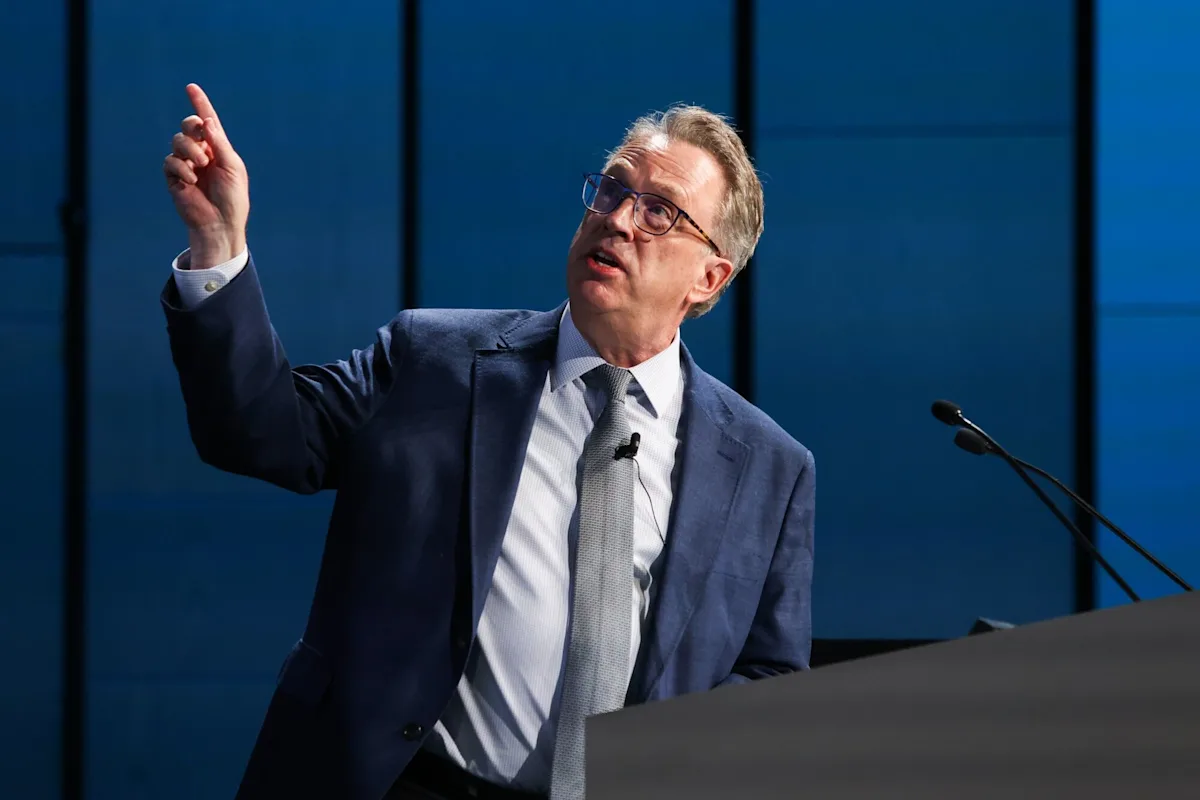
“The demand for macro economists will still be vibrant,” said New York Fed President John Williams, sparking laughter from an audience that, during the two-day event, included chiefs from the Bank of England, the Reserve Bank of India and the Swiss National Bank.
The debate showcased how, in tandem with the way it has fired up equity markets, AI has become the most engaging intellectual matter of the moment for central bankers even as they navigate a global energy shock, a shift in policy direction for many of them and a realignment of bond markets toward the highest yields in decades.
Williams offered the most optimistic take on the promises offered by the technology, compared with remarks to the conference by Fed colleagues Alberto Musalem and Jeffrey Schmid. He spoke months after worries about a vicious spiral of job cuts briefly spooked equity markets.
“History has taught us that you can have higher and higher productivity, higher and higher standards of living, without structural unemployment,” the New York Fed chief said. “I’m not a believer that we’re going to have long-term structural unemployment.”
Given the US economy’s role at the heart of the AI revolution, the Fed finds itself at the center of the debate. Its new chairman, Kevin Warsh, last year suggested an AI-driven productivity surge could allow the central bank to keep rates lower than it otherwise would, just as former Chairman Alan Greenspan argued in the 1990s at the advent of the internet age.
Other Fed officials don’t seem so sure. Musalem, president of the St. Louis Fed, became the latest US policymaker to push back on that notion by worrying aloud to the Reykjavik conference about possible inflation.
“The demand pressures associated with the AI boom are very real,” he said. “We see them in the data center buildout, the demands for electricity and memory chips, and the buoyant share prices of AI companies that are helping propel consumer spending.”
He cautioned that it’s risky, from an inflation perspective, to bank on the prospect of future productivity growth.
“To borrow Robert Solow’s famous observation about the computer revolution in the 1980s, today we see AI everywhere but in the aggregate productivity statistics,” Musalem said.
Schmid, the Kansas City Fed chief, wondered about the implications for jobs. He observed that reports from his district don’t necessarily point to AI replacing workers, but that anecdotal evidence suggests it is replacing hiring.
“Most industries have seen a decline in headcount over the past year, independent of their rate of AI adoption,” he cautioned. “This suggests a more general phenomenon behind the weakness of hiring.”
Williams suggested that whatever its consequences, AI will force a range of adjustments in the labor market, though again he offered a positive spin.
“We’ll have to basically retrain employees and train people to use these skills,” he said. “But also people coming out of school today are far ahead of us on this already. You look at people who are hired today coming out of college, they’re already using AI tools on a daily basis.”
Bank of England Governor Andrew Bailey said that, for central banks, AI isn’t just something to study in the economy, but a tool to implement in their organizations. He revealed the BOE’s Monetary Policy Committee is using large language models to predict how their meeting minutes will be received by the market.
“It’s helpful to us because it does occasionally throw things up, and it says, ‘Look, if you do this, this is how it will be received. Is that what you want?’” he said in a Bloomberg Television interview with Stephanie Flanders.
He added the BOE is increasingly using AI for everything from coding to economic modeling.
The conference was just one manifestation of the fascination of central bankers with AI and its potential. One official who wasn’t there was Bank of Italy Governor Fabio Panetta, who was busy on Friday delivering a major annual speech in Rome chronicling the country’s economic challenges.
Despite the International Monetary Fund warning of Italy’s “too high” debt, he barely touched on the matter. Instead, he devoted more than 600 words to AI, saying it could boost productivity by as much as 1 percentage point.
“In the most favorable scenario, these gains could more than offset the decline in potential output caused by the contraction in the working-age population,” he said. “Combined with higher labor-force participation, this would make durable growth in the Italian economy possible.”
–With assistance from Alessandra Migliaccio.
Most Read from Bloomberg Businessweek
©2026 Bloomberg L.P.


 dailynewsnblog