dailynewsnblog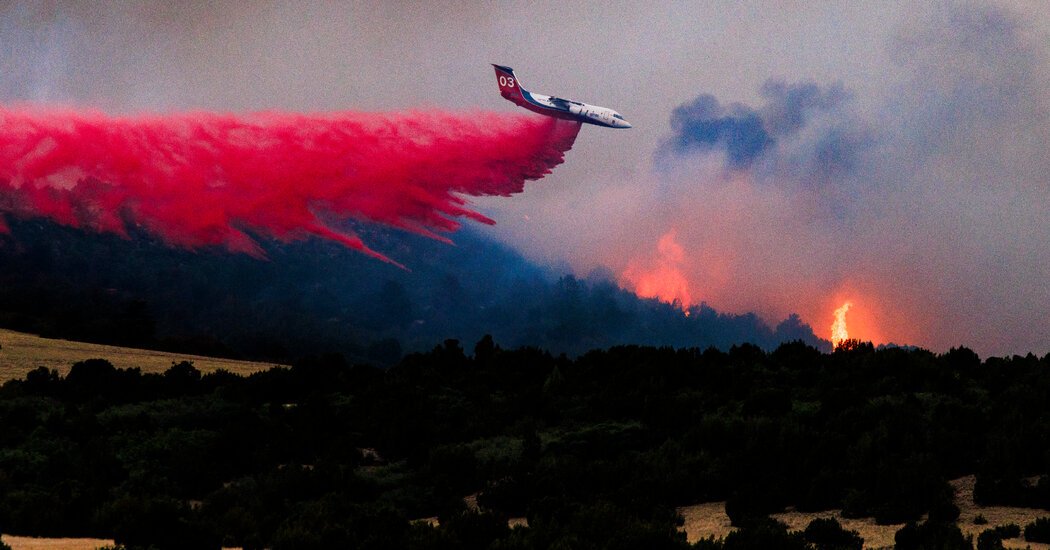
A wildfire burning near Pueblo, Colo., has covered more than 66,000 acres as of Friday morning and forced hundreds of households to evacuate in southern Colorado.
The blaze in Pueblo and Custer Counties, known as the Aspen Acres fire, expanded by over 11,000 acres overnight, according to Al Nash, the public information officer for the team managing the fire. Pushed by strong overnight winds, the fires made an eight-mile run to the south, and a more than four-mile run to the north, he said.
As of Friday morning, firefighters had still not managed to contain it.
More people were evacuated as the fire grew, including the entire population of the small mountain town of Colorado City, and its surrounding areas, said Gayle Perez, public information officer for the Pueblo County Sheriff’s Office.
In all, more than 4,000 properties have been evacuated since the fire began on Monday morning, Ms. Perez said, the vast majority of those in Pueblo County.
The fire began in Custer County, but as of Friday morning, was surging into Pueblo County. It is burning in steep, mountainous terrain that is difficult to reach. It is also a ranching area. Earlier in the week, the Pueblo County Sheriff’s office warned farmers who could not transport their animals to cut their fences.
National Guard soldiers will be deployed later on Friday to take over staffing checkpoints on roads leading into the fire area, Mr. Nash said. That will allow sheriff deputies currently working there to return to step up patrols of evacuated areas.
Winds on Monday, the day the fire began, were strong enough to “pick up a commercial steel trash dumpster, throw it up in the air, and across the street,” Lloyd Smith, sheriff of Custer County, said in an email. “I watched this happen on Day 1.”
Custer County is a rugged area with five 14,000-foot mountains, Mr. Smith said.
“So the fire is inaccessible to most vehicles,” he added.
Phil Daniels, the incident commander with the Colorado Division of Fire Prevention and Control, said at a Wednesday news conference that very low humidity, winds blowing over 30 miles per hour, and dry brush, timber and grass were contributing to the Aspen Acres fire’s rapid spread.
Gary Kyte was at his family’s ranch in the southern part of Beulah Valley on Monday despite an evacuation order, and defended his property from the flames using thousands of gallons of water stored on the property.
He described scorched trees bare of pine needles, with plumes of smoke rising in the distance.
“It is like an incredible moonscape around the valley,” he said. “It almost looks like snow. The trees, you can see right through the forest now. And the ground is just all white and green.”
The incident management team is asking people not to return home to save their property if they’re under evacuation orders, Ms. Repetski said.
“It’s for their safety,” she said. “It’s also for firefighters’ safety.”
Heavy smoke prompted the city and county of Pueblo to cancel outdoor activities like swimming and tennis.
Multiple large fires in the state over the past couple of weeks have absorbed firefighting resources, but “we are the No. 1 fire in the region as well as in the United States right now, so when we ask for it, we get it,” Mr. Daniels said in the news conference. “But we can’t bend the laws of physics. Sometimes, things have to come from a long ways away.”
The Aspen Acres fire is human-caused and under investigation.
The wildfire season, affected by drought and a warm winter, is revving up early, and thousands of acres in Colorado and other Western states have burned. Three firefighters died on Saturday in a fire blazing along the Utah-Colorado border.
Gov. Jared Polis of Colorado declared the Aspen Acres fire a disaster emergency on Monday. It’s one of multiple fires in the state to have received the designation recently.
The Gold Mountain fire in Ouray County in southwestern Colorado covered about 18,000 acres as of Thursday. But winds have pushed the fire to the north and northeast, away from population centers.
Much of the state is under a red flag warning, indicating that weather conditions can lead to extreme fire behavior. Mr. Polis has encouraged residents ahead of the Fourth of July to “please leave fireworks to the professionals” and to follow local fire restrictions.