dailynewsnblog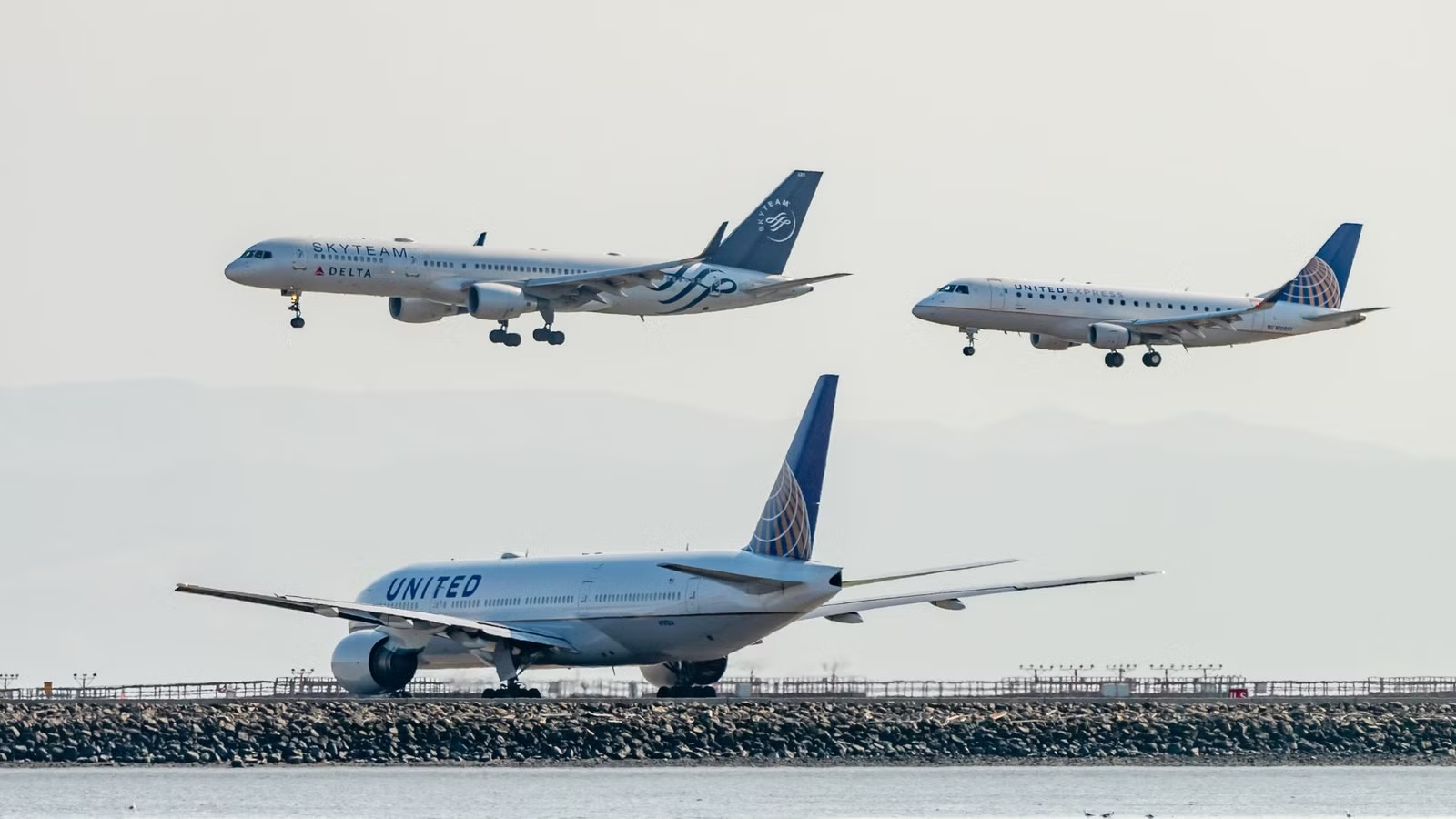
In March, the Federal Aviation Administration declared an official halt to the iconic parallel landing pattern scheme at  San Francisco International Airport (SFO). The decision came as part of a wider safety campaign following the tragic accident in Washington DC, when an American Airlines regional jet fatally collided with a military helicopter during final approach.
The increased landing separation requirements coincide with the beginning of construction, which also closes two runways, significantly reducing the airport’s capacity. It has now been revealed through internal communication at the agency that the FAA is planning to institute a new flight procedure for the airport’s runway 28R, according to a post on X by Sam Ogozalek.
Preventing Loss Of Separation Events At SFO

The reason why SFO operated parallel landing approaches was to increase the throughput of arrivals and departures, but the FAA stopped the practice because the two runways that run east and west, 28L and 28R, are just 750 feet (229 m) apart. SFO was permitted to conduct its famous landing procedure with a waiver for visually dependent approaches that required the pilots to keep sight of the other aircraft. The FAA is now requiring air traffic control to manage separation, which means that this waiver is no longer possible.
The legacy waiver at SFO only applied during clear weather. Under the current rules, SFO would need at least 2,500 feet (762 m) of separation between the runways to begin parallel landings again. This would allow for radar tracking, like on bad weather days, and most likely would also include a staggered approach for any two planes landing at the same time. All arriving aircraft must now follow a staggered, diagonal sequence along the final approach path.
Since the decision to end parallel landings, SFO has seen 25% to 30% of arriving flights delayed by 30 minutes or more.  United Airlines, the biggest operator at SFO, has also had to hold aircraft at their departing airports on regional and domestic commuter flights to avoid making the plane circle over the airfield for extended periods before landing. Still, the improvement in safety is clear, with Ogozalek sharing this message from FAA Administrator Bryan Bedford:
“Since this corrective action plan was put into effect, there have been zero loss of separation events. We have been working with [the airport] and airline operators… A new flight procedure for Runway 28R will be published next month.”
New Landing Procedures In The Bay: PRM Or CSPA

What the FAA may introduce to SFO is advanced precision runway monitored approaches and closely spaced parallel approach procedures. PRM would implement a high-speed radar scanning array to provide updates every one second during landing approaches. This would allow for highly accurate ATC control and permit reduced separation between aircraft. Similarly, CSPA uses Automatic Dependent Surveillance-Broadcast (ADS-B) devices on board to deconflict the two planes.
PRM and CSPA, using ADS-B, combine as a unified system that solves the safety problem of ensuring aircraft have continuous and unbroken confirmation of their position relative to other airliners at all times in the terminal environment. PRM is most helpful in keeping the plane separated laterally, or left to right. CSPA uses ADS-B to make sure that planes hold the correct spacing in sequence, or front-to-back separation.
End Of An Era: Why The FAA Just Banned SFO’s Iconic Parallel Landings
There will be no more wingtip-to-wingtip flying over the Bay Area.
Capacity Cuts Equal Slow Going In San Francisco

The decision to change the landing approach at SFO in order to improve safety has unfortunately significantly reduced the arrival capacity. Comparing peak landing rates at the airport during routine operations, it is now down 33% from the time when the waiver was in place. That equals 36 flights per hour under the new rules, compared to 54 per hour with the parallel landing procedure.
The $180 million worth of construction on runway 1R and 19L is projected to be completed sometime in October and will improve capacity, but both remain closed for now. Until then, adding the procedures to use PRM and CSPA on runway 28R would help alleviate some congestion.