dailynewsnblog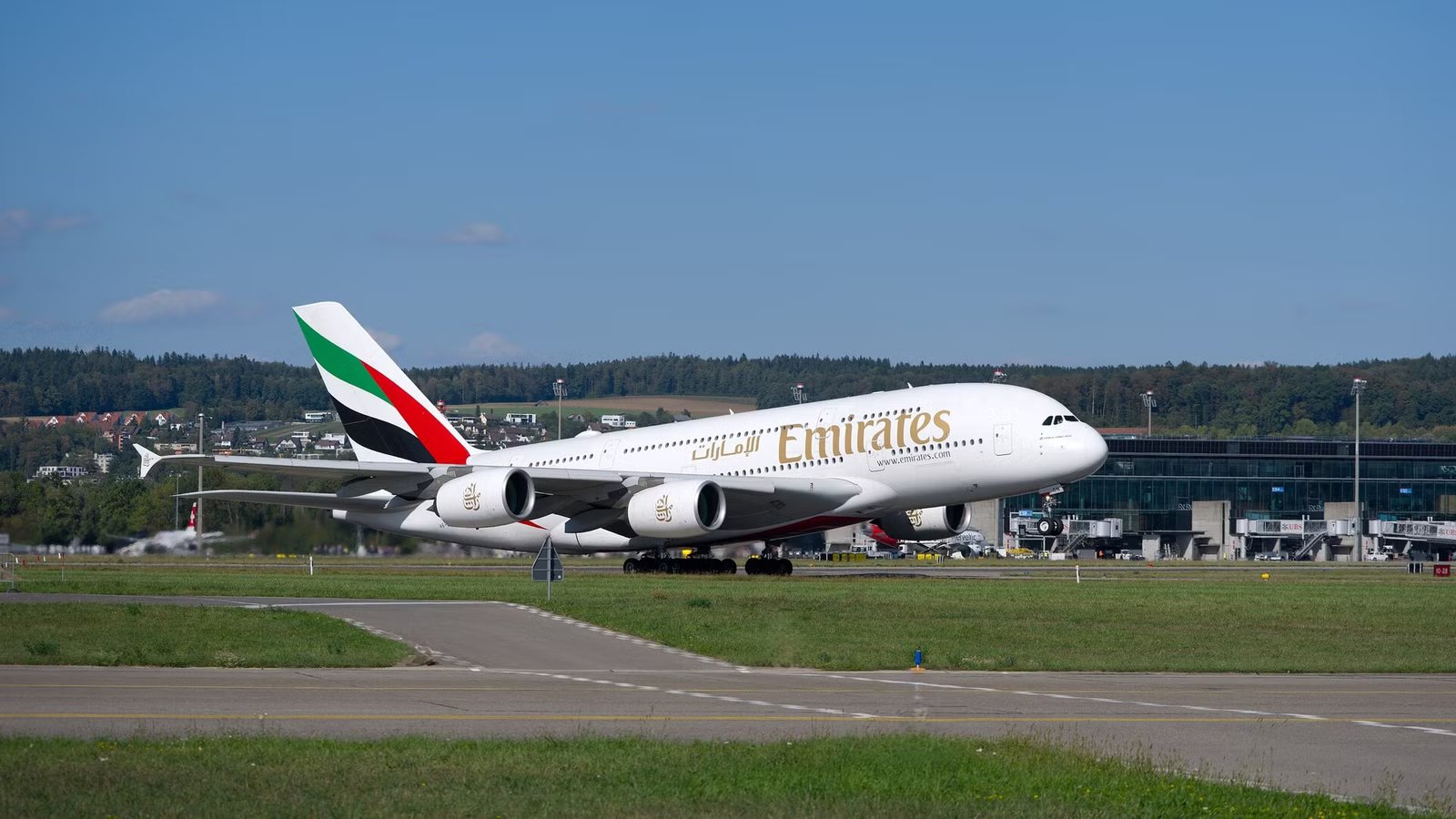
 Emirates is bringing its Airbus A380 back to
  Beijing Capital Airport (PEK), with the superjumbo replacing a Boeing 777-300ER on one of the airline’s two daily Dubai flights from October 4. Aeroroutes reports a changing schedule, with the aircraft operating until November 30, disappearing for December and January, and returning from February 1 through March 27, 2027. The westbound Beijing–Dubai sector is scheduled for as much as 9 hours in mid-winter over a distance of 3,632 miles (5,845 km).
The return comes as Emirates’ mainland Chinese operation moves decisively beyond post-pandemic restoration. The airline now serves five cities with 49 weekly flights, compared with 35 across three gateways before its latest expansion. China’s post-pandemic aviation recovery had lagged: international passenger flights were still only 84% of 2019 levels in 2024. However, international airport traffic grew 18.7% in 2025, while China-related traffic at  Dubai International Airport (DXB) jumped 16.6% to 2.5 million passengers.
Emirates’ A380 Returns To Beijing On October 4

Emirates will use the A380 on EK306/307, leaving its second daily EK308/309 rotation on the Boeing 777-300ER. The October timetable will adjust slightly when entering the Northern Winter schedule, but the bigger curiosity is the two-month interruption: after flying throughout October and November, the A380 disappears during December and January before returning in February. That indicates a targeted capacity deployment with the A380 rather than a straightforward permanent replacement of the 777.
Flight | Route | Departure | Arrival | Aircraft | Frequency | Block time |
|---|---|---|---|---|---|---|
EK306 | Dubai – Beijing | 3:20 AM | 2:45 PM | Airbus A380 | Daily | 7h25 |
EK307 | Beijing – Dubai | 12:40 AM | 5:30 AM | Airbus A380 | Daily | 8h50 |
EK308 | Dubai – Beijing | 11:00 AM | 11:30 PM | Boeing 777-300ER | Daily | 7h30 |
EK309 | Beijing – Dubai | 6:50 AM | 11:40 AM | Boeing 777-300ER | Daily | 8h50 |
OAG data shows that the Gulf giant has a reasonably long history of flying the superjumbo to PEK. The first departure took place more than 16 years ago, in August 2010. Flights operated daily through 2020, when the COVID-19 pandemic put a hold on everything. The equipment was once again used briefly in 2023, but replaced with the 777-300ER as China’s post-pandemic recovery was slower than elsewhere.
However, the A380 that will be returning to Beijing will be markedly different, as Emirates has scheduled its 487-seat configuration, which is the result of its $5 billion, 110-aircraft retrofit program. The aircraft includes 14 First Class suites, 76 Business Class seats, 56 Premium Economy seats and 341 Economy seats. That is substantially less dense than Emirates’ older 517- and 519-seat three-class A380s that used to ply the route, and introduces the award-winning Premium Economy cabin at the front of the main deck to the route for the first time.
The A380’s return also follows a rapid rebuild of Emirates’ Beijing operation over the course of this year. The airline launched a second daily flight in July, initially operating both services with 777-300ERs; just three months later, one of those rotations will periodically step up to the superjumbo. This is in line with the airline’s larger China expansion, spurred on by increasing travel demand and trade between the UAE and China, supported by deepening bilateral ties and initiatives like the Belt and Road Initiative.
Emirates’ China Capacity Has Grown By 88%

The timing of this A380 addition reflects a broader change in Chinese aviation. China’s international flights were slow to recover post-pandemic, but notably accelerated last year. Mainland airports handled 117.8 million international passengers in 2025, up 18.7% from the year prior, while CAAC has continued encouraging foreign airlines to restore and expand capacity.
Emirates has responded by growing beyond its traditional daily flights to Beijing and Guangzhou, and twice-daily to Shanghai. New routes to  Shenzhen Bao’an International Airport (SZX) and Hangzhou Xiaoshan International Airport (HGH) were added in July last year, taking mainland China flying from 28 to 42 weekly services, a 50% increase. Shenzhen was also the airline’s first mainland destination to receive its latest retrofitted 777-300ER.
Chinese Gateway | Frequency | Weekly Flights | Aircraft Used | Major Recent Development |
|---|---|---|---|---|
Beijing Capital (PEK) | 2 daily | 14 | A380, 777-300ER | 2nd daily added July 2026; A380 returns October 4 |
Shanghai Pudong (PVG) | 2 daily | 14 | A380, 777-300ER | One daily flight moved to A380 in October 2025 |
Guangzhou (CAN) | Daily | 7 | A380 | A380 replaces 777-300ER from October 1, 2026 |
Shenzhen (SZX) | Daily | 7 | A380, 777-300ER | New route launched July 2025 |
Hangzhou (HGH) | Daily | 7 | A350 | New route launched July 2025 |
Total | — | 49 | 75% increase in flights since mid-2025 |
But the new routes are only part of the equation. Emirates has also been substantially increasing capacity to China. Like Beijing, one of the twice-daily flights to  Shanghai Pudong International Airport (PVG) was moved over to the A380 last year, and the daily flight to
  Guangzhou Baiyun International Airport (CAN) will also shift to the superjumbo in October this year. Factor in the second daily flight added to PEK earlier this year, and Emirates has not only had a 75% increase in flights to China since mid-2025, but an 88% increase in overall capacity, with nearly 20,000 weekly seats now available.
Even the “smallest” route to Hangzhou is notable. It became Emirates’ first mainland destination to receive the Airbus A350 only three months after launching, with the airline subsequently reporting exceptionally strong demand from Hangzhou and the wider Zhejiang region. This has no doubt been driven by its partnership with Loong Air, based at HGH, which expanded onward connectivity to more than 110 points across China.
Consequently, while Dubai’s China traffic rose 16.6% to 2.5 million passengers in 2025, we can expect that to increase even more substantially when the data for 2026 becomes available.
Beijing Is Now A 124-Million-Passenger Two-Airport Market

Beijing itself has changed dramatically since Emirates’ pre-pandemic A380 heyday. Beijing Capital became China’s first airport, and only the world’s second after  Hartsfield-Jackson Atlanta International Airport (ATL) to surpass 100 million annual passengers in 2018.
  Beijing Daxing Airport (PKX) subsequently opened in 2019, creating a dual-hub system. By last year, Capital handled 70.76 million passengers, up 5.0%, while Daxing reached 53.61 million, up 8.4%, putting their combined annual throughput at nearly 125 million.
Emirates also faces direct competition rather than owning the Beijing–Dubai market.  Air China operates a daily service on the route with a 293-seat Boeing 787-9. Meanwhile, across Beijing at Daxing, Emirates’ Gulf rivals are also going bigger.
  Qatar Airways is increasing its daily operation to the flagship Airbus A350-1000 from October, while
  Etihad Airways is upgauging its daily route from a Boeing 787-10 to a 777-300ER . Etihad is simultaneously expanding its overall mainland China operation to 35 weekly flights across six gateways, illustrating how strongly the Gulf–China market is attracting additional capacity.
Beijing Airport | Airline | Gulf Hub | Frequency | Aircraft Used |
|---|---|---|---|---|
Capital (PEK) | Emirates | Dubai | 2 daily | A380, 777-300ER |
Capital (PEK) | Air China | Dubai | Daily | 787-9 |
Daxing (PKX) | Qatar Airways | Doha | Daily | A350-1000 |
Daxing (PKX) | Etihad | Abu Dhabi | Daily | 777-300ER |
Demand indicators clearly support all this capacity expansion. Beijing welcomed 5.48 million inbound visitors in 2025, up 39% from the year prior, and suggesting that China’s capital truly has put the challenges of the pandemic firmly behind it. Given all this, Emirates’ A380 return to Beijing looks less like a nostalgic restoration, and more like another indication that China’s international aviation recovery has entered a new stage.