dailynewsnblog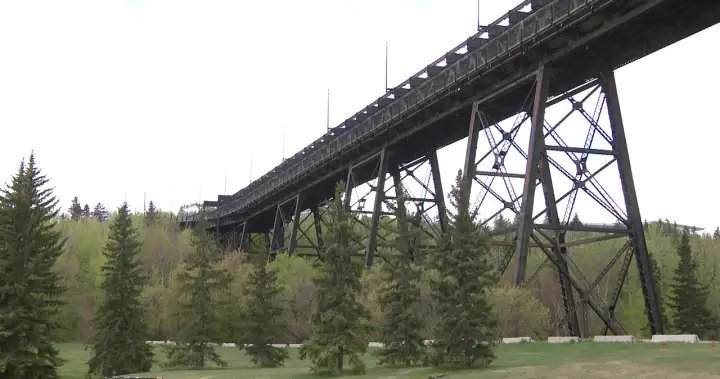
For over 100 years, two historic bridges in central Edmonton have ferried millions of vehicles and people over the waters of the North Saskatchewan River.

But the end of the road is nearing as the city is ramps up planning for their inevitable replacements.
The aptly-named High Level Bridge and Low Level Bridge each have surpassed the typical bridge life expectancy of 75 to 100 years and are living on borrowed time.
Rehabilitations every few decades have kept the structures in service, but continuing to do that will eventually end up costing more than replacement.
City administration estimates the bill for the High Level alone would exceed $1 billion.
“A complete long-term rehabilitation is no longer a feasible or fiscally responsible approach,” said Natalie Lazurko, a director with the City of Edmonton transportation planning and design department.
“These bridges are over 100 years old. With the High Level being 113 years old and the Low Level northbound bridge being 126 years old, they’ve run their course.”
The city has known for some time the High Level would require extensive work in the coming years and ahead of the 2023-2026 capital budget cycle, recommended funds be allocated to future renewal.

Since then, however, the city has had industry experts give the bridge a closer examination — revealing the condition of the High Level Bridge is worse than previously understood in 2022.
“At 113 years old, the bridge is beyond the end of its lifecycle, making rehabilitation a high-risk, high-cost endeavour with an extended construction schedule,” the city report said.
Aging steel on the High Level Bridge over the North Saskatchewan River in Edmonton, Alta. on Tuesday, May 19, 2026.
The steel structures, in particular the High Level, have been an iconic part of Edmonton’s skyline since they were built in the early 1900s — but a closer look at rusting girders and beams reveals their aging state.
“Bridges need to be replaced. You can’t kick that can down the road — that is a real safety issue,” Mayor Andrew Knack said.
“This shouldn’t be a surprise for anyone, so really it’s a conversation about how you make sure you do this thoughtfully, safely and as quickly as possible without comprising all of that.”
A City of Edmonton report released Tuesday outlines the proposed approach to replacing both bridges over the next two decades without crippling traffic for years at a time.
Low Level Bridge plan
The Low Level Bridge over the North Saskatchewan River in Edmonton, Alta. on Tuesday, May 19, 2026.
Global News
The report suggests starting design on a new Low Level Bridge next year and finishing construction by 2030.

Get daily National news
Get daily Canada news delivered to your inbox so you’ll never miss the day’s top stories.
The Low Level is actually two different bridge decks built at different times: the northbound span was constructed in 1900 to carry rail traffic and is Edmonton’s oldest river crossing bridge.
Edmonton’s Low Level bridge on June 28, 1915.
Credit; City of Edmonton archives
The southbound side was built in 1949 and underwent its most recent major rehabilitation in 1994, so after 30 years it was due for rehabilitation that wrapped up this past winter.
The northbound bridge underwent its most recent major rehabilitation in 2006, which the city said provided an additional 25 years of service.
The bridges collectively see a substantial amount of daily traffic, ranging from around 30,000 to 40,000 vehicles per day.
The Low Level Bridge over the North Saskatchewan River in Edmonton, Alta. on Tuesday, May 19, 2026.
Global News
Under the city’s proposed plan, the southbound bridge would be demolished while the northbound, which is a historic structure that is also much more robustly built due to originally being designed for trains, could be repurposed for non-vehicle active uses.
Though it is the older of the two Low Level Bridges, the city said the northbound span is in better condition than the southbound.

High Level Bridge plan
The High Level Bridge over the North Saskatchewan River in Edmonton, Alta. on Tuesday, May 19, 2026.
Global News
The High Level Bridge was built by the Canadian Pacific Railway between 1910 and 1913. The one-way southbound bridge sees 24,000 to 27,000 vehicles per day across the river.
For the High Level, rehabilitation is planned between 2027 to 2030 in order to keep the bridge operational until a replacement is built in the next dozen or so years.
Planning, design and construction of a new bridge is slated for between 2031 to 2039.
Preparation work will be ongoing for many years to come, administration said, requiring city council to make budget decisions during each of the next several capital budgets.
The High Level Bridge over the North Saskatchewan River in Edmonton, Alta. on Tuesday, May 19, 2026.
Global News
The city recognizes there will be great interest in the project and says public consultation will occur.
“The High Level and the Low Level bridges have provided enormous value to Edmontonians over the past 100+ years and are vastly important to the economic heart of the city,” said Pascale Ladouceur, City of Edmonton branch manager of transportation planning and design.
“This is a long-term planning work and will take place over many years involving future design, technical and funding decisions.”
The northbound Low Level Bridge is on Edmonton’s inventory of historic resources which the city said warrants a discussion about conservation.
The High Level Bridge, however, requires even more consideration: it was designated a municipal historic resource in 1995.
That means in order to decommission it, council would need to repeal the historical designation, which has only been done three times since the city’s heritage conservation program was created in 1982.

High Level Bridge literally bridged the divide between two communities: its construction was a major factor in the amalgamation of the City of Strathcona and the City of Edmonton on Feb. 1, 1912.
The character-defining elements of the bridge include the truss systems, tall concrete piers, streetcar tracks on top, the bridge superstructure and substructure, the metal handrails and the black paint colour.
The High Level Bridge over the North Saskatchewan River in Edmonton, Alta. on Tuesday, May 19, 2026.
Global News
Once upon a time, the bridge also had a man-made waterfall called the “Great Divide” that was turned on for special occasions until 2009, when Environment Canada raised concerns about pumping large amounts of chlorinated tap water into the river.
On Tuesday, the city dashed hopes of such a feature being included in the replacement.
“Unfortunately, the reasons why the waterfall was decommissioned in the first place are still valid today,” Ladouceur said.
“There is no way to make the waterfall both environmentally friendly and operationally friendly.”
The High Level Bridge is one of the few ever constructed in Edmonton to combine four modes of transportation: train, streetcar, automobile and pedestrian — but it was built long before semi trucks and large cube vans were the primary mode of commercial transportation.
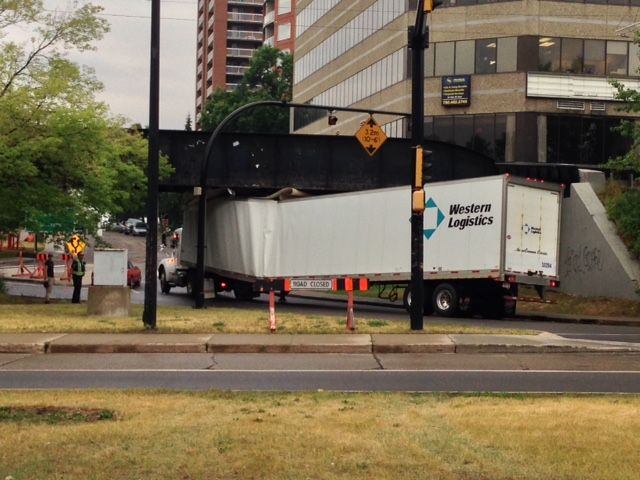
A semi-truck doesn’t make it through the 3.2 metre clearance at the west entrance of Edmonton’s High Level bridge, June 30, 2015.
Dave Carels, Global News
The High level is also on marked on maps as a commercial transportation route — leading to unfamiliar truckers getting stuck trying to cross the low-clearance enclosed bridge.
The city says that will get fixed.
“The replacements of the bridges will look at modern standards and so the height restriction that you see on the existing High Level Bridge absolutely won’t be a constraint in the future,” Lazurko said.
“We look to make sure that trucks and large vehicles are not getting stuck on our modern day bridges.”
It’s too early to know for sure how much replacing both bridges will cost, but the city on Tuesday estimated it will be around $1 billion.
A City of Edmonton diagram of the tentative timeline to replacing the Low Level Bridge and High Level Bridge.
City of Edmonton