dailynewsnblog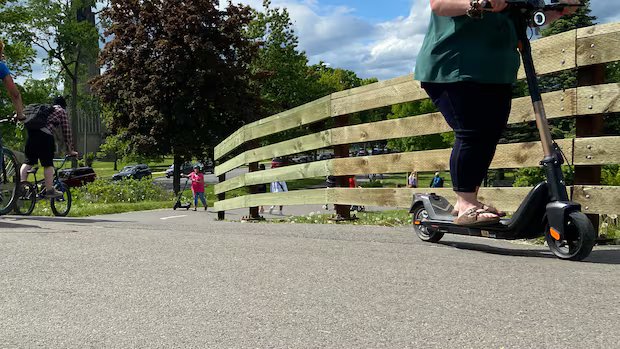

Listen to this article
Estimated 5 minutes
The audio version of this article is generated by AI-based technology. Mispronunciations can occur. We are working with our partners to continually review and improve the results.
With the rise in popularity of e-scooters and e-bikes, the Newfoundland and Labrador government is seeking the public’s input on new road safety regulations.
Government Services Minister Mike Goosney told reporters on Thursday that legislation needs to keep up with technological advances.
“There are no secrets that there will be incidents if we don’t address it sooner than later,” he said.
Prior to this announcement, parents in Labrador west told CBC News that they hope the province will move on regulating these modes of transportation to make it safer.
Jackie Granter and Kesha Morgan said they’ve seen more of these motorized vehicles on the road but have concerns that they aren’t operating safely and riders rarely wear helmets.
“You could be driving along and the scooter’s in front of you and then all of a sudden they cut right in front of you,” Granter told CBC Radio’s Labrador Morning.
Morgan said she also doesn’t see these riders sharing the road, which she attributes to a lack of safety instructions prior to getting an e-scooter.
“Fortunately I haven’t had any near misses myself, but I have seen vehicles either ahead of me having to swerve very far around some kids on scooters,” said Morgan.
Both parents said they support efforts by the provincial government to make changes to the Highway Traffic Act to regulate e-bikes and e-scooters.
“I think it’s a good idea and I hope that they don’t take a long time to figure it out,” said Granter.
She would like to see a safety course that teaches the rules of the road prior to children being allowed to operate these forms of transportation, adding it should be on municipalities and the province to bring in rules and enforce them.
Morgan would like to see a program that acts like a road test that requires users to carry a pass on them while operating these types of motorized vehicles.
Survey available for those who want to weigh in
An online questionnaire is available on engagenl.ca for the public to give their input.
The survey asks about potential safety requirements like age requirements, helmets, reflective gear, education and other rules. It also asks if there should be a minimum age to operate devices, where should people be allowed to operate (On or off the sidewalk, for example), and speed limits.
The province is also accepting written submissions by email (roadsafetyfeedback@gov.nl.ca) or by mail to the department of Government Services.
With hopes to bring regulation changes to the House of Assembly this fall, Goosney said his door is always open.
“Any suggestions, recommendations, whether you’re from the province, in the province, we want to hear from everybody,” he said.
‘They are not toys’
A recently released Canadian Pediatric Society survey of Canadian pediatric specialists, conducted from late 2025 to early 2026, documented 10 deaths, 12 ICU admissions and 26 hospitalizations lasting more than 48 hours over the previous 12 months as a result of e-scooter crashes.
The survey found the head was the most often injured body part, with 47 per cent of cases having head injuries.
Pamela Fuselli, president of Parachute Canada, a national charity that aims to curb preventable injuries, said the survey results aren’t surprising.

Doctors warn they’re seeing an increase in e-scooter injuries across Canada. CBC’s Leila Beaudoin speaks with motorized vehicle safety expert Julia Kent of CAA, who says safety rules must tighten.
Like the Canadian Pediatric Society and American Academy of Pediatrics, her organization also recommends children under 16 not operate these vehicles.
“They are not toys. Even though they are a lot of fun and they do have their place,” Fuselli told CBC Radio’s The St. John’s Morning Show.
A variety of groups have a part to play in making these devices safer, she said, from manufacturers to legislators and enforcement.
“That’s really a strong combination for preventing injuries,” said Fuselli.
Gaps in regulations
Julia Kent, director of social responsibility and advocacy for the Canadian Automobile Association Atlantic, said the adoption of these types of motorized vehicles seems to be outpacing regulations, with many jurisdictions not having rules around what she called “micro-mobility vehicles.”
“Governments and regulations just can’t keep up. Emergency rooms are definitely seeing the impact,” Kent told CBC News.

She said injuries from these vehicles are more severe than a typical bike accident because they can go faster.
“They are absolutely a risk. It’s a really convenient, nifty way to get around, but it does not come without risk,” said Kent.
Other jurisdictions have brought in regulations around helmets, speed limits and where they can be used, she said. While it will take time to introduce regulations, Kent believes it can be done.
Download our free CBC News app to sign up for push alerts for CBC Newfoundland and Labrador. Sign up for our daily headlines newsletter here. Click here to visit our landing page.