dailynewsnblog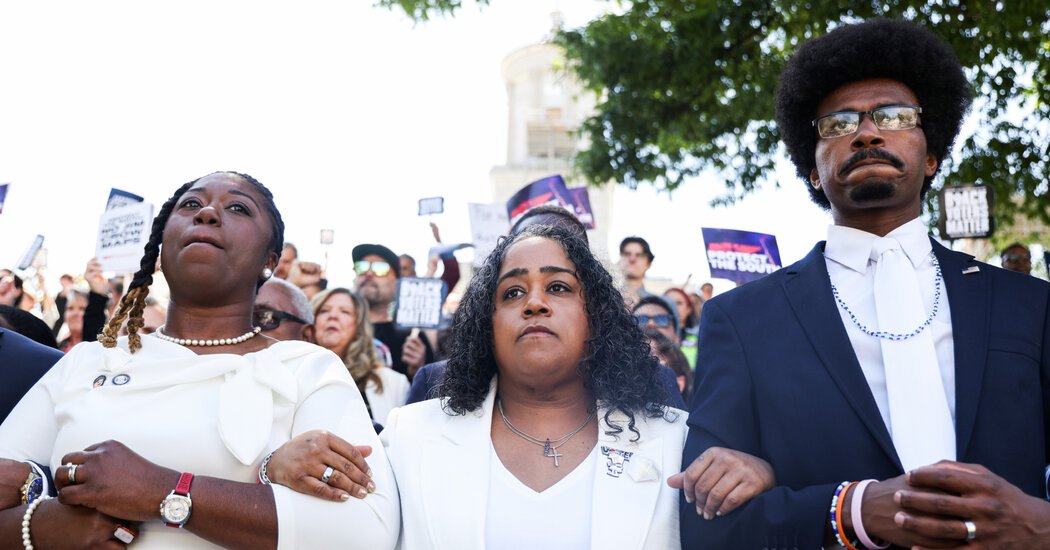
A coalition of voters and Democratic candidates sued Tennessee officials in federal court late Thursday over its new congressional map, arguing that it was unconstitutional to implement new district lines this close to the state’s August primary.
It was the latest twist in the aftermath of a Supreme Court ruling last week on the Voting Rights Act that declared congressional districts in Louisiana to be an unconstitutional racial gerrymander. The ruling set off a frenetic scramble in Tennessee and several other Republican-led states to redraw their districts for partisan advantage on the assumption that they are no longer required to preserve Black majority districts.
The Republican supermajority in the Tennessee General Assembly muscled through a new congressional map on Thursday that carves up the majority-Black city of Memphis, home to the state’s lone Democratic-held seat.
The lawsuit and its outcome took on heightened stakes after the Virginia Supreme Court on Friday struck down a voter-approved map that created four Democratic-leaning districts in the state. If Tennessee’s map holds — and if other Southern states approve new maps that dilute majority-Black seats held by Democrats — Republicans will have established a structural advantage across multiple districts ahead of the 2026 midterm elections.
“Changing the rules midstream will create chaos for voters and throw communities into upheaval,” Rachel Campbell, the chairwoman of the Tennessee Democratic Party, which is also part of the lawsuit, said in a statement. “We will fight these racially gerrymandered maps tooth and nail because the future of democracy in Tennessee, across the South, and throughout this nation depends on it.”
The lawsuit centers on the constitutional right to vote under the First and Fourteenth Amendments, and it argues that both the voters’ and candidates’ constitutional rights were harmed by changes to the congressional map that undermined months of campaigning and voter education based on the old map.
The lawsuit also references a legal doctrine known as the Purcell principle. That principle, stemming from a contested 2006 Supreme Court ruling in Purcell v. Gonzalez, discourages changes to voting rules and procedures close to elections.
The lawsuit was filed overnight by a cluster of voters, as well as four Democratic candidates: Representative Steve Cohen of Memphis, whose district was divided up among three new Republican-leaning districts; State Representative Justin J. Pearson, who had challenged Mr. Cohen for the Memphis seat; Mayor Chaz Molder of Columbia, a lead challenger to Representative Andy Ogles in what was once a solely Middle Tennessee seat; and Chaney Mosely, a candidate for a Nashville-area seat.
A second lawsuit is already underway in state court, filed Thursday afternoon by the NAACP Tennessee State Conference.
“While the wisdom of changing the law is demonstrably open to debate, as evidenced by the boisterous disagreement surrounding its passage, this is a political dispute that carries political consequences and should be resolved through political processes,” Attorney General Jonathan Skrmetti said in a filing responding to the lawsuit in state court.
Spokeswomen for Gov. Bill Lee, a Republican, and Mr. Skrmetti did not immediately respond to requests for comment about the federal lawsuit. The lawsuit also names Tre Hargett, the secretary of state, and Mark Goins, the Tennessee coordinator of elections, in their official positions. A spokeswoman for the secretary of state’s office declined to comment, citing the ongoing litigation.
In their brief filed before the district court for the Middle District of Tennessee, the candidates and voters argue that the sudden shift of the congressional districts just months before the primary “will wreak chaos on the electorate, will cause significant voter confusion” and will affect election officials’ ability to administer the election. They asked the court to stop the implementation of the map before the 2026 election.
Tennessee was the first state to draft and approve a map after the Supreme Court’s ruling raised the bar for challenging district lines under the Voting Rights Act. Within a week, Mr. Lee summoned lawmakers to Nashville for a special session, and Republican leaders had drawn and approved a new map that gives the party an advantage toward electing an entirely Republican congressional delegation.
The map carved up the Ninth Congressional District, where two-thirds of the voting-age population is Black, into thirds, most likely eliminating the state’s lone Democrat-leaning district. It also moved district lines around the Nashville area in an apparent bid to shore up Mr. Ogles.
Candidates now have until noon on May 15 to file papers with the secretary of state’s office. Those who already qualified may remain in the new district with the same number. At least one Republican, State Senator Brent Taylor, has already announced his candidacy for the new Ninth Congressional District.
All four congressional candidates on the suit warned that they would have to “to expend more resources identifying, associating with, and campaigning to voters who live in the newly-enacted district.”
They also pointed to litigation filed in February 2022 after a new map of State House and State Senate districts that year was challenged, prompting a push to delay the qualifying date from April to May. At the time, Tennessee officials argued against moving the qualifying date. The State Supreme Court agreed.
Seamus Hughes and Katherine Chui contributed research.