dailynewsnblog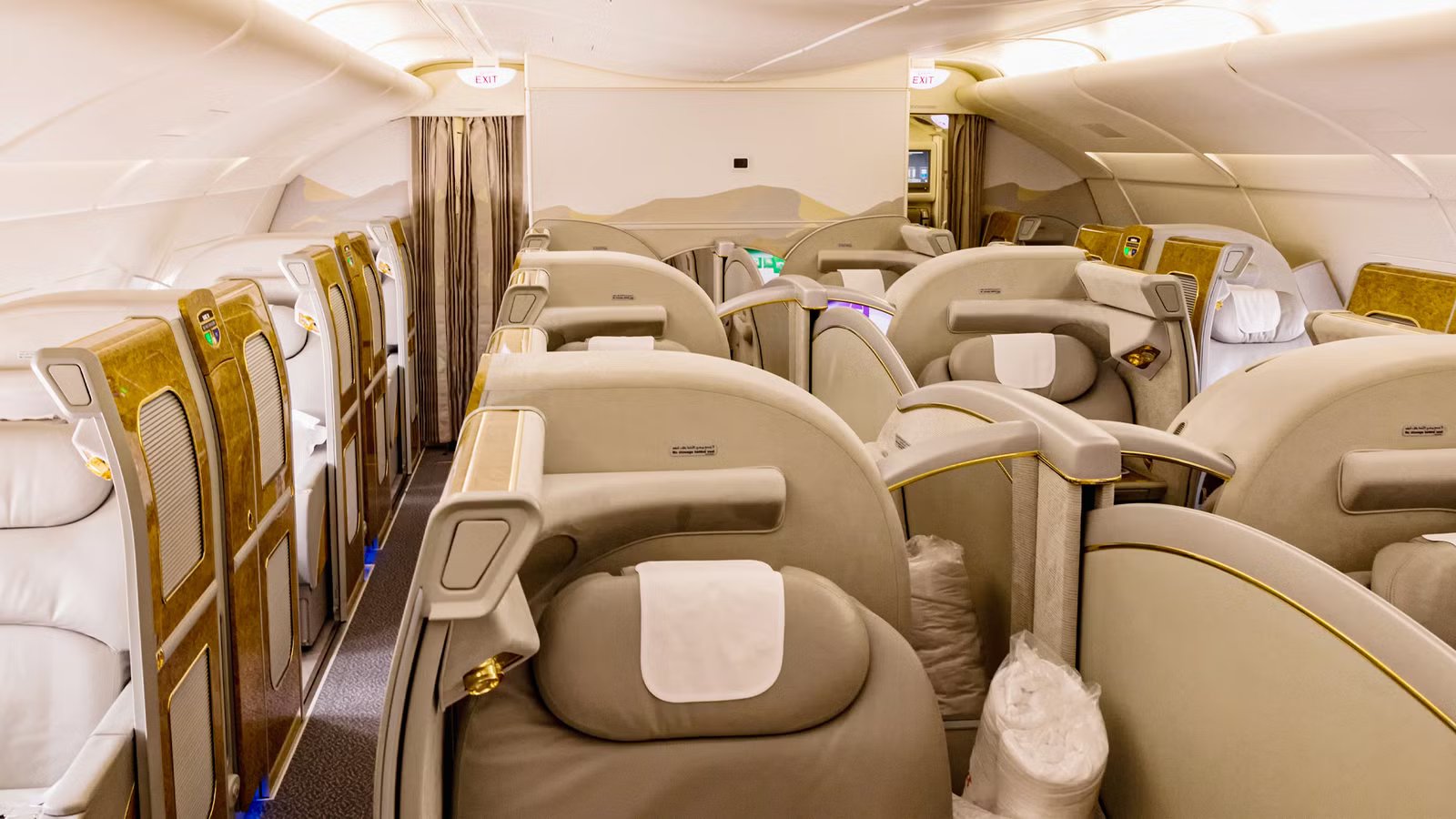
 Emirates‘ Airbus A380 first class cabin is widely considered among the most exclusive and recognizable environments in commercial aviation, yet its compact seat count is a result of deliberate design trade-offs. The aircraft itself is a double-decker giant capable of carrying hundreds of passengers, but the carrier chooses to restrict the first class section to just 14 fully enclosed suites on its four-class variants.
Maintaining this level of exclusivity requires a significant sacrifice in total passenger capacity, as the space occupied by these suites could hold dozens of economy or premium economy seats. In the competitive long-haul market, especially on routes connecting the United States to Dubai and beyond, the configuration of the upper deck determines the profitability of the entire airframe.
Heavy Aircraft With A Heavy Reliance

Exclusivity on the upper deck is centered on a handful of seats that must anchor the flight’s profitability. The first class cabin on the four-class A380 is located at the front of the upper deck and features just 14 suites arranged in a 1-2-1 layout to ensure every passenger has direct aisle access. Each suite is equipped with sliding doors for total privacy, a personal mini-bar, a small wardrobe for garments, and a dedicated tablet to control seat functions and the ICE entertainment system.
Premium cabins, despite their low seat counts, often generate a disproportionately large share of total flight revenue, frequently accounting for between 30% and 40% on long-haul routes. This revenue density allows the airline to maintain high-cost amenities like the onboard Shower Spa, which is reserved exclusively for the 14 first class passengers. Every square inch on the upper deck is treated as high-value space, meaning that the decision to keep only 14 suites is a balance between maintaining high ticket prices and ensuring the cabin remains full.
Data from recent fleet updates suggests that Emirates is constantly evaluating the yield of this space against other cabin classes. The massive footprint required for a single first class suite, including the mechanical components for the lie-flat bed and the privacy partitions, represents a significant opportunity cost. If the demand for $15,000 tickets fluctuates, the airline faces the hidden trade-off of having idle space that could have been filled by more traditional premium seating.
Maximizing The Unique Nature Of The A380

Precision engineering of the upper deck allows Emirates to stack its most profitable segments in a way that maximizes both luxury and floor space. Behind the 14 first class suites, the airline typically installs 76 business class seats, which also feature a 1-2-1 configuration to maintain a premium standard across the entire top floor. This layout creates a continuous premium zone that is physically separated from the high-density economy seating on the lower deck, aiding in noise reduction and service efficiency.
Navigating the transition between first class and the rest of the cabin involves managing shared amenities like the famous onboard lounge and bar. First class passengers have their own private showers at the front, but they must move toward the rear of the upper deck to access the social hub shared with business class. Enabling all of this movement requires wide aisles and specific floor reinforcements to handle the weight of the bar and the concentration of passengers in one area.
|
Cabin Class |
Seat Count |
Layout |
Key Features |
|
First Class |
14 |
1-2-1 |
Sliding doors, Shower Spa, Private wardrobe |
|
Business Class |
76 |
1-2-1 |
Lie-flat beds, Direct aisle access, Mini-bar |
|
Premium Economy |
56 |
2-4-2 |
40″ (101.6 cm) pitch, Calf rests, Cream leather |
|
Economy Class |
338 |
3-4-3 |
13.3″ (33.7 cm) screens, Global catering |
The carrier has used the A380 as its flagship to showcase these massive installations, but the weight and space they consume are permanent trade-offs in fuel efficiency. Emirates must ensure that the weight of the water for the showers and the marble-heavy finishes in the first class cabin do not overly restrict the aircraft’s range on ultra-long-haul legs. Such considerations are central to why the airline has limited the suite count to 14, preventing the front of the aircraft from becoming too heavy for optimal flight trim.
Emirates’ Unusual Airbus A380 Cabin: A Peek Inside the World’s Highest-Capacity Jet
Emirates has 15 Airbus A380s with a staggering 615 seats each!
In Comes Premium Economy

Strategic tension has recently emerged within the cabin design as Emirates introduces its new premium economy product across the A380 fleet. The reconfigured three-class layout actually places a newly added 56-seat premium economy cabin at the front of the upper deck, occupying the same footprint that on four-class A380s is normally reserved for the 14 first class suites. It highlights a significant switch toward premium-heavy configurations that cater to travelers willing to pay more than economy but less than the five-figure first class fares.
Passengers on these high-density variants will notice that the removal of first class allows for a massive increase in the total number of premium seats. In the updated 569-seat configuration, the airline can accommodate 56 premium economy travelers in the space where only 14 suites once stood, representing a fourfold increase in passenger density for that specific area. The prestige of first class is lost on these specific airframes, and the revenue stability provided by 56 higher-fare seats often outweighs the erratic demand for ultra-luxury suites.
Every new retrofit reflects a balancing act between maintaining a world-class image and maximizing the yield of the superjumbo. Moving premium economy to the upper deck in some configurations, Emirates is effectively democratizing the top-floor experience, far removed from the days of high exclusivity. This change in the blueprints of the aircraft suggests that the airline sees a larger growth opportunity in the middle-tier premium market than in expanding the already niche first class segment.
Global Strategist

Inside the broader Emirates fleet strategy, the A380 remains the strategist of the long-haul network, even as the carrier prepares for the arrival of the Boeing 777X. The 777X will feature a different first class product, potentially moving away from the 1-2-1 layout to a more spacious but lower-capacity Game Changer suite. Comparing the two aircraft reveals that the A380 is still the only plane capable of housing the heavy shower spa equipment, a feature that won’t make the jump to the twin-engine 777X.
Across the retrofitted fleet, premium seats have risen to 23% of total capacity on the updated aircraft, up from just 9% on the earlier 615-seat configurations. This increase is largely driven by the addition of premium economy and the optimization of business class layouts, while first class seat counts have remained stagnant or been removed entirely on certain routes. The hidden trade-off here is that while the A380 feels more luxurious, it is actually becoming more crowded in the premium categories to drive higher yields.
Airlines like Emirates must decide whether to chase the halo effect of first class or the cold efficiency of a premium-heavy 777X or A380. The A380 offers a unique volume that allows for high-visibility marketing, like the bar and showers, that a 777X, due to its narrower fuselage, would struggle with accommodating. Consequently, the 14 first class suites on the superjumbo serve as a powerful branding tool that justifies the premium pricing of the entire airline, even if they only represent a fraction of the total seats.

18 Years After Emirates Took Delivery Of Its First A380, The Quadjet Is Still The Backbone Of Its Long-Haul Network
Emirates’ bold move to acquire the A380 transformed air travel, but 18 years later, challenges loom.
Where Scrutiny Is At Its Highest

Japanese travelers have historically shown a high affinity for the A380 first class product, particularly on prestige routes between  Narita (NRT) or
  Haneda (HND) and Dubai. Cultural nuances in the East Asian market place a high value on privacy and discreet service, making the fully enclosed suite design of the Emirates cabin highly attractive. For these long-haul journeys, which can last over 11 hours, the ability to close a door and have a private room in the sky is a major selling point for high-net-worth individuals and corporate executives.
While premium economy is being rolled out globally, the first class cabin remains a critical asset for the Japanese market where interactions with crew are expected at the highest levels. Emirates competes directly with Japan Airlines and All Nippon Airways, both of which offer exceptional first class products, forcing the Dubai carrier to maintain its 14 suites to stay competitive. If Emirates were to remove first class in favor of more premium economy seats, it might lose its top-tier status among Japan’s most lucrative travelers as well as those connecting through these hubs.
Cultural expectations also influence the soft product within those 14 suites, such as the inclusion of high-end teas and specialized meal options. The already much wider products offered by JAL and ANA are definitely something that Emirates will be looking at closely as width becomes far more of a differentiator for airlines globally. This demographic is less likely to compromise on the lie-flat experience, which is why the airline continues to prioritize the four-class A380 on these specific routes.
More Decades To Come

Emirates plans to keep its A380s in the sky for another 15 years, meaning the current cabin configurations must be future-proofed through massive retrofit programs. The airline is currently spending billions to update the interiors of over 100 aircraft, ensuring that the 14 first class suites remain modern while integrating the new premium economy cabin. This longevity is rare in the aviation world, where most carriers are retiring their four-engine planes in favor of smaller, more efficient twins.
Premium economy is becoming the new standard for comfortable travel, and the gap between the back of the plane and the front will only widen in terms of price and exclusivity. Emirates faces the continuing challenge of preserving its world-class first class product while simultaneously shifting its fleet’s center of gravity toward a more premium-focused, high-yield layout.
Precision in yield management will dictate whether we see further reductions in first class suites or a total commitment to the current prestige model. For now, the 14 suites at the front of the upper deck stand as a monument to a fading era of sky palaces, protected by the airline’s unique ability to fill them with the world’s most affluent travelers.