dailynewsnblog
Tolerable. That’s the word I’d use to describe living with the XPS 13 and its meager 8GB of RAM. The minute I booted into Windows, it already had 80 percent of its memory committed to invisible processes, like “Anti-malware service executable” and “Secure biometrics.” Once I started launching web browsers and filling them with tabs, memory usage climbed to 95 percent and never let down.
Sure, I could still browse the web, respond to Slack messages and write this review in Evernote, but it was hard not to notice the minor hiccups when scrolling through windows or doing just about anything. Sometimes, these hiccups turned into complete brain farts, like when it took 30 seconds for Evernote to stop showing me a blank screen and display my recent notes. All too often, using the XPS 13 felt like the computing equivalent of walking through mud. It’s technically possible, but it’s an absolute mess.
I was also surprised to see how much slower Intel’s Core 5 320 chip was compared to the XPS models from 2024, which offered either an Intel Core Ultra 7 155H or Snapdragon X Elite. Both of those systems blew away the new XPS 13 in Geekbench 6’s multi-threaded CPU test and GPU benchmark. The Snapdragon XPS 13 was almost twice as fast in graphics, while the 2024 Intel model was three times faster. You’d easily be better off trying to find one of those systems used, instead of buying the new XPS 13.
Perhaps that comparison is a bit unfair, though, as this XPS 13 is basically a completely different animal than its predecessors. It’s probably better to think of it as the “XPS Neo,” something that looks like its more expensive siblings, but is just riddled with compromises to reach its low price.
Funny enough, the XPS 13 is less compromised than the MacBook Neo in some ways (even though Apple’s machine also trounces it in Geekbench 6). It features 512GB of storage to start, while Apple only offers 256GB. You also don’t get the option of equipping the Neo with 16GB of RAM at all. If you want more memory, you have to jump to the $1,299 MacBook Air.
It’s also notable that Dell shoved in a faster 120Hz 1440p screen in the XPS 13, whereas the MacBook Neo sports a more standard 60Hz display. Beyond the faster refresh rate, which makes scrolling through web pages and documents look nicer, the XPS 13’s screen is bright enough to use in direct sunlight, much like the Neo’s. It’s perfectly fine for browsing the web or watching some videos, but there’s nothing truly notable about it. There’s no hint of the excellent contrast you get from OLED screens, or the crazy high brightness of MiniLED.
 Devindra Hardawar for Engadget
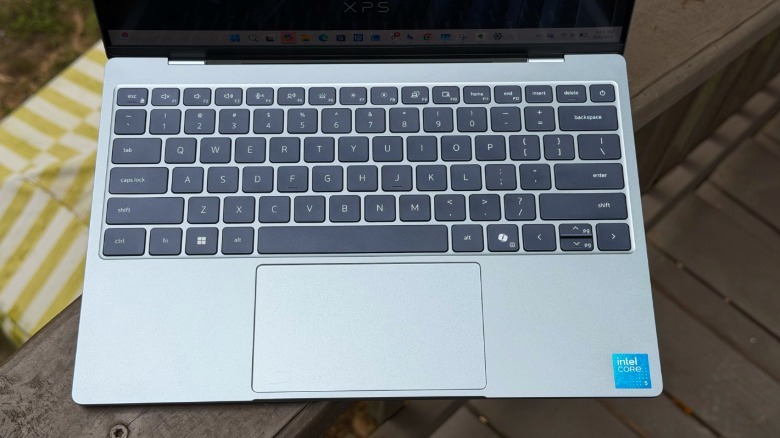
While the XPS 13 returns to old-school chiclet keys — something the XPS lineup haven’t had for years — they’re comfortable enough for heavy typing. There’s not much key travel, but I was still able to type quickly without many errors. I wish I had kinder words to say about the XPS 13’s trackpad, though. Using it felt like being transported a decade into the past, when mechanical keyboards plagued PCs everywhere. It’s decently accurate for swiping, but its top third doesn’t actually register clicks. That’ll require a ton of adjustment if you’ve been spoiled by haptic touchpads from Apple or the Surface lineup, which allow you to click anywhere.
The XPS 13’s quad-speaker array is technically another advantage over the MacBook Neo, but in my testing it doesn’t sound much better. It’s clear, but tinny, with no sense of depth that you find on the XPS 14’s speakers. Both systems also share the same amount of USB-C ports, but Dell makes things a bit more convenient by placing one port on each side of the system. That could be a lifesaver if you’ve got a short charging cable. (Apple deserves kudos for sticking with the 3.5mm headphone jack, though. Dell gave up on it years ago.)
When it comes to battery life, the XPS 13 lasted 15 hours and 56 minutes in PCMark 10’s Modern Office battery benchmark. That’s five and a half hours longer than the XPS 14, and it bested the previous Intel XPS 13 by almost three hours. The Snapdragon Copilot+ XPS 13 went for nearly 18 hours, but that’s also a far more efficient chip.