dailynewsnblog
The aviation industry has spent the past several years grappling with the challenge of disruptive passengers. This problem intensified during the pandemic era before becoming one of the most widely discussed operational and safety concerns facing airlines worldwide. While reports of disruptive behavior once dominated headlines across multiple regions, recent industry data and executive commentary suggest that the global picture may finally be improving.
Indeed, many airlines are reporting fewer incidents than in previous years. However, the situation is not uniform across every market. Speaking during the IATA Annual General Meeting in Rio de Janeiro in June 2026, industry leaders highlighted a notable contrast emerging in South America.
On the whole, global trends appear to be moving in a positive direction. However, carriers operating throughout the continent are increasingly concerned about a sharp rise in incidents involving disruptive passengers and the lack of regulatory consequences that often accompany them.
Global Numbers Are Moving In The Right Direction

According to IATA Director General Willie Walsh, airlines have recently observed a decline in disruptive passenger incidents compared to previous years. Although any occurrence remains unacceptable from a safety and operational perspective, the overall trajectory appears more encouraging than it was during the height of the problem several years ago.
Walsh suggested that a combination of factors may be contributing to the improvement. Airlines worldwide have become significantly more aggressive in pursuing passengers whose actions cause disruptions, delays, or costly diversions. In many jurisdictions, carriers are increasingly willing to seek financial compensation from offenders, particularly when their behavior forces an aircraft to divert or causes extensive operational disruption. Walsh discussed the trend further.
“Any incident is unacceptable, and airlines are very clear that we will not tolerate this sort of behavior. We’ve seen more and more airlines take very strong action against anybody who disrupts flights, including pursuing people for costs associated with any diversions.”
Historically, some carriers were reluctant to pursue lengthy legal action against disruptive passengers because of the associated costs and administrative burden. More recently, however, airlines have begun treating such incidents as serious operational threats rather than isolated customer-service issues. The growing willingness to impose meaningful consequences appears to be sending a message to travelers that misconduct onboard an aircraft can carry substantial financial and legal risks.
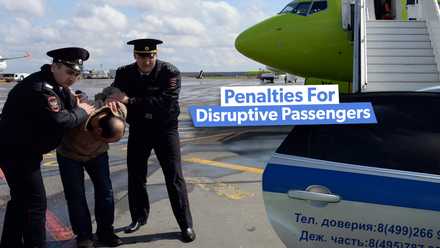
Fines, Flight Bans & Jail Time: What Are The Penalties For Disrupting Flights Around The World?
Many countries follow a no-tolerance policy when it comes to jeopardizing the safety of flight and its occupants.
Safety Remains The Primary Concern

Although disruptive passenger incidents often attract attention because of dramatic onboard videos or social media coverage, airline executives continue to emphasize that safety remains the central issue. Aircraft operate in highly controlled environments where cabin crew, pilots, and ground personnel must work together to ensure the safe transport of hundreds of passengers.
As such, any behavior that interferes with crew instructions, threatens other passengers, or distracts flight deck operations can quickly escalate into a serious safety concern. Walsh stressed this point during the discussion, noting that interference with flight operations cannot be tolerated regardless of the circumstances surrounding an incident. He added that “any interference with the safe operation of the aircraft is clearly unacceptable.”
Even incidents that may initially appear minor can create significant operational complications. A disruptive passenger may require restraint by cabin crew, assistance from other passengers, intervention by law enforcement upon arrival, or, in extreme cases, an unscheduled diversion that forces the aircraft to land at another airport.
Catch what other flight trackers miss
Emergency squawks, holds, NOTAMs — live signals, no signup.
Open tracker
Catch what other flight trackers miss
Emergency squawks, holds, NOTAMs — live signals, no signup.
Open tracker
Such diversions can cost airlines tens of thousands of dollars once fuel, airport charges, crew scheduling disruptions, passenger reaccommodation expenses, and maintenance considerations are taken into account. Beyond the financial impact, they can also create cascading delays throughout an airline’s network, and for this reason, airlines increasingly view disruptive passenger behavior as a direct threat to operational reliability in addition to its obvious safety implications.
Airlines Are Taking A Much Harder Line

One of the most significant developments in recent years has been the increasingly aggressive stance airlines are adopting toward offenders. Carriers around the world have introduced stricter policies covering abusive behavior, intoxication, refusal to comply with crew instructions, and physical or verbal harassment of airline employees.
Several airlines have publicly pursued compensation claims against passengers whose actions resulted in costly diversions, while others have expanded internal no-fly lists. Walsh acknowledged that these stronger responses may be helping to reduce incident rates globally, although he stopped short of identifying a single cause for the decline.
“I am pleased to say that we’ve actually seen a decline,” he stated. “Now whether that’s because of publicity around what airlines are doing, or whether it’s just that the environment has changed, I’m unclear at this stage.”
Publicity may indeed be playing a role, too, and stories involving passengers receiving substantial financial penalties or facing criminal prosecution often attract widespread media attention. The visibility of these cases serves as a reminder that disruptive behavior can have consequences extending far beyond the duration of a flight.
At the same time, airlines have invested heavily in crew training programs designed to identify and de-escalate potentially problematic situations before they worsen, and enhanced procedures for reporting incidents and coordinating with authorities have also strengthened the industry’s response capabilities. Together, these measures appear to be contributing to a more controlled environment on many routes worldwide, even if the problem has not disappeared entirely.
South America Is Seeing The Opposite Trend

While global indicators are encouraging, LATAM Airlines Group CEO Roberto Alvo warned that South America is moving in a different direction. According to Alvo, disruptive passenger incidents are increasing across parts of the region at a concerning pace. His remarks stood in stark contrast to Walsh’s observations regarding worldwide trends and highlighted the uneven nature of the challenge facing the industry.
“Unlike the average around the world, where this is coming down, in South America, it is going up, and it is going up very sharply.”
The comments are particularly noteworthy given LATAM’s position as the largest airline group in the region. It operates extensive domestic and international networks across multiple South American countries, and with major hubs at the likes of São Paulo Guarulhos International Airport (GRU), Santiago de Chile Comodoro Arturo Merino Benítez International Airport (SCL), and Lima Jorge Chávez International Airport (LIM).
As such, the carrier possesses a broad view of passenger behavior trends throughout the continent. Although detailed regional statistics were not provided during the discussion, Alvo’s assessment suggests that airlines in South America are experiencing an increasing number of incidents, even as counterparts elsewhere report improvements.
The divergence raises important questions about the factors driving passenger behavior across regions and whether global solutions can be effectively applied across markets with varying legal, regulatory, and cultural environments. For South American carriers, such as LATAM, Sky Airline, and  Aerolíneas Argentinas, the issue appears to be evolving from a general industry concern into a rapidly growing operational challenge that requires targeted regional action.
Regulation May Be A Key Factor

Alvo attributed much of the increase in disruptive behavior to what he described as inadequate regulation and insufficient consequences for offenders. In many countries, airline crews possess clear authority to address onboard incidents, but the legal framework governing prosecution, fines, and post-flight enforcement can vary significantly.
As such, where penalties are inconsistent or difficult to impose, deterrence may be weakened. Alvo argued that this regulatory gap is contributing directly to the rise in incidents throughout parts of South America.
“This is a function of probably not having the adequate regulation and the consequences to people that disrupt the operations.”
He went on to note that regulations addressing these issues remain absent in some jurisdictions across the region, limiting the industry’s ability to respond effectively. The challenge highlights an important reality of international aviation, as airlines operate across national borders, but enforcement mechanisms remain largely dependent on individual governments and legal systems. A passenger engaging in disruptive behavior on one route may face different consequences depending on where the incident occurs.
As a result, airlines can implement internal policies and pursue civil claims where possible, but meaningful deterrence often requires support from lawmakers, regulators, and law enforcement agencies. Without a consistent framework, airlines may find it more difficult to discourage repeat offenders or demonstrate that disruptive conduct will result in significant penalties.
Industry Cooperation Is Becoming Increasingly Important

Despite their differing assessments of current trends, both Walsh and Alvo agreed on one critical point: addressing disruptive passenger behavior requires collective action. Airlines can strengthen policies and pursue legal remedies, but lasting progress depends on cooperation among carriers, regulators, airports, governments, and industry organizations.
The issue extends beyond the individual passenger responsible for an incident because disruptions frequently affect hundreds of other travelers whose journeys may be delayed, canceled, or otherwise impacted. Alvo emphasized this broader perspective when discussing the importance of treating unruly passenger behavior as a major industry concern rather than an isolated problem affecting individual airlines.
“As an industry, we must be working together to bring this as an important topic, because it’s not about the passenger that disrupts the operations, it’s about the hundreds of passengers that actually get affected because of the situation,” Alvo added.
That observation captures why the debate remains so significant in 2026, and every diversion, delay, or onboard disturbance creates consequences for passengers, crew members, airport operators, and airline networks. Even when incidents involve only a single individual, the operational impact can spread across multiple flights and affect travelers far removed from the original event.
For the global industry, the recent decline reported by Walsh offers evidence that stronger enforcement and greater awareness may be producing results. For South America, however, Alvo’s warning suggests that the region is confronting a different reality, one where rising incident rates and regulatory shortcomings continue to present a growing challenge for airlines and policymakers alike.