Qamar Ahmed, the cricket journalist and broadcaster, as well as a former first-class cricketer, has passed away in Karachi, Pakistan. He was 88 years old.
Ahmed – or ‘Q’ as he was fondly and widely known to his fellow journalists – was for a long time, arguably Pakistan’s most accomplished and best-known cricket journalist and broadcaster, a career he embarked upon in London after leaving behind a fledgling first-class career in Pakistan in the 1950s. Eventually he would travel the world covering international cricket for a number of newspapers and magazines, and news agencies such as Reuters and AFP. He also worked for the BBC.
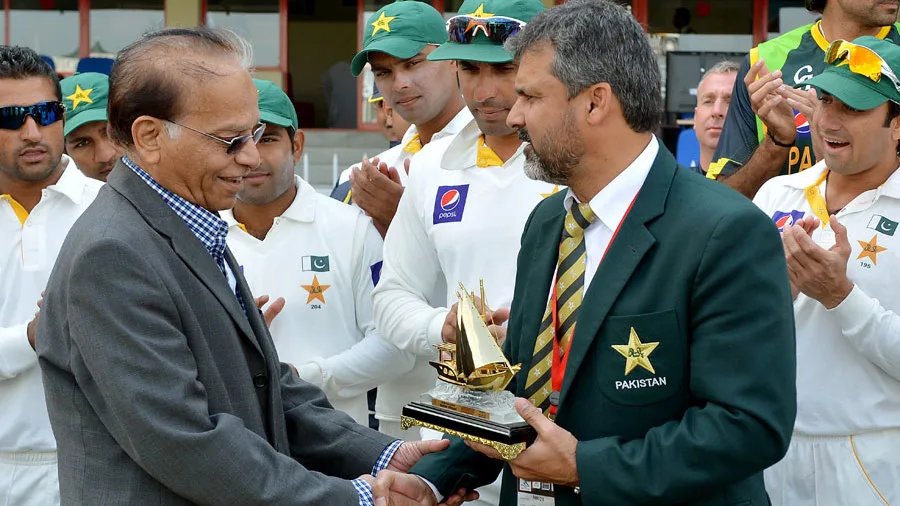
Additionally, he also did broadcast work for various TV channels and radio stations, including for TVNZ during the 1992 World Cup in Australia and New Zealand – which Pakistan won. He covered every single World Cup until the 2007 one in the Caribbean. By then he had stopped covering ODIs – “pyjama cricket,” as he called it – and focused purely on Tests. The third Test between Pakistan and Sri Lanka in Sharjah in January 2014, marked his 400th Test as a journalist – only a handful have covered more.
His long and well-travelled career meant he was an eyewitness to many of Pakistan cricket’s most seminal moments, including that 1992 World Cup triumph. He was in the hotel rooms of players when the famous pay dispute of 1976-77 happened, paving the way for the professionalisation of Pakistan’s cricketers. He was also present on Pakistan’s tour of the West Indies in 1992-93, when four players – Wasim Akram, Waqar Younis, Mushtaq Ahmed and Aaqib Javed – were briefly detained for marijuana possession, chronicling it in his book ‘Testing Times’. He was also present during the terror attacks on the Sri Lanka cricket team in Lahore in March 2009. Not just Pakistan’s moments either: Q was witness to Sunil Gavaskar’s 10,000th run, Richard Hadlee’s 400th wicket, Anil Kumble’s 10-for, cricket’s 1000th Test and its 2000th in 2011.
He was also the writer of the autobiographies of Hanif Mohammad and Waqar Hasan. His last book, ‘Far More than A Game’ came out in 2020 and was a memoir of his life in the game. It was a rich life, and it meant he was a lively raconteur around press boxes and cricket circles. The most popular of his stories invariably revolved around some of Pakistan’s biggest stars in the 1970s and 80s, such as Imran Khan and Javed Miandad, both of whom were regular guests at his London home. Many of them are too salacious to publish here but are well-known to journalists who had spent time with Q. Indeed, a visit to Q’s London home was a fixture for touring cricketers (and journalists) of the time, an opportunity to enjoy not only his generous hospitality and company but also – and this was not to be missed – his culinary skills.
These relations were reflective of a different era for the sport and journalism, when there was less distance between journalists and their subjects. Q could count for instance, Mushtaq Mohammad, one of Pakistan’s most influential captains and allrounders, and Zaheer Abbas, one of their greatest batters, among his closest friends. But in truth, there are few cricketers from that time who would not have come across or engaged with Q. Another of his closest friends was the late actor Mohammad Ali, one of the great superstars of the Pakistan film industry . He was also the subject of some of Q’s funniest stories and proof that of a rich life outside the game.
Even though he had stopped covering cricket regularly over the last few years, he remained a fixture in cricket circles. Last October, he attended the UK’s Cricket Media Club lunch (of which he was a member) and was the recipient of a generous and cheery birthday toast. He seemed, as ever, in good health, the result of a disciplined lifestyle and, no doubt, an athletic early career.
Indeed, it was as a left-arm spinner in Pakistan’s fledgling domestic circuit that he first rose to prominence in the mid-1950s. He did well enough across 17 first-class matches to push for a Pakistan spot, most notably for the 1957-58 tour to the Caribbean. Living in Hyderabad, however, meant he was outside the radar of selectors who, in those days, focused on the urban centres of Lahore and Karachi. Still, he does hold the rare distinction of having dismissed all the Mohammad brothers, including Hanif, Sadiq and Mushtaq on their debuts; his friendship with Mushtaq began, no doubt, when they made their first-class debuts in the same game.
One of his favourite stories was that he dismissed Hanif in the game before Hanif made his world record 499. The punchline was that Hanif had made 129 by the time Q got him, and that he holed out to long-on. He was still turning that left arm over in media games until the mid-2000s, and standing as umpire after he stopped playing, his love for the game undimmed until the very end.
Source link


 dailynewsnblog