dailynewsnblog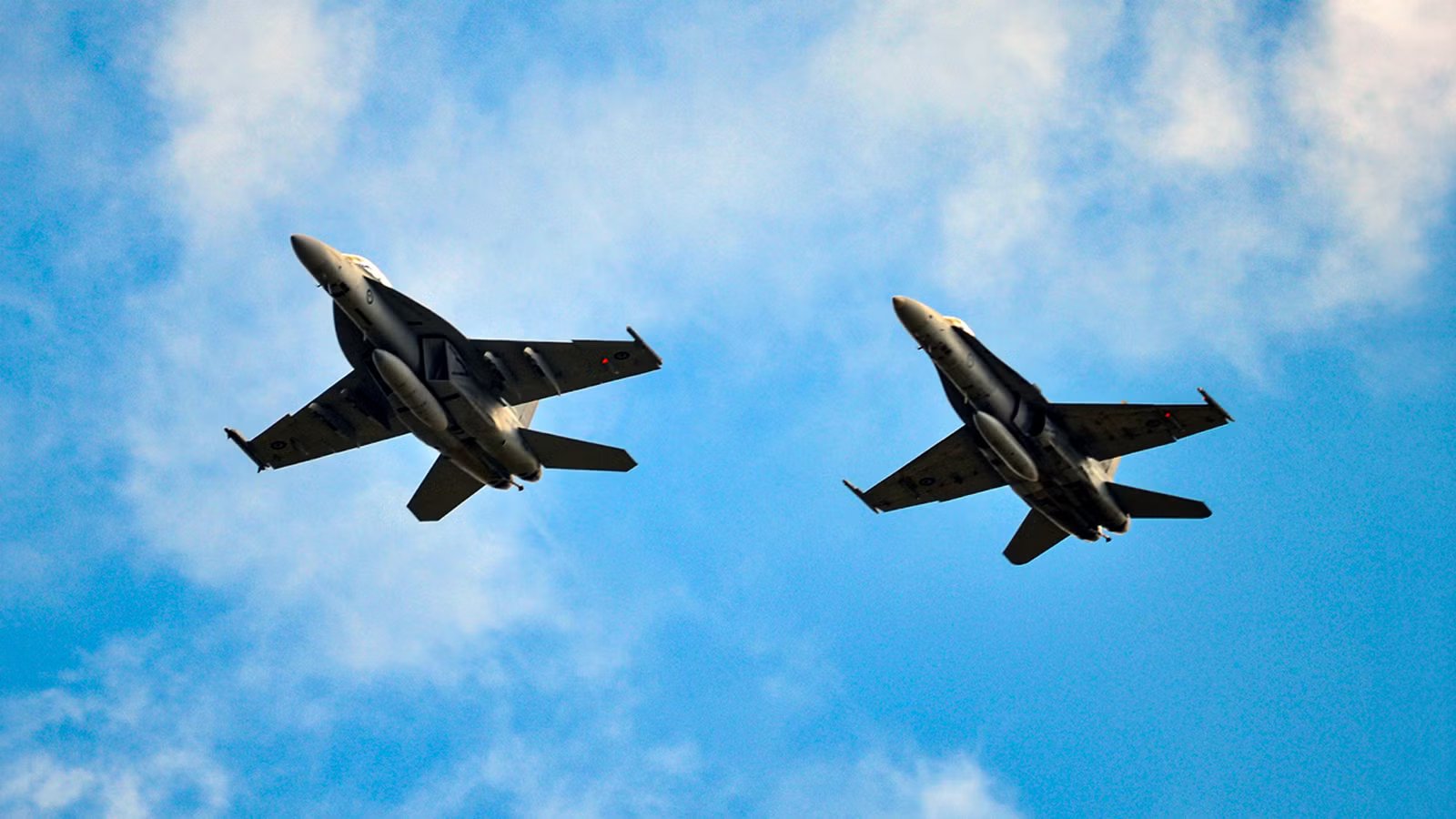
The US Navy made history when the Lockheed Martin F-35C became the first carrier-capable stealth fighter jet to achieve initial operating capability. The Joint Strike Fighter has completely revolutionized Naval Aviation by bringing stealth technology to tailhook squadrons for the first time in history. Still, that has not deterred America’s Navy from pursuing the next evolution in carrier air power.
The F-35C was actually not intended to be a replacement for the Boeing F/A-18 E/F Super Hornet Strike Fighter that is currently the backbone of the Navy’s Air Wings. It is a complementary platform as the first fifth-generation fighter jet to hit the flight deck, but the race is still on to develop a sixth-generation fighter jet, dubbed F/A-XX, to truly succeed the Navy’s Strike Fighter Mission set.
Notably, this program looked like it was going to be sidelined when Boeing was awarded the contract to develop the Air Force’s Next Generation Air Dominance. Instead, it has been resuscitated by lawmakers with $897 million in funding to jump-start the engineering and manufacturing development phase. The top competitors are currently a carrier variant of Boeing’s F-47 or an unnamed concept that has been teased by Northrop Grumman for renderings on social media.
Kick-Starting The Air Wing Of The Future

The F/A-XX programwas officially launched in 2012, with formal requirements being issued in 2015. While Lockheed Martin was eliminated after the 2025 downselect, which narrowed the field to Boeing or Northrop Grumman, funding in 2026 and the budget request for 2027 seem to indicate that significant progress would be many years down the road. However, on January 20, the House and Senate Appropriations Committees increased the funding for the FAX program by roughly 10 times its existing budget to a total of $972 million.
As a result, the Navy has revised its request for proposals, and the Chief of Naval Operations, Admiral Daryl Caudle, announced that it would proceed to the EMD phase in pursuit of a final contender. A decision may come as early as August under the newly accelerated program timeline. Once the winner has been awarded, the Navy is currently targeting initial operating capability for the first squadrons to deploy aboard aircraft carriers in the mid-2030s.
In the latest update, the Pentagon officially elevated the F/A-XX to an ACAT-1 high-priority program, transferring decision authority directly to the Office of the Under Secretary of Defense for Acquisition and Sustainment. The Navy’s top leadership has confirmed they are on track to award the massive, winner-take-all production contract to one of the two ‘Primes’ now under consideration.
The End Of An Era: No More Rhinos

The current fleet of Super Hornets has been flown heavily during decades of continuous deployment. The F/A-XX is a direct replacement for the aging Super Hornet, whereas the fifth-generation F-35C serves as a complementary asset, not a full-scale replacement. The final delivery of the venerable Boeing Super Hornet, affectionately known as the Rhino, is slated for 2027, with the last batch of 17 jets rolling off the assembly line before it is spun down.
The primary accelerator for the program’s sudden revival by Congress is China’s aggressive military modernization. China’s People’s Liberation Army Air Force is rapidly scaling its land-based Chengdu J-20 Mighty Dragon stealth fleet toward 1,000 airframes while operationalizing the carrier-launched J-35 stealth fighter from its new catapult Fujian aircraft carrier groups. More importantly, China is already flight-testing two distinct, parallel sixth-generation fighter prototypes: the massive Chengdu J-36 and the smaller, carrier-capable Shenyang J-50.
The F/A-XX is being built specifically to replace the Super Hornet’s role as the high-capacity, heavy-payload workhorse of the carrier strike group. It will focus on fleet air defense and heavy anti-surface strike, combining advanced deep stealth with a vast internal weapon payload capacity. Meanwhile, the F-35C is optimized for low-observable daytime strike and sensor-node coordination. It is built to quietly penetrate highly contested enemy air defenses, map threats, and network information back to the fleet.
Next Gen Air Warfare: Pivot To The Pacific

For years, detractors of carrier strike group strategy have argued that aircraft carriers are obsolete in the era of stealth technology and long-range standoff missiles. The advent of hypersonic cruise missiles like China’s anti-ship DF-27 and the proliferation of stealth aircraft like the J-20 has given a superficial boost to this point of view; however, there are fundamental fallacies in this argument. The most basic value of an aircraft carrier is the fact that it is literally a moving air base.
Every single US Navy super carrier, of which there are 11, can carry more tactical aircraft than most Air Forces on the planet. Armed with an air wing composed of next-gen stealth fighters and advanced loyal wingman drones, this force becomes an incredibly lethal powerhouse on the battlefield of tomorrow. While no ship or base is entirely safe from missiles, a nuclear-powered Ford-class aircraft carrier can move at more than 35 mph (km/h), which makes it an extremely mobile and unpredictable floating air force.
The US Indo-Pacific strategy relies on using the F/A-XX to exploit this mobility by massively extending the carrier’s reach. The F/A-XX is being engineered with a massive internal fuel capacity and advanced variable-cycle engines, giving it an unrefueled combat radius exceeding 1,000 miles (1,609 km). This single advancement allows US supercarriers to park safely outside the heart of China’s hypersonic missile envelope while still threatening the Chinese mainland.
The F/A-XX will not fly alone. It acts as a flying “quarterback” for stealthy, low-visibility Collaborative Combat Aircraft derived from stealth drone programs like the X-47. They act as scout nodes, electronic warfare jammers, and “missile trucks” carrying extra ammunition. By sacrificing cheap drones to absorb enemy air-defense missiles, the F/A-XX keeps its human pilots safe. The F-35C completes the package by operating as a passive, low-observable sensor node to feed target data to the other harder-hitting aircraft or even ships in the carrier strike group.
The Alliance Of Island Chains In The West-Pac

The F/A-XX ensures that the US Navy can constantly shift its launch points across millions of square miles of open ocean. In the Indo-Pacific, land bases are targets, but moving airfields are weapons. The US and its allies maintain massive, heavily armed air bases across Japan, Okinawa, Guam, and the Philippines, also known as the First and Second Island Chain. In a conflict, China can target them with precision ballistic and cruise missiles.
The First and Second Island Chains form a critical geographic barrier to contain hostile naval expansion. However, defending them solely from land bases creates a dangerous strategic bottleneck. By replacing the aging Super Hornet with the F/A-XX, the carrier air wing transforms into an integrated, long-range weapon system. This system blends the unique capabilities of three distinct platforms into a unified strike network.
By combining extreme stealth, a 1,000+ mile striking range, and disposable drone swarms, the F/A-XX ensures that the aircraft carrier remains the most lethal, survivable, and indispensable weapon in the US Pacific strategy. By operating fluidly outside the primary threat zones, the F/A-XX and its integrated drone fleet can launch persistent, heavy-hitting counter-offensives. This mobility complicates enemy planning, secures the gaps between the island chains, and ensures that allied forces can maintain air and sea dominance across the Indo-Pacific.
This mobile triad is essential to the broader, multi-domain allied defense strategy. When land-based airfields are forced to defend against incoming missile barrages or repair damaged runways, the mobile carrier strike groups ensure continuity of operations.
The Next Era Of Naval Aviation

For the last two decades, the Carrier Air Wing has been tethered by short-range, manned fourth-generation aircraft like the F/A-18E/F Super Hornet. The introduction of the F/A-XX sixth-generation fighter completely dismantles the Cold War-era design of the Carrier Air Wing. Unlike the Super Hornet, the F/A-XX’s tailless, smooth-underbody design provides omnidirectional stealth. This allows the air wing to operate in highly contested airspace during broad daylight, rather than waiting for complex electronic warfare suppression packages to blind enemy radar first.
A Carrier Strike Group is surrounded by concentric rings of defense. The F/A-XX pushes the outermost ring of the fleet’s situational awareness and engagement capability thousands of miles wide. Traditionally, a strike package meant launching dozens of manned jets, putting dozens of human pilots at risk. The F/A-XX shifts the air wing to a hybrid model where a single manned sixth-generation fighter acts as a command node, controlling a swarm of low-visibility Collaborative Combat Aircraft.
Currently, a massive portion of a carrier’s air wing must be dedicated to flying ‘buddy tanker’ refueling missions just to get short-range Super Hornets to their targets. The F/A-XX’s native 1,000+ mile unrefueled range frees up dozens of aircraft slots on the flight deck, allowing the carrier to pack more raw, offensive firepower instead of support aircraft. The fleet can exploit its 30-knot speed to constantly change headings across millions of square miles of open ocean, turning the carrier into a ghost on adversary long-range tracking radars.