dailynewsnblog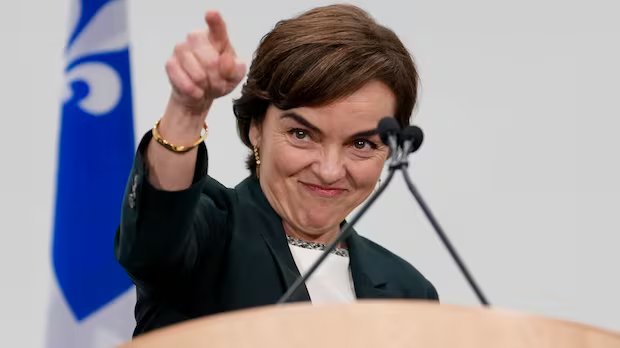
It has been just four years since Christine Fréchette took office with the Coalition Avenir Québec. On Wednesday afternoon, she was sworn in as the province’s 33rd premier.
Fréchette defeated veteran politician Bernard Drainville in Sunday’s leadership vote, with 58 per cent of the vote.
The 55-year-old has signaled a departure from the style of her predecessor, François Legault, promising a “new generation” of leadership for a party struggling to find its footing in the polls.
“You have chosen a woman, a Gen Xer and a unifier of people,” she said in her victory speech on Sunday.
Her supporters and friends are betting that her pragmatism and collaborative style will help reset the party, which is slumping in opinion polls. But she will quickly be put to the test with an election set for Oct. 5.

Fréchette, 55, first took office with the CAQ four years ago. At her swearing-in ceremony, she spoke about the similarities between the challenges her generation went through and the issues people are facing today.
Starring in ‘Sept in the City’
“She’s a very passionate person,” said Caroline Sauriol, a friend who has known Fréchette since her 20s. The two met through Force Jeunesse, an advocacy group formed to defend the interests of young workers as benefits were clawed back during the austerity of the 1990s.
“She has a clear mind on what’s right and what’s equitable and how the society should be functioning,” Sauriol told CBC News, adding that “she’s a very courageous person, very determined as well.”
Sauriol and Fréchette were later part of a group of young women professionals known as “Sept in the City” — a nod to Sex and the City — which also included Dominique Anglade, the former leader of the Quebec Liberals.
Fréchette took longer to enter politics than Anglade but, in Sauriol’s view, it was quite a “linear, meaningful road,” even though it has taken “many different forms throughout her career.”
Born and raised in Trois-Rivières, Que., Fréchette has a lengthy resume that includes leadership roles in economic development and stints on several influential boards.
She holds a bachelor’s in business administration from HEC Montréal and a master’s in international relations from Université Laval.

Fréchette is the second woman to hold the position of Quebec premier. Here’s how her personal and political history landed her at the helm of the province.
In 2007, she joined CÉRIUM, a think tank at the Université de Montréal, working under Jean-François Lisée. When Lisée became minister of international relations in the Pauline Marois government, Fréchette was appointed his deputy chief of staff.
She ultimately quit that job over the proposed Charter of Values, introduced by Drainville, who was also a Parti Québécois (PQ) minister at the time. The charter aimed to ban visible religious symbols for public sector employees.
While she left the PQ over that move, she has since stated her support for Bill 21, the CAQ’s secularism law, which she views as a more balanced successor.
Fréchette then returned to the economic sector, serving as a director at Montréal International and later as president of the Chambre de commerce de l’Est de Montréal (CCEM) from 2016 to 2021.
“She is someone that will listen, and that is willing to get the opinion of others,” Jean-Denis Charest, who succeeded her at the CCEM, said in an interview.
“She’s also known to be good at convincing people to move forward in the direction she believes is the right one.”
Economic issues a priority
After winning her seat in the Sanguinet riding south of Montreal in 2022, Fréchette was appointed minister of immigration. Two years later, she became economy minister — a post she held until she stepped down to run for the leadership.
During the leadership campaign, Fréchette presented a more moderate approach to Quebec identity than her rival, Drainville, who took a hard line on immigration.
For instance, Fréchette said she would temporarily reinstate the cancelled immigration pathway known as the Quebec Experience Program (PEQ) for two years to allow up to 45,000 “PEQ orphans” to settle in the province.
She has also said she wouldn’t force through Bill 1, the CAQ’s controversial proposed constitution, prior to the fall election.
In her victory speech, she listed her top three priorities: reducing financial pressure on families, protecting the economy and restoring confidence in Quebec’s future.
When asked on Radio-Canada’s Tout un matin whether there was room for nationalism among those priorities, Fréchette insisted there was — pointing to a commitment to extend French language laws to adult education and vocational training.

She reiterated in that interview that she plans to announce a “bundle of measures” as early as this week to reduce grocery prices and improve access to housing and government services.
“Working to reduce the cost of living for families, for Quebecers, will be among my first actions,” she said.
“Grocery costs are hitting budgets hard, as are rent and housing costs. These are two sectors where I want to act quickly.”
‘Not a nationalist firebrand’
However, some observers wonder if a focus on the economy will be enough to overcome the PQ and a resurgent Quebec Liberal Party.
Fréchette is also facing pressure within her own party as she puts together a new cabinet, which is expected to include Drainville. The National Assembly resumes sitting May 5.
“She’s not a nationalist firebrand,” said Francine Pelletier, a journalism professor at Concordia University and the author of Dream Interrupted: The rise and fall of Quebec nationalism.
“She shies away from that kind of identity politics. But what exactly she represents apart from a strong economy — I think most people in Quebec do not know.”