dailynewsnblog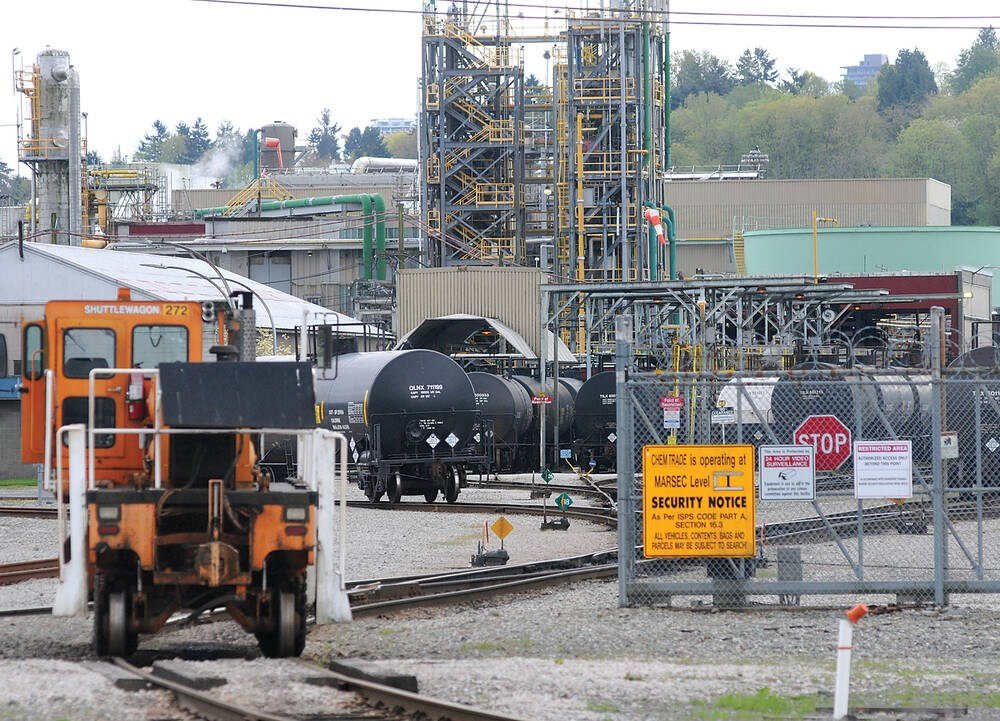

District of North Vancouver council will vote for a second time on the chemical plant’s request to continue chlorine production
With the fate of the North Vancouver Chemtrade chlorine plant once again up for debate by district council, neighbouring residents, plant workers and chemical industry insiders weighed in during a second public hearing that stretched over two evenings last week.
The unusual second public hearing June 16 and 17 came after the District of North Vancouver council voted to reconsider its earlier rejection of a rezoning request by Chemtrade to allow for continued production of hazardous substances at its Amherst Avenue chlor-alkali plant, where the company and its predecessors have been making the industrial product since the 1950s.
In late April, Chemtrade wrote to Mayor Mike Little offering several concessions and asking for reconsideration.
Changes proposed include putting a covenant on the property’s title expressly stating that chlorine operations at the plant must end by Dec. 31, 2046 when the company’s lease with the Vancouver Fraser Port Authority is up (or sooner if the lease ends before then). Planned safety improvements that were already part of Chemtrade’s proposal would also be enforceable through the covenant.
The company is also committing to updating the quantitative risk assessment already submitted to council before building permits can be issued, and then again eight and 10 years after to ensure that the plant’s risk to the public remains within acceptable levels.
Little said earlier he wanted to see if the new conditions put forward by Chemtrade changed anything about how the public sees the proposal.
But speakers at last week’s marathon public hearing continued to express starkly opposing views about the plan, with those opposed citing the inherent safety risk of operating a chlorine plant in a residential area and potentially dire consequences in the event of a leak.
In contrast, a number of plant employees, executives and chemical industry insiders spoke of Chemtrade’s impeccable safety record, low likelihood of a leak and the economic importance of the plant to both North Vancouver and provincial heavy industries. They also pointed to Chemtrade’s supplying of 70 per cent of the chlorine used to make bleach that disinfects drinking water supplies in Western Canada. If the chemical isn’t made locally, it will have to come from the United States or from much further away in Canada, which also carries risk, they said.
George McKay, who lives on Dollarton Highway, about two kilometres from the plant, said he was surprised to see a public hearing about the plant continuing to operate at its current location.
“I don’t think it’s a compatible use,” he said. “I think we’re just taking on somebody else’s problem.”
Laurie Parkinson, who lives near Park and Tilford, said she also opposes the rezoning for public safety reasons.
“Years ago, you banned the production of hazardous materials, specifically naming chlorine on the land Chemtrade wants to move on to,” she told council. “This should stop this rezoning…. Chemtrade has known they need to move for almost 20 years. They still have six years to move. Instead, they’re pressuring you.”
Jeff Powell agreed, telling council, “You wouldn’t allow a new plant to go into production for chlorine at this site now…. It’s time to shut this down.”
Trey Bell also urged the council to stand firm on its earlier decision to reject Chemtrade’s rezoning request. Council’s first responsibility is to protect the health and safety of residents, he said.
“Even if the risk of a chlorine leak is low, the potential consequences are severe enough that they cannot be ignored,” he said.
He added the risks associated with transporting chlorine by rail through populated areas have not received sufficient scrutiny.
Kelly Thomas with BakerRisk, that organization that performed the risk assessment for Chemtrade, said it’s important to consider not just “how bad it could be,” but also how likely that is.
Dan Thompson, who said he’s been providing engineering to the chlor-alkali industry for 10 years, said chlorine plant tank design has improved over recent decades to the point that problems are extremely rare.
“Compared to other hazardous material design requirements, chlorine tanks have some of the most rigorous design and testing maintenance requirements,” he said.
Lee Coonfer, CEO of the BC Water and Waste Association, said if Chemtrade is forced to shut down, “You don’t replace this capacity very easily.”
Sam Amin said his engineering firm works with Chemtrade and he has no qualms about living nearby in North Vancouver with his family.
“I don’t have that kind of panic about risk, about chlorine being a catastrophic event,” he said, pointing to the plant’s 70-year safety record.
Phoebe Yap, who works at Chemtrade, said few activities – including driving a car – have zero risk, but those risks can be mitigated and managed. In the case of Chemtrade, “I believe that this risk is worth having and worth managing,” she said.
Several questions and answers during the public hearing focused on Chemtrade’s role in providing disinfection to municipal water supplies. Chemtrade supplies chlorine to another company that makes bleach which is then added to water supplies.
North Vancouver resident Heather Drugge suggested the talk about water disinfection was a red herring, saying caustic soda, which is used in heavy industry and is another chemical produced by the company, is the profitable part of Chemtrade’s business.
“The drinking water story is what they tell us. The caustic soda story is what they tell investors,” she said. “DNV is being asked to absorb a risk that the port has already decided it doesn’t want.”
Susie Chant, MLA for North Vancouver Seymour, urged council to approve the project, saying “It’s a decision that affects the security of our drinking water,” as well as other key industries.
“If this facility were to shut down, communities in Western Canada would face immediate and serious challenges,” she said.
Chant’s comments were in addition to a June 11 letter to council from Ravi Kahlon, minister of jobs and economic growth, who also urged council to approve Chemtrade’s rezoning request, saying the chemicals produced by Chemtrade can’t be readily sourced elsewhere and are essential to a number of industries.
Council will reconsider its decision at a future meeting, tentatively scheduled for July 6.