dailynewsnblog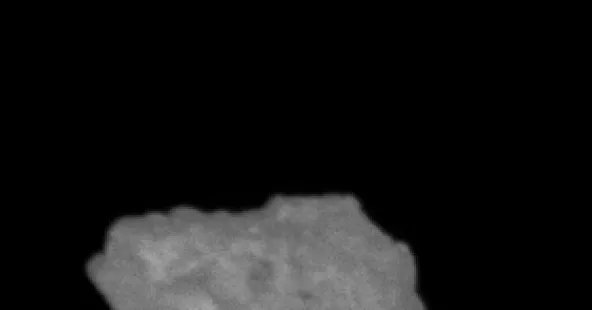
The China National Space Administration’s asteroid probe Tianwen-2 successfully reached the asteroid Kamo’oalewa, which orbits the sun in a path nearly identical to Earth’s.
After undergoing multiple orbital adjustments in deep space, it first detected Kamo’oalewa on June 6, 2026. On July 2, it successfully captured the first-ever images of Kamo’oalewa from a distance of about 20 kilometers. This achievement comes at the end of a 400-day journey covering a distance of roughly 1 billion kilometers.
Kamo’oalewa is the most stable of Earth’s known quasi-satellites, and because it orbits the sun in near-synchronous motion with Earth, it is considered a relatively accessible celestial body.
But landing on the asteroid—let alone gathering samples—will be a challenge. Kamo’oalewa has an average diameter of only about 41 meters and rotates at high speed. This means the spacecraft must achieve stable contact and collect samples within a limited time frame. If it manages to gather samples, it will then release them in a capsule during an Earth flyby in November 2027.
Tianwen-2 is equipped with multiple cameras with different focal lengths. In addition to switching between a narrow-field-of-view camera and a wide-field-of-view camera depending on the situation, it also features a detachable camera that will be used during sample collection. Since the probe’s orientation must be finely adjusted when capturing images, seizing these limited windows of opportunity is an extremely difficult task. Tianwen-2 plans to conduct more detailed scientific observations of Kamo’oalewa’s shape, material composition, and internal structure.
If this mission is successful, it will mark another achievement in asteroid sample return, following Japan’s Hayabusa and Hayabusa2 missions—the first to return asteroid samples to Earth—and NASA’s OSIRIS-REx mission. Material from small celestial bodies orbiting near Earth could provide clues to understanding the formation of the solar system, including Kamo’oalewa.
“It is highly likely to contain primordial information from the early days of the solar system’s formation, and it holds great scientific value for studying early material composition, formation processes, and evolutionary history,” explains Han Siyuan, deputy director of the Lunar and Space Exploration Engineering Center and spokesperson for the Tianwen-2 mission.
Researchers have previously theorized that Kamo’oalewa is a fragment of the moon blown away by an asteroid impact millions of years ago, and that explanation has been widely accepted until recently. This is because the spectrum of reflected light closely resembles that of silicate minerals found on the moon’s surface. Simulations also backed up the theory.
In May, though, an international research team—including the Chinese Academy of Sciences— published a paper that casts doubt on this leading hypothesis. A reanalysis of available data found that the central wavelength of the absorption band—the point where light weakens at a specific wavelength—matched the characteristics of LL chondrites (a type of meteorite with low iron and metal content).
The research team conducted an experiment in which they irradiated LL chondrite meteorite powder with a laser to simulate space weathering caused by solar wind and micrometeorites. The results closely matched observational data of Kamo’oalewa. The researchers posit that Kamo’oalewa likely migrated to the Earth’s vicinity from the Flora family—a group of celestial bodies in the asteroid belt.
If Tianwen-2 successfully completes its mission to take samples and return to Earth, it will likely help answer questions about Kamo’oalewa’s origins. But first, it has to reach the asteroid’s surface.
This story originally appeared in WIRED Japan and has been translated from Japanese.