dailynewsnblog
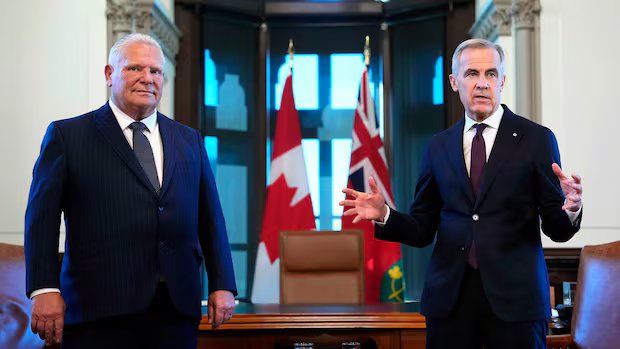
Alongside Ontario Premier Doug Ford, Prime Minister Mark Carney announced an $8.7-billion support package for steel, critical mineral and auto sectors on Wednesday.
Ford said the federal-provincial agreement “will protect workers in key provincial industries from tariffs and will pave the way for new good-paying jobs” across Ontario.
The partnership with the Ontario government earmarks $2.5 billion over two years for the province’s auto industry to build the “connected and electric vehicles of the future.”
Ottawa is providing $1.5 billion of the auto funding, with Ontario providing the remaining $1 billion.
The support for auto companies comes at a time of uncertainty caused by the trade war with the United States.
“An integrated North American auto sector will be stronger, more competitive and provide better jobs for our workers,” Carney said. “But we recognize these are not the objectives of the current U.S. administration. Their approach has changed, and so must ours.”

Standing with Ontario Premier Doug Ford, Prime Minister Mark Carney said on Wednesday that new investments in Ontario’s Ring of Fire critical minerals projects, the steel sector and the auto sector will protect up to 290,000 jobs across the province.
In August, U.S. President Donald Trump threatened to increase tariffs on all cars, trucks, auto parts and steel to 50 per cent on Jan. 1. That threat came after Carney announced he was retaliating with matching dollar-for-dollar tariffs on American goods.
The U.S. is already hitting finished vehicles and non-CUSMA-compliant auto parts imported to the U.S. with 25 per cent levies.
“Ontario and Canada are being challenged right now,” Ford said. “We see it in every corner of our province where tariffs and trade uncertainty are leaving workers and their families worried.”
Also in the joint package, Ottawa is easing greenhouse gas regulations as U.S. tariffs pressure Canada’s automotive sector.
Canada’s emissions standards are now set to flatline until 2030 — maintaining 2026 levels for new light-duty vehicles through the 2029 model year. Annual increases are set to resume in the 2030 model year.
Ottawa initially proposed increasing emissions standards from 2026 through 2035 to reach its goal of 75 per cent EV sales by 2035.
Brian Kingston, president of the Canadian Vehicle Manufacturers’ Association, says the step will provide “some relief” to the auto industry.
“By pausing the regulation and flatlining to 2030, it gives companies some flexibility as they deal with a much more significant threat, which is of course U.S. tariffs,” Kingston said.
At the same time, Evan Pivnick, associate director of public affairs at Clean Energy Canada, said the change is a setback for the government’s EV sales targets.
Pivnick said that even though Carney acknowledges a global shift toward EV adoption, “the policies that are meant to help ensure Canadians are able to access a larger share are just delayed.”
Ottawa’s loosened emissions standards come after the Trump administration made similar changes on Monday.
The U.S. finalized rolling back fuel economy standards for new vehicles, reversing policies meant to boost fuel efficiency and promote using electric vehicles.
Because of the Canadian auto industry’s close integration with the U.S., Kingston says Canada needs to remain “relatively closely aligned” with its southern neighbour on that front.
“We cannot diverge significantly from the United States if we intend to have an industry of the size and scale we have right now in Canada,” Kingston said.

The Carney government is aiming to have three out of every four new vehicles sold in Canada to be electric by 2035. (Doug Ives/The Canadian Press)
Industry Minister Mélanie Joly said on her way into a caucus meeting on Wednesday that the government wants to continue to provide support to auto companies impacted by the Trump administration’s reversal in regulations.
“A lot of our auto producers have been deeply impacted, not only by the American tariffs but indeed by the fact that the American administration has decided to reduce massively its different protection regarding GHG emissions,” Joly said.
Carney said Canada’s imperative to invest in cleaner auto technologies is “reinforced by the radical transformation of the global auto sector” toward lower emissions, greater connectivity and more advanced manufacturing.
Carney said the investment is “the next major step forward” in positioning Canada as a global leader in EV production.
Measures for steel, critical minerals
The federal-provincial partnership also launches a $5-billion Joint Steel Action Fund — $3.55 billion from Ottawa and $1.67 billion from Ontario, both over five years.
Carney said the investment will allow steel mills to upgrade their machinery, manufacture more products that Canada needs and expand to meet demand from markets other than the U.S.
“When Canadian projects need specialized steel, they can increasingly count on Canadian mills, and Canadian steelworkers, to supply it,” Carney said.
Ottawa is also setting out $1 billion over three years to match Ontario’s investment toward building a road to reach the mineral-rich Ring of Fire region.
Ontario has been trying to get the federal government to help pay for and speed up development of the Ring of Fire.
Ford has called mining critical minerals in this area an “ace in the hole” that could help give Canada leverage against American tariffs.
Carney said Ottawa and Ontario are creating a co-ordinated process for federal and provincial permitting to open mines. Carney said the process for opening a mine in Ontario has historically taken over 15 years.