dailynewsnblog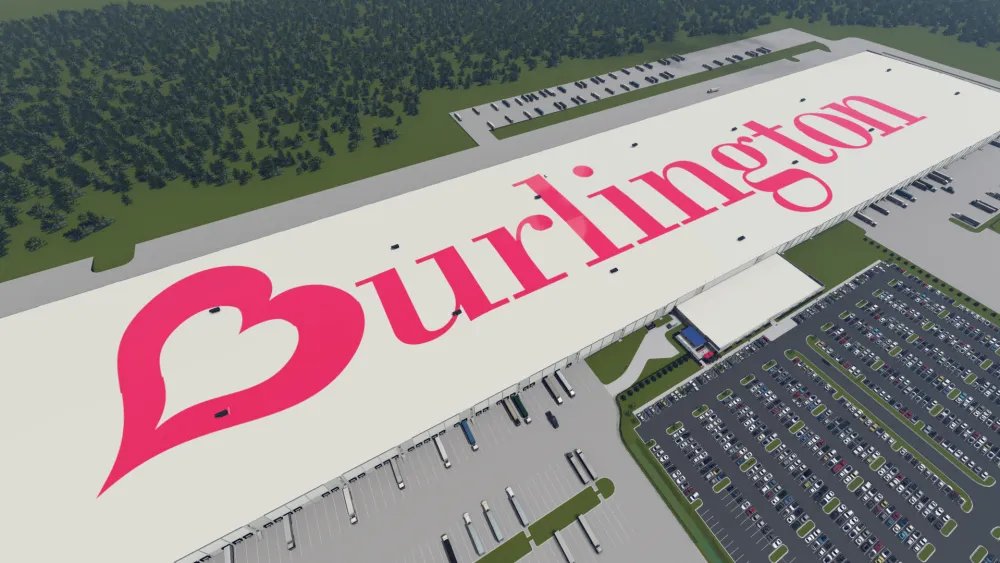
Burlington Stores is set to open up an additional 4 million square feet of new warehouse space through 2028, expanding its supply chain footprint by 50 percent with the launch of its two biggest distribution centers yet.
The off-price retailer is prepping for a Savannah, Ga.-area distribution center to open this spring. The Georgia facility will be Burlington’s largest yet at 2,057,000 square feet, or twice the size of the apparel, accessories and home goods seller’s distribution center in Logan, N.J.
Officially located in Ellabell, Ga., the warehouse has 12 job openings listed on the Burlington website, including four asset protection team members, a weekend manager and a returns and damages coordinator.
Based on the physical locations of Burlington’s stores and vendors near the distribution center, the company expects to shave some freight costs relative to sales, said Kristin Wolfe, chief financial officer of Burlington Stores, during an earnings call on March 5.
According to POH+W Architects, which designed the Georgia facility, the distribution center is equipped with 155 dock doors and five drive-in dock doors, and supported by 26 miles of interior conveyors.
And early last month, the company broke ground on a nearly 2-million-square-foot site in Buckeye, Ariz. The Phoenix-area facility is expected to open in 2028.
Burlington estimates that it will pay up about $290 million in capital expenditures to support its supply chain initiatives in 2026, largely related to the completed buildout and opening of the Georgia site and the beginning construction on the Arizona DC.
“It does typically take two or so years for a DC to be fully ramped up,” said Wolfe in the call. “Over time, we absolutely expect this state-of-the-art design for the off-price DC to drive cost efficiencies for us, notably significantly faster processing time.”
Wolfe said the retailer expects to modify its distribution footprint over time to have most of its inventory and processing pass through its most efficient distribution centers.
According to an April 8 press release, the Arizona facility will be highly automated, integrating smarter sorting systems, enhanced workstations and custom software to streamline daily operations.
“These enhancements boost productivity, efficiency, and overall workflow, helping merchandise reach store shelves faster, with the goal of giving customers the chance to find something new every time they shop,” the statement read.
At full capacity, the facility is estimated to create “thousands” of new jobs.
The supply chain expansion aligns with Burlington’s desires to keep growing its store base. The company will open an additional 110 net new stores nationwide by the end of 2026.
As of Jan. 31, the company operated 1,212 stores. The retailer announced in 2020 that over the long term, it sought to expand to 2,000 total stores.
Currently, Burlington operates six distribution centers located in either California or New Jersey that ship 99 percent of merchandise to its stores. These six distribution centers occupy a combined 5,135,000 square feet, and each includes processing, shipping and storage capabilities.
The company also operates five separate warehousing facilities to support its distribution centers. The warehouses take up 2,383,000 square feet and primarily serve as storage facilities.
When including the new Arizona and Georgia distribution centers, Burlington will own four of the 13 properties.
“Historically, we have leased our distribution centers, which made sense at the time when our balance sheet was much more leveraged,” Wolfe said in an earnings call last March. “We now have the balance sheet strength to own rather than lease. Ownership gives us greater control over the design of these buildings. It also allows us to leverage this capital investment as we grow over time and to avoid significant rent increases at each lease renewal.”
On top of the distribution centers and warehouses Burlington operates, the retailer has arrangements with third parties to use “pool point” facilities throughout the U.S. that help the company streamline and optimize their distribution network. A pool point is where freight is sorted based on its final destination and then sent off for delivery.
Wolfe said during last month’s call that the company has made “significant progress” reducing supply chain expenses as a percentage of sales via productivity initiatives in the DCs and cost-savings projects across the supply chain.
Over the past two years, supply chain costs have contributed a combined 70 basis points (0.7 percentage points) of margin improvements, she said.
Burlington’s supply chain productivity and cost-savings initiatives are expected to offset the startup costs of the Savannah DC, causing supply chain costs as a percentage of sales to be relatively flat for 2026.
In the first quarter, the retailer is expecting 0.1 to 0.2 percentage points of headwinds to margins based on the spending at the Georgia facility.
“As the year goes on, we expect that deleverage to moderate as we offset with these cost savings initiatives,” said Wolfe.