dailynewsnblog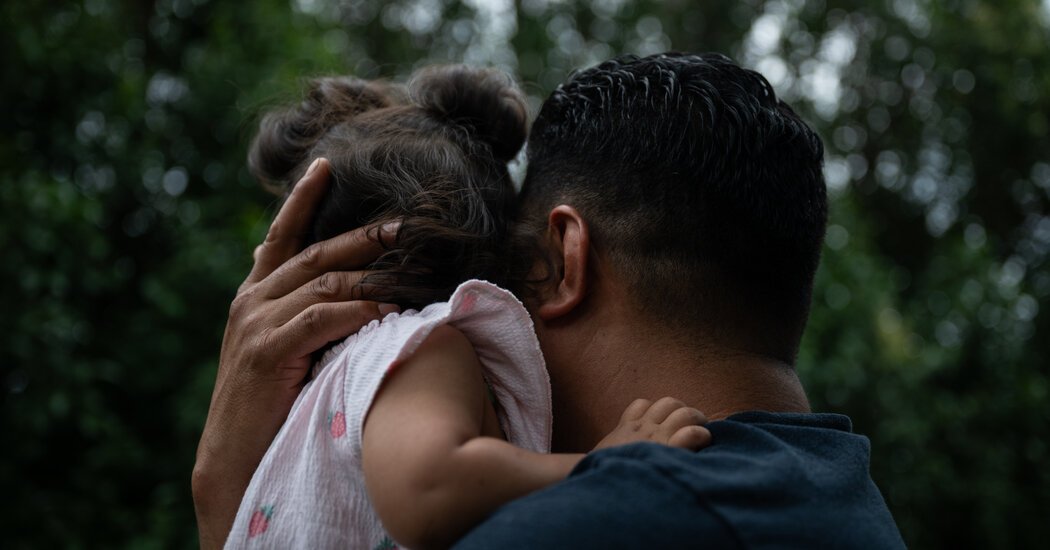
Ledy Ordonez was on the job at a San Antonio seafood wholesaler last July when immigration agents entered the facility, taking her and about a dozen others into custody. The single mother remains in detention, separated from her only child, Alonzo, a U.S.-born 2-year-old now in the care of a friend.
“He can walk and talk now,” Ms. Ordonez said from a detention center in Texas. “I’ve missed so much.”
A new analysis suggests that more than 100,000 children have been separated from their parents during the Trump administration’s immigration crackdown. And roughly three-quarters of those children, like Alonzo, are likely U.S. citizens, according to estimates from the Brookings Institution that were shared with The New York Times.
The Brookings estimate of the number of children who are U.S. citizens is more than double the amount that would be expected over the same time period based on official Department of Homeland Security data. The researchers, whose report is based on a statistical analysis of the detainee population, argue the official statistics are an undercount because of how the government collects that information.
The findings point to a scale of family separations that far eclipses that of the first Trump administration’s “zero tolerance” policy in 2018, when about 5,500 children were removed from their parents immediately after crossing the southern border.
D.H.S. did not directly respond to questions about the number of parents who had been detained or the analysis suggesting that the official statistics did not reflect the full number of U.S.-born children whose parents had been arrested.
D.H.S. said in a statement that parents are given a choice of being removed with their children or placing their U.S.-born children with a designee.
“Any way you cut it, there are tens of thousands of children who have experienced parental detention since this president entered office,” said Tara Watson, a senior fellow at Brookings. “The majority are U.S. citizens,” she said.
The researchers estimated that about 205,000 children have had a parent detained — typically a precursor to deportation — including about 145,000 who are citizens. They used data from the Census Bureau and on Immigration and Customs Enforcement arrests to determine the likely number of children detainees had based on their immigration status, sex, age, nationality and whether they were married.
The United States is home to more than 13 million immigrants who are vulnerable to deportation, because they either are undocumented or have temporary statuses. Some five million children under the age of 18 live with at least one unauthorized immigrant parent, according to estimates by several think tanks, and more than four million of them are U.S. citizens.
The Trump administration has arrested about 400,000 immigrants during enforcement operations in the interior of the country. There is no reliable information about how many children the detainees have, or what happened to those children once their parents were taken into custody.
Ms. Watson, an economist, and her co-author, Maria Cancian, a public policy professor at Georgetown University, sought to answer those questions, they said.
The estimates assume immigration enforcement is essentially random — that immigrant parents are just as likely to be detained as immigrants without children. But the researchers also created an interactive tool that estimates the likely number of children affected by parental detention under different enforcement scenarios and assumptions. Their most conservative estimate for the number of U.S.-born children with a parent detained is about 117,400. Their highest estimate is approximately 175,000.
The researchers said they considered 145,000 to be their most accurate estimate, and they predicted that it will grow, given that Congress allocated $45 billion in the One Big Beautiful Bill to expand detention capacity.
Their estimate contrasts with figures released by D.H.S., which say the parents of about 60,000 U.S.-born children were arrested over the same time period. In their report, the researchers theorized the discrepancy was becauseD.H.S. was not consistently asking about children, or detainees were fearful of revealing they had children, worried about putting them or their caregivers at risk.
Based on interviews with child welfare agencies, the researchers estimated only a small fraction of the children end up in the foster care or similar arrangements.
“We found that remarkably few end up in foster care — most children stay with friends and family who don’t have a legal obligation to care for these children,” said Dr. Cancian, who studies child welfare and immigration.
Many schools and legal aid organizations have helped immigrants appoint a caregiver for their children in the event they are separated.
However, the children are often left in the care of older siblings or working-class families already grappling with financial hardship and precarious immigration statuses, making these arrangements ultimately unsustainable, experts say.
If the government is separating children from good parents who happen to be undocumented, it has “the obligation to safeguard their well-being,” Dr. Cancian said.
Public Counsel, a nonprofit legal aid organization in Los Angeles, has educated more than 4,000 immigrants on custody plans since last year, ensuring that someone is empowered to make medical and school-related decisions.
Still, the nonprofit regularly receives calls from schools, churches and others seeking assistance for children whose parents were just detained.
“We are seeing kids in tenuous situations, left with neighbors who don’t have the proper paperwork they need; older siblings who have children of their own; and cases where a father cannot handle young children,” said Sharon Cartagena, a family law lawyer at the nonprofit.
Casey Revkin, executive director of Each Step Home, which began by assisting immigrant families during the 2018 border separations, now focuses almost exclusively on helping parents in detention who have lived in the United States for many years and were separated from their children.
“Almost every day we are contacted by a mom in detention who was arrested and taken from her kids,” said Ms. Revkin, whose group raises funds to help parents in detention pay for phone calls to their children. “This time the cruelty is often being inflicted on U.S.-citizen children.”
The mother of Samantha Lopez, a 3-year-old U.S. citizen, was turned over to ICE last month by a sheriff’s deputy after a traffic stop while she was driving to her restaurant job, according to her husband.
Mr. Lopez, who asked that his full name not be disclosed out of concern that he could be targeted by ICE, said that his wife had told agents she had a young child, to no avail.
“I am feeling such a void and such anguish,” he said. “When our daughter talks to her mom, she listens attentively and then starts to cry.”
“This is my American child being harmed,” he said.
Mr. Lopez, a construction worker, said that he needed to work as much overtime as possible to afford a lawyer to secure his wife’s release, but he must also watch his daughter after day care.
Ironically, having a U.S.-born child can keep families apart.
Ms. Ordonez, who has been separated from her U.S.-born son for more than 10 months, said that she pleaded with agents long ago to allow the pair to stay in a family detention center while she fought her case. But American citizens cannot be held in immigration detention.
“I never wanted to be separated from my only child,” she said.
Agents have warned Ms. Ordonez that her deportation is imminent, she said. To accompany his mother, Alonzo needs a passport. Ms. Ordonez has been struggling to arrange it, she added. Agents warned her recently that they would deport her without the boy if she did not obtain the document, leaving him with his current caretakers.
“These aren’t family or anything, they are just caring for him as a favor,” she said, weeping. “If they deport me, I want to take my child.”