dailynewsnblog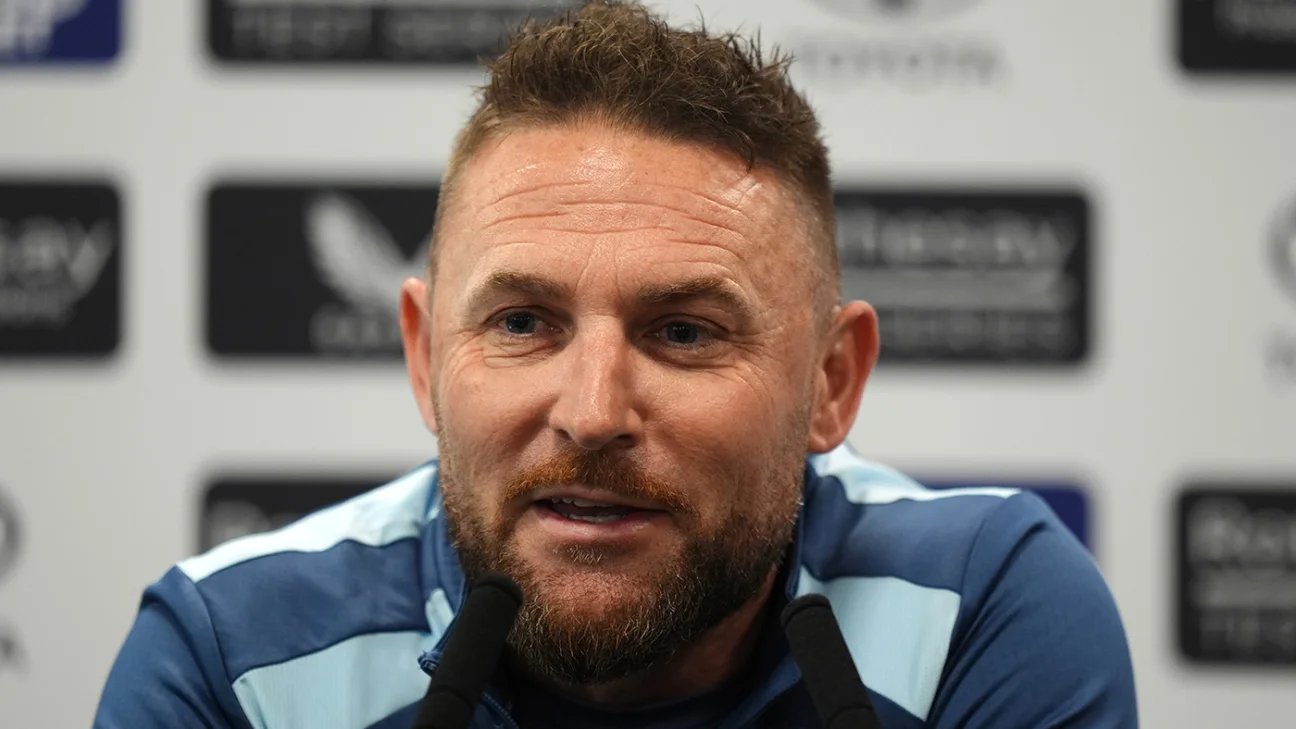
“I don’t really like the terminology of things, as you guys are well aware.”
“It was about trying to get the best out of these guys,” McCullum said. “Trying to initially bring some joy and some enthusiasm back into it. Understanding that these guys have options outside of playing for their country. They have options which have a lot less scrutiny, a lot more money and a lot less demands on them. And we wanted to create an environment off the back of Covid and some poor performances beforehand where guys were excited to jump in the car to Lord’s to meet up with the English cricket team, and were excited about taking on opposition teams and dealing with the scrutiny and being able to handle that.
“To ultimately want to choose playing for England over the other option which comes with a lot less scrutiny around it. That was initially what we were trying to create. And then as we went along it was about trying to have an identity about how you wanted to play. To try and play with a sense of freedom whilst also understanding big moments and try and transfer pressure onto the opposition. And see how the opposition handles it. If they can stand up to you then okay.
“Then things evolve and things change and teams naturally… people, personnel adjust. And I think during that time, we just were not quite able to succinctly nail everything we wanted. And hence when those pressure moments arrived in the biggest series, when pressure was at its highest, we unfortunately weren’t able to achieve it. For that, I put my hands up.”
There is a certain irony to McCullum’s honesty, even if it might be too late in what has been a catastrophic start to the England men’s Test summer. Having decided to take a more proactive role with media engagements, it has ultimately seen him emerge as the main fall guy. The first to be pushed after Ben Stokes chose to leave on his own terms after the third of a six-Test summer. Managing director Rob Key remains the only one of the trio to remain untouched.
“I was the leader of that group [for the New Zealand series]. I was in charge of the team culturally, in charge of the team tactically, in charge of the team results-wise as well. If you don’t get the results, fundamentally you get replaced”
Brendon McCullum
McCullum even took responsibility for matters beyond his control. It was Stokes who set the Indiana Jones-sized boulder rolling into the ECB’s offices when he embarked on that ill-fated night out after victory in the first Test at Lord’s. One that led to an Oval Test featuring three debutants and two players – Emilio Gay and Matthew Fisher – with just a single cap to their names. Even without Stokes’ shock retirement during the series decider at Trent Bridge, New Zealand had the momentum, not just the better cricketers.
“For me, I was the leader of that group,” said McCullum, when given the opportunity to lean into the mitigating factors to the 2-1 defeat that sealed his fate. “I was in charge of the team culturally, in charge of the team tactically, in charge of the team results-wise as well. If you don’t get the results, being a results business, fundamentally you get replaced.
“I’m not unaccustomed to that. I’ve been around this game for 20-odd years and I know if you aren’t getting the results, someone else needs an opportunity. I put my hand up for that and accept it wasn’t good enough.”
All of which only adds to the peculiarity of the situation McCullum find himself in. Continuing on under the same people that took the decision to part-fire him. Occupying a job that is the easier of the two to replace, a much neater fit for mooted candidates such as Richard Dawson, Jonathan Trott and Ryan Campbell.
Make no mistake, McCullum’s stock among the playing group remains strong, particularly among a more experienced white-ball cohort, including the crossover Test stars such as Joe Root, Jacob Bethell, Jofra Archer, Josh Tongue, and especially Harry Brook.
Since McCullum added the ODI and T20I sides to his remit in 2025, his relationship with Brook has flourished, to the point that McCullum described him as “almost one of my other sons”. And it was instructive that he sought to win any foreseeable custody battle by ringfencing Brook as his limited-overs captain, with question marks over whether the Test vice-captain is ready for a promotion.
“I think you know what I think of Harry. My level of affection for Harry as a player, a person and a captain. Of course I’d like Harry to carry on and us work together. I’m sure myself and the new Test coach will have a good conversation over it.”
Depending on the new Test coach and their plans, Brook could be one of a number of friction points that emerge in the impending split-coach era English cricket is about to dive back into. The clubhouse leader Andy Flower did not have a great experience of that arrangement with Ashley Giles in the final two years of his first go as England coach. McCullum even acknowledged the scales tipped too far against Matthew Mott when the pair had a similar working relationship between 2022 and 2024.
It remains to be seen whether McCullum is afforded the same extracurricular privileges as the new Test coach, who may well be allowed to seek franchise opportunities – or at least keep existing ones – and even skip the odd Test.
A limited-overs series with Pakistan is due for next May, ahead of a likely one-off Bangladesh Test, which may clash with 2027’s edition of the IPL. McCullum would need to be on deck for that with a crucial 50-over World Cup later that year.
That is, of course, if McCullum is still in situ at the turn of the year, or even beyond this summer. By then, he might have decided his time with the England has truly run its course. For now, he is cracking on, chastened, pride dented but spirits, at least at the time of writing, undimmed.
Back in 2022, McCullum came for the red-ball job. Now, in 2026, he is left with the white-ball one.
Vithushan Ehantharajah is an associate editor at Cricinfo