dailynewsnblog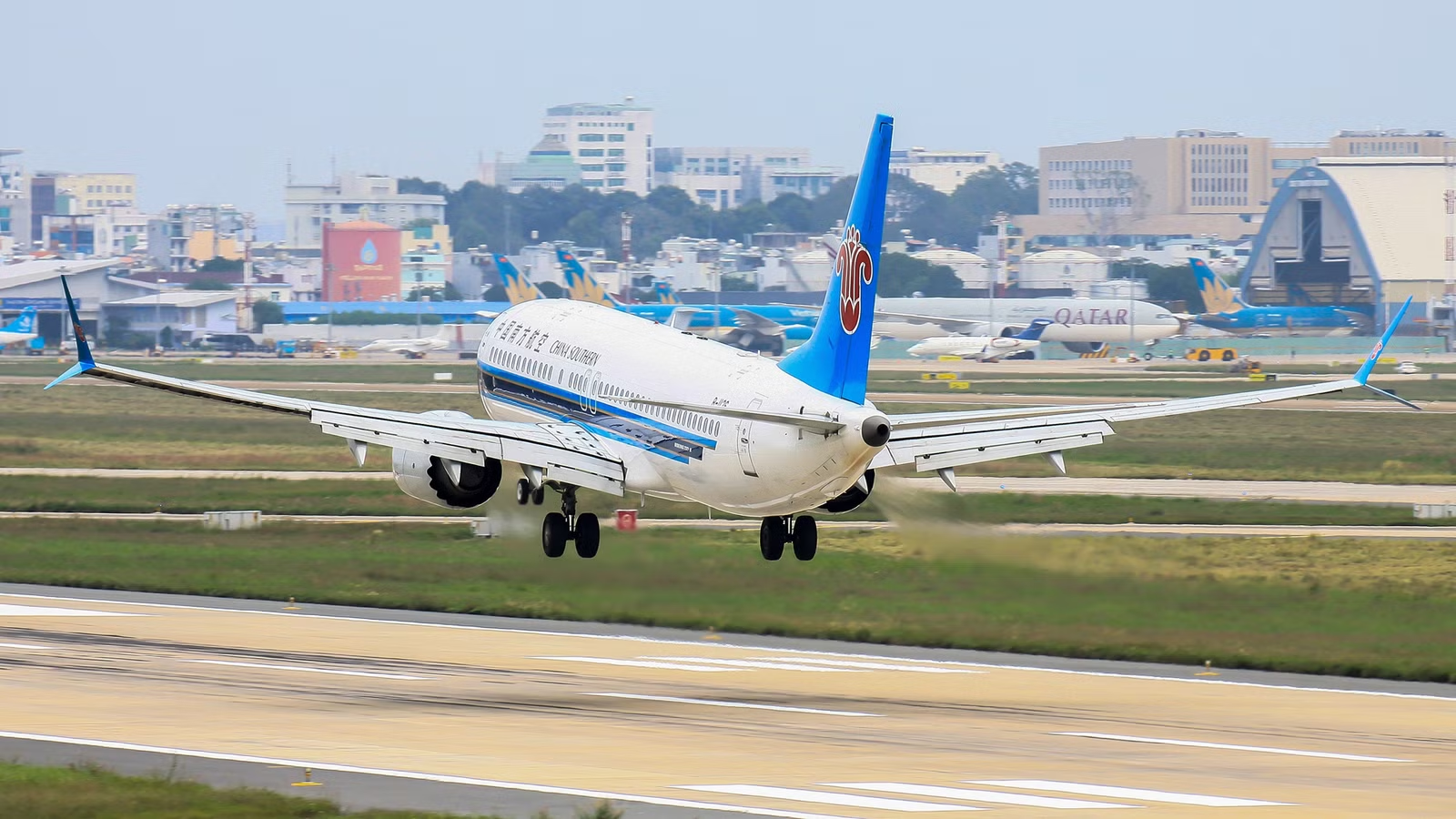
Boeing’s deal to sell at least 200 commercial jets to China is in danger of “falling apart” due to a dispute over the supply of engine parts and maintenance. The Chinese government has reportedly pushed hard for terms guaranteeing the long-term supply of engine parts and other services.
The White House has pushed back against Beijing’s negotiating pressure, claiming that post-sale maintenance was not part of the estimated $17 billion to $19 billion agreement reached in May. Although no formal deal was signed in Beijing, US President Donald Trump claimed the deal could eventually involve up to 750 aircraft, marking the first major Chinese order for  Boeing in almost a decade.
Boeing’s Multi-Billion China Deal In Danger Of Collapsing

A report by Politico cited three people familiar with the matter, one of whom claimed the deal may fall apart if a compromise cannot be reached. The unresolved terms involve the long-term coverage of engines, spare parts, maintenance and servicing, with Beijing seeking assurances that it will not become overly dependent on a support relationship that the US could later restrict.
When announcing its deal with Boeing, the Chinese government stated that it also included “adequate supply guarantees for engines and spare parts,” although this was not confirmed by the planemaker or the White House. The impasse is set to be a significant talking point this week during a visit from Chinese Vice Foreign Minister Ma Zhaoxu. A source told Politico:
“The sticking points are less about aircraft pricing than the long-term package around engines, spare parts, maintenance and servicing. China wants confidence that it won’t become dependent on a support relationship the US could later restrict.”
Why Beijing Is Pushing Hard For Guarantees

China’s insistence on confirming parts and servicing is to ensure the long-term viability of its airlines flying Boeing jets. A fleet of 200 or more narrowbody and widebody jets would tie Chinese carriers to US-controlled spares and technical support for at least two to three decades, putting it at the mercy of future US policy.
In May 2025, China was briefly subjected to sanctions involving export licenses for critical aviation technology, including engines and components. Those suspensions covered CFM International LEAP-1C engines for the Comac C919, GE Aerospace CF34 engines for the C909, along with components from Honeywell Aerospace and Collins Aerospace, although the licenses were reinstated by July.
Boeing CEO Kelly Ortberg has described China’s commitment as an initial tranche, with reports suggesting that the country intends to buy several hundred more jets in stages, potentially adding 300 to 500 aircraft for a total of up to 700.
Boeing’s Position In China Remains Fragile

Beijing has repeatedly clashed with Boeing over the years, suspending deliveries and barring Chinese airlines from ordering Boeing-made planes on multiple occasions. Following the two 737 MAX crashes in October 2018 and March 2019, the Civil Aviation Administration of China (CAAC) became the first regulator in the world to ground the type, before China suspended most Boeing orders and deliveries later that year.
Boeing deliveries would not resume until December 2023, followed by the first restarted MAX deliveries in January 2024. Beijing once again ordered its airlines to stop taking Boeing deliveries or placing orders in April 2025 in response to US tariffs, before deliveries resumed in June. China accounts for around 10% of Boeing’s commercial backlog, but the planemaker has not penned a firm deal with a Chinese airline since 2017.
As a result of Boeing’s prolonged absence from the market, rival Airbus has scooped up a sizable bulk of Chinese demand. According to the European manufacturer, it now holds around 55% market share in China and has over 2,200 aircraft in service with Chinese carriers. The company has sealed multiple major deals with Chinese airlines in the past 18 months, including a $21.4 billion agreement with China Southern Airlines for 137 Airbus A320neo-family jets in April, and a $15.8 billion deal with China Eastern Airlines for 101 A320neos.