dailynewsnblog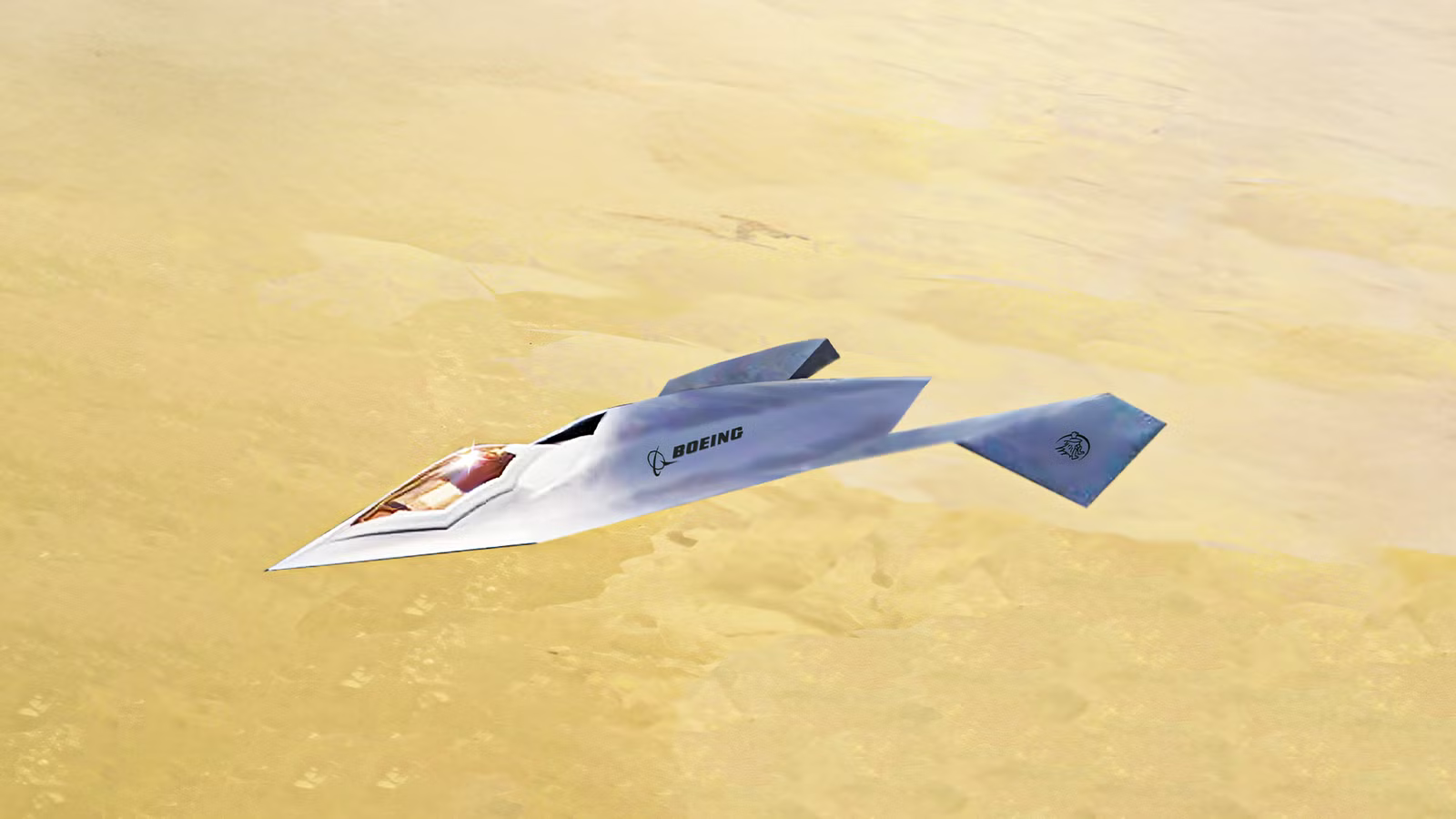
In the late 1990s,  Boeing built a unique stealth demonstrator that never carried a weapon or broke any records, and rolled on landing gear borrowed directly from a Beech King Air. The $67 million that funded the YF-118G Bird of Prey was spent entirely out of pocket as a proof of technology. Originally started by McDonnell Douglas’s Phantom Works division, the program solely aimed to prove that stealth aircraft could be designed and built on a minimal budget in a rapid timeline.
McDonnell Douglas, and later Boeing after their 1997 merger, funded the entire effort as a bet that a private company could out-design the government’s own sluggish procurement process. Rather than spending hundreds of millions developing custom components for an experimental craft, engineers treated the project like a “Frankenstein” jet, utilizing a variety of off-the-shelf and borrowed parts.
The landing gear was directly adapted from a light turboprop while the engine was a common Pratt & Whitney business jet model. While the internal components were decidedly low-tech, the airframe itself was cutting-edge. The project pioneered early 3D computerized design and cheap, ‘disposable tooling.’ The Phantom Works division proved that stealth aircraft no longer required a decade of development and a blank government check to build.
McDonnell Douglas Places Its Bet Under Pressure

The program officially began in 1992, at a critical moment when McDonnell Douglas desperately needed a major win to compete. Lockheed had already claimed the stealth spotlight with the F-117 Nighthawk and was pulling ahead again with the YF-22, and Northrop had released the B-2 Spirit’s flying-wing design to the public. According to the National Security Journal, Douglas needed to prove it could still be a major player in the future of military aviation with its own designs.
Company leadership handed its advanced projects office the assignment to demonstrate combat-capable stealth without waiting for a formal military requirement or a government competition to deliver funding. The Air Force agreed to play a supporting role, managing flight clearances and providing test facilities at the Nevada Test and Training Range near Groom Lake, but the development costs came entirely from company funds.
That arrangement gave engineers something a government program rarely offers, which was total freedom from the confines and constant requirement changes that stretch most defense aerospace efforts across many years. The tradeoff was that every dollar spent had to be justified internally to corporate leadership, which quickly set up the central design constraint that would define the aircraft. Phantom Works had to build something that successfully flew under the radar, but make it using as many commercial components as possible.
Building Stealth From Spare Parts

The Bird of Prey’s extreme frugality showed in nearly every major system on the airframe. Aside from its notoriously mundane landing gear, the ejection seat was also sourced from an AV-8B Harrier jump jet. The powerplant was a single P&W Canada JT15D-5C turbofan, the exact same engine family typically used in light business jets.
Producing roughly 3,190 pounds of thrust, this modest engine was enough to push the 47-foot-long airframe to about 300 miles per hour (483 km/h) with a service ceiling near 20,000 feet (6,096 meters). While these performance numbers were quite slow even for the era’s trainers, what the aircraft lacked in speed it made up for in strict stealth. The jet featured a blended, gapless ‘gull-wing’ shape. The control surfaces flowed directly into the wing rather than hinging off it in a way that would reflect radar energy.
On top of that, the engine intake was tucked into the spine of the fuselage so it did not present a direct line of sight to a threat radar. The composite skin was built in large, single-piece panels rather than the many smaller fastened sections typical of earlier stealth jets, cutting down on the seams and rivet lines that scatter radar returns. Still, just as important as the shape was how the team actually got there.
The YF-118G’s Area 51 Career

Boeing engineers modeled the jet almost entirely in a three-dimensional virtual environment before cutting a single part. They then used disposable tooling built specifically for a short production run rather than the expensive, reusable jigs that stealth programs had traditionally required. That digital-first, throwaway-tooling approach is widely considered more consequential than the airframe it produced. Yet, a design built this fast still had to prove it could actually fly.
The Bird of Prey first flew on September 11, 1996, and completed its 38th and final sortie in April 1999. All were out of Groom Lake, or Area 51, under a strict classification veil that kept the aircraft’s existence secret for another three years. Every one of its 38 flights was aimed at proving manufacturing and shaping concepts rather than testing mission systems. The airframe carried no radar, no weapons bay, and no combat avionics.
This was a deliberate choice that let engineers isolate the variables they cared about the most. Specifically, stealth signature and build cost, without the scheduled risk of integrating a complex fire-control system. According to the Air Force’s summary of the program, the 38 flights tested ways to make the aircraft less observable to both radar and the naked eye while also validating the large single-piece composite structures.
That rapid pace stands in sharp contrast to the multi-year program delays that had plagued Lockheed’s F-22 Raptor and would later plague the F-35 Lightning II. However, the harder test was not whether the experimental aircraft could fly. It was whether the lessons it generated would actually survive the transition into a weapons program.
From A Classified Hangar To A Losing Fighter Competition

Boeing and the Air Force declassified the Bird of Prey program on October 18, 2002, revealing it at a public ceremony where then-Boeing Integrated Defense Systems president Jim Albaugh credited the project with completely reshaping how the company approached aircraft design. The stated reason for lifting the secrecy was telling in itself.
The manufacturing techniques pioneered on the Bird of Prey had already become standard practice inside Boeing by the time the wraps came off, having migrated directly into the company’s X-32 demonstrator for the Joint Strike Fighter competitionand later into the X-45A unmanned combat air vehicle. That lineage is where the story gets more complicated than the celebratory version usually told.
The X-32 lost the Joint Strike Fighter contract to Lockheed Martin’s X-35 in October 2001, a defeat driven by a thermally stressed vertical-lift system that recirculated hot exhaust gases back into the engine, plus a wide chin intake that compromised stealth performance more than the X-35’s design.
Aviation analyses went further, arguing it is highly unlikely Boeing would have avoided the cost overruns and technical setbacks that later dogged the F-35 program even if the X-32 had won, since many of those problems traced back to the Pentagon’s own demand for a single airframe that could satisfy the Air Force, Navy, and Marine Corps at once.
In other words, the manufacturing and shaping lessons the Bird of Prey generated proved sound, but they were not enough by themselves to win Boeing a massive fighter contract when a rival’s overall system architecture was simply more mature. The techniques survived, but the specific airplane built to showcase them in competition did not.
The Shape That Outlasted The Program That Built It

The unresolved question the Bird of Prey leaves behind is not whether digital design and disposable tooling work, as that argument has been thoroughly settled for two decades. Instead, it is whether a large defense contractor and a government acquisition system built around decade-long programs of record can actually sustain the rapid pace the demonstrator proved was possible.
What did survive now sits in plain view at the National Museum of the USAF above an F-22 Raptor. The blended, angular shaping the Bird of Prey pioneered is visible in the refined contours of the F-22 and F-35. Both of which contrast with the legacy style of the faceted F-117.
The Air Force spent much of the following two decades trying to formalize the Bird of Prey’s virtual-design, rapid-tooling approach into an official military acquisition strategy. For example, Will Roper’s “Digital Century Series” concept explicitly proposed using agile software development and digital engineering to quickly field small batches of fighters on a compressed timeline before rapidly replacing them.
A Template The Air Force Is Still Trying To Recreate

While that vision for crewed fighters has since stalled in recent years, the US Air Force and Navy are now applying a similar procurement style to its Collaborative Combat Aircraft program. Under the large-scale drone initiative, advanced prototypes are moving from digital models to their first physical flights on a highly compressed timeline. The CCA Loyal Wingman drones are aiming for an eventual fleet size of 1,000 from multiple makers, modular hardware, and ‘vendor agnostic’ software.
Whether this program succeeds where the Digital Century Series stalled will say far more about institutional discipline than about stealth technology itself. The Bird of Prey never fired a weapon and never entered production, but the $67 million question it posed to the rest of the industry is still the same one the Air Force is trying to answer.
Catch what other trackers miss
Emergency squawks, holds, NOTAMs — live signals, no signup.
Open tracker
Catch what other trackers miss
Emergency squawks, holds, NOTAMs — live signals, no signup.
Open tracker