dailynewsnblog
Fall is officially here, which means that one of my favorite seasons — soup season — has made its grand entrance. After realizing this, I glanced at the blender sitting on my counter and thought, “You’re about to put in some work.”
Our Picks

Bottom Line
Why we like it:
Vitamix’s VX1 is the successor to our previous best blender overall, the Explorian, which has been discontinued and de facto …
Pros & Cons
-
Blended tough ingredients including nuts as well as any model we tested -
Self-cleaning and pulse modes -
Three ways to turn it on or off -
Large 64-ounce capacity -
Variable 10-speed control helps keep ingredients moving -
Includes a 5-year warranty that covers the motor base
-
No “high” blending option -
Not dishwasher-safe -
It’s pricey at $380 -
Limited warranty

Bottom Line
Why we like it:
The Ninja BlendBoss excelled at making smoothies and crushing ice during our testing. The personal blender has an unusual but…
Pros & Cons
-
Interesting design -
Excelled during ice and smoothie tests
-
Ideal for single servings only

Bottom Line
Why we like it:
Having tested the Ninja Twisti for five years, we love this small-yet-mighty blender, but its modest size might not be the be…
Pros & Cons
-
Built-in twisting tamper -
Compact size makes storing easy -
Includes single-serve blending cups
-
One of the loudest during operation -
Higher potential for breakage because of the extra plastic parts -
Base rocks a bit when blending at full speed -
Canister is not dishwasher-safe

Bottom Line
Why we like it:
The price of the NutriBullet Power Core XL Blender is hard to beat. This full-size unit is often found for around $85, making…
Pros & Cons
-
Most affordable blender on our list -
Simple controls -
Dishwasher safe pitcher and lid -
Large pitcher
-
Not the best choice for dry ingredients -
May need more manual help when using it with thick recipes

Bottom Line
Why we like it:
When you reach a certain level (and price), most blenders do just about everything you need, and so you have to start splitti…
Pros & Cons
-
Powerful -
Sturdy build -
Blend IQ technology works well, mostly eliminating the need to stop and stir -
Large canister
-
Most expensive on our list

Bottom Line
Why we like it:
Ninja blenders are famous for bringing big power at an approachable price, and the Ninja Professional (BL610 model) is no exc…
Pros & Cons
-
Removable blade -
Easy to use -
Dishwasher-safe parts -
Handles tough ingredients with ease -
One of the quitest during operation
-
Limited features -
Less premium feel
Although I use my blender year-round for smoothies, soup season is when it really shines. That’s why I was excited to help test and rank blenders for CNET this year. From turning chunky soups into creamy bisques to blending fibrous smoothies and creamy nut butters, we put each model through its paces to determine which blenders truly deserved a spot on our list.
Whether you’re looking for a blender you can use every morning to make a healthy smoothie or one that can tackle soups, dips and more, these are the best blenders of 2026.
What is the best blender of 2026?

Based on CNET’s hands-on testing, the Vitamix VX1 tops our list as the best blender for most people, thanks to its ability to blend dense foods such as almond butter and hummus smoothly. It has the power and ease of use we expect from Vitamix while costing $120 less than pricier models like the Vitamix 5200. It also offers a self-cleaning mode, pulse feature, cord storage and multiple ways to turn the blender on and off safely.
Best blenders of 2026

Best overall blender
Vitamix VX1
-
Blended tough ingredients including nuts as well as any model we tested -
Self-cleaning and pulse modes -
Three ways to turn it on or off -
Large 64-ounce capacity -
Variable 10-speed control helps keep ingredients moving -
Includes a 5-year warranty that covers the motor base
-
No “high” blending option -
Not dishwasher-safe -
It’s pricey at $380 -
Limited warranty
Why we like it:
Vitamix’s VX1 is the successor to our previous best blender overall, the Explorian, which has been discontinued and de facto replaced by this model. By comparison, the VX1 has a self-cleaning program, offers 0.2 more horsepower and has a capacity of 64 ounces, 18 more than the Explorian.
The 1440-watt VX1 performed the best in two tests: blending raw almonds into almond butter in 1 minute and 13 seconds and turning chickpeas into hummus in 58 seconds, making it the fastest of all the blenders we tested. This type of power shows how much a Vitamix blender can do.
While still pricey at $380, the VX1 costs $120 less than the Vitamix 5200. The two are close in specs, except the VX1 has 0.2 more horsepower, is smaller in size and has a self-cleaning program on its dial.
Who is it best for:
The 9.5 x 7.8 x 19.6-inch, 12.6-pound VX1 has a sleek, modern look and comes with a cord holder underneath, which is nice for storage. The cord itself is 3.5 feet long, so it can reach faraway outlets. Thanks to its stainless steel blades, included tamper, variable speed control with 10 speeds and pulse feature, it’s easy to blend a variety of foods.
The VX1 has a self-cleaning program: Just add a drop of dish soap and warm water, turn the speed dial to the bubble icon on the left and let it clean the blender’s container for you. (Note that more stubborn substances, like almond butter, may require scrubbing by hand with a bottle brush.)
I found this blender safe to use because it has an on/off switch under its base that must be turned on for it to work. There’s also a start-pause switch on the front of the blender and a standby mode on its speed dial that will stop the blender from mixing. This could be helpful in households with children.
Who should avoid it:
The blender doesn’t have a protective high-speed blend setting on its front panel like the Vitamix 5200, so you have to manually set the speed dial to 10, which is essential if you want to prevent the blender from overheating when blending more challenging foods or liquids. If it does overheat, you’ll have to wait 20 to 45 minutes for it to cool down.
The VX1 isn’t dishwasher-safe either, so you have to wash it by hand or rely on its self-cleaning feature. Compared to the 5200, the VX1 has two years less on its limited warranty.
During testing, the VX1 struggled only when blending ice, which compacted against the blade after 50 seconds while attempting to blend the remaining large cubes. If you regularly blend ice, consider the Ninja Professional below; it took just 7 seconds to create perfect crushed ice with no residual chunks.
- Power
- 1440W
- Dimensions
- 9.5 L x 7.8 W x 19.6 H inches
- Weight
- 12.6 pounds
- Capacity
- 64 ounces
- Speeds
- 10
- Modes
- pulse, self-cleaning
- Average decibels when blending a smoothie
- On high: 88.8 dB. On low: 58.6 dB
Best personal blender
Ninja BlendBoss
-
Interesting design -
Excelled during ice and smoothie tests
-
Ideal for single servings only
Why we like it:
The Ninja BlendBoss excelled at making smoothies and crushing ice during our testing. The personal blender has an unusual but nifty design with a blending jar that doubles as a 26-ounce travel tumbler. Once your drink is blended to your desired consistency, simply unscrew the blade top, replace it with the drinking lid and head out the door. The slim base of the tumbler also fits into most car cupholders.
The one-touch Auto-iQ program on the blender means you can hit one button, then the machine adjusts blend time and shifts speed, pauses and pulses in accordance with the program. The Auto-iQ made blending smoothies and shakes totally hands-off every time I used it. I never once had to make manual adjustments, but the option is there in a pinch.
Who is it best for:
The Ninja BlendBoss is ideal for single-serve smoothies, especially for those who want to take them on the go without creating more dirty cups or to-go tumblers.
It’s a nice option for anyone who seeks whimsy in their kitchen tools. It comes in a range of colors, including lavender lemonade, stone mint, cyberspace, blue raspberry, watermelon bubblegum and pink peppercorn, which helps it stand out from other personal blenders.
Who should avoid it:
If you want to use your blender for large batches of smoothies, soups, almond butter or dips, this isn’t the best option since the tumbler design is geared toward single servings that don’t exceed 26 ounces.
- Power
- 1100W
- Dimensions
- 6.69 D x 6.69 W x 12.91 H inches
- Weight
- 5.63 pounds
- Capacity
- 26 ounces
- Speeds
- 3
- Modes
- blend, smoothie, ice crush, pulse
- Average decibels when blending a smoothie
- Smoothie mode: 92 dB
Best mid-size blender
Ninja Twisti
-
Built-in twisting tamper -
Compact size makes storing easy -
Includes single-serve blending cups
-
One of the loudest during operation -
Higher potential for breakage because of the extra plastic parts -
Base rocks a bit when blending at full speed -
Canister is not dishwasher-safe
Why we like it:
Having tested the Ninja Twisti for five years, we love this small-yet-mighty blender, but its modest size might not be the best fit for everyone. In addition to cranking out clump-free smoothies in seconds without stopping to scrape, this blender nailed the other tests, including turning nuts into a paste and crushing ice. With 1,100 watts of operating power, there isn’t much this blender can’t pulverize in a snap.
If smoothies are the No. 1 reason you pull out a blender, Ninja’s Twisti is the best model for your money. This smartly designed, compact blender features tamper blades built into the lid that you can twist manually to loosen stuck or stubborn ingredients without stopping the motor. They work just as advertised, keeping all the ingredients moving with just a few turns of the top crank. The smoothie setting, which alternates between high and low speeds, also helps frozen fruit, nut butters, powders and liquids incorporate quickly.
Who is it best for:
The Ninja Twisti is best for smoothie lovers who want the option to make a larger 34-ounce smoothie or swap in the 18-ounce to-go cup. It’s also great if you want to use your blender to make party dips. It’s the perfect middle ground between a full-size and a personal blender, with plenty of power for whatever blending task you ask of it.
Who should avoid it:
One reason this unit isn’t atop our list is that it’s small — just 34 ounces — so it isn’t the best pick if you use your blender for large batches of soups, frozen drinks or sauces. It’s also on the loud side, and the powerful motor can overwhelm the small base, causing it to shake. Luckily, there are suction cups fixed to the bottom to keep it steady.
- Power
- 1100W
- Dimensions
- 13.62 L x 8.5 W x 12.99 H inches
- Weight
- 7.01 pounds
- Capacity
- 34 ounces
- Speeds
- 2
- Modes
- Extract, smoothie, frozen, spread, bowl
- Average decibels when blending a smoothie
- Smoothie mode: 94 dB

Best budget blender
NutriBullet Power Core XL Blender
-
Most affordable blender on our list -
Simple controls -
Dishwasher safe pitcher and lid -
Large pitcher
-
Not the best choice for dry ingredients -
May need more manual help when using it with thick recipes
Why we like it:
The price of the NutriBullet Power Core XL Blender is hard to beat. This full-size unit is often found for around $85, making it the most affordable blender on our list.
The Power Core XL took longer than some of the models we tested, but it effectively crushed ice and whipped chickpeas into smooth hummus to our satisfaction.
The center cap on the lid is useful for adding ingredients or releasing steam when blending hot soups without removing the full lid.
Who is it best for:
Because the pitcher can hold up to 72 ounces, it is a great pick for families who make large batches of smoothies, soups or blended drinks. It’s a formidable blender fit for regular use but without the high cost.
Who should avoid it:
Although the Power Core XL performs well with large batches of smoothies and soups, it struggled a little with drier, denser ingredients compared to some higher-priced options on our list. During testing, it needed more manual help when making almond butter and required extra olive oil when blending chickpeas for hummus. However, for everyday blending recipes with liquids, the blender punches above its weight, especially considering its price.
The build is also notably cheaper-feeling than a Vitamix, Ninja or Breville, but we’ve had good luck in the past with NutriBullets holding up with regular use.
- Power
- 1400W
- Dimensions
- 12.2 L x 9.45 W x 15.59 H inches
- Weight
- 10.14 pounds
- Capacity
- 72 ounces
- Speeds
- 3
- Modes
- Pulse, smoothie
- Average decibels when blending a smoothie
- On medium: 94 dB
Best premium blender
Breville Super Q
-
Powerful -
Sturdy build -
Blend IQ technology works well, mostly eliminating the need to stop and stir -
Large canister
-
Most expensive on our list
Why we like it:
When you reach a certain level (and price), most blenders do just about everything you need, and so you have to start splitting hairs. Vitamix, Blendtec, Hurom, Braun and Cleanblend all make powerful blenders you likely won’t regret buying — but what we love about Breville’s stately Super Q, beyond its performance, are the thoughtful touches. The build and materials used for this blender are sturdy and elegant, and the canister is a different, slightly silkier grade of plastic.
The Q also comes with loads of extras, but nothing superfluous. In addition to the 68-ounce canister and a staggering 1,800-watt motor base, you get a 24-ounce blending cup with its own separate blade attachment for making single-serve smoothies or soups to take on the go. There are also dozens of presets to learn, but once you do, blending becomes a very enjoyable experience.
Who is it best for:
The Super Q performed very well during our tests over the years. Previously, it shredded cheese with ease, pulverized raw almonds to smithereens and made quick, consistent work of ice and a pancake batter mix. In our most recent tests, it nearly matched the performance of our top pick, the Vitamix VX1, when blending a green smoothie and butternut squash soup, and during our ice test.
The Breville has a few blender settings and programs, but since it’s not trying to reinvent the wheel, there aren’t so many that it’ll overwhelm you.
Who should avoid it:
This is the most expensive blender we tested, but it was also the most pleasurable to use. That being said, if you’re on a budget, this probably isn’t the right pick for you. But given our prior experience with Breville kitchen appliances, we’re confident that if you do take the plunge into this premium pick, it will last you a very long time.
- Power
- 1800W
- Dimensions
- 8.15 D x 10.47 W x 17.95 H inches
- Weight
- 15.5 pounds
- Capacity
- 68 ounces
- Speeds
- 12
- Modes
- Smoothie, soup, frozen dessert, pulse/ice crush, auto clean
- Average decibels when blending a smoothie
- Smoothie mode: 58 dB
Easiest to clean
Ninja Professional
-
Removable blade -
Easy to use -
Dishwasher-safe parts -
Handles tough ingredients with ease -
One of the quitest during operation
-
Limited features -
Less premium feel
Why we like it:
Ninja blenders are famous for bringing big power at an approachable price, and the Ninja Professional (BL610 model) is no exception. The 1,000-watt blender with 72-ounce jar has simple controls and a sturdy build that makes it one of our favorite budget-friendly full-size blenders.
The BL610 excelled at blending chickpeas into hummus, turning three cups of almonds into nut butter and was even able to blend up ice without any water added in and the blade never got stuck.
One of my favorite features is the removable blade that spins up the center, so you don’t have to worry about leftover ingredients hiding under the blade. The unique design also helps blend ingredients thoroughly and keeps them from getting lodged around the bottom walls.
The removable blade on this Ninja model makes cleaning easier than traditional blender designs, but it’s sharp, so handle it with caution.
Who is it best for:
If you want a blender that can handle hearty nut butters and tough ingredients without a hefty price tag, this is about as good a value blender as you’ll find. It’s easy to clean with dishwasher-safe components and is often on sale for under $90, making it a strong budget pick.
Who should avoid it:
If you’re looking for advanced settings and a premium build, you may be happier with a Vitamix or the Breville Super Q. While the Ninja Professional delivers high-performance blending, its features are simple; to be fair, that straightforward design is one of the reasons I liked it.
- Power
- 1000W
- Dimensions
- 10.71 D x 8.27 W x 15.94 H inches
- Weight
- 7.1 pounds
- Capacity
- 72 ounces
- Speeds
- 3
- Modes
- Pulse
- Average decibels when blending a smoothie
- On medium: 87 dB
Best blenders compared
| Power | Speeds | Modes | Capacity | Weight | Dimensions | |
| Vitamix V1 | 1,440W | 10 | Pulse, self-cleaning | 64 ounces | 12.6 pounds | 9.5 L x 7.8 W x 19.6 H inches |
| Ninja BlendBoss | 1,100W | 3 | Blend, smoothie, ice crush, pulse | 26 ounces | 5.63 pounds | 6.69 D x 6.69 W x 12.91 H inches |
| Ninja Twisti | 1,100W | 2 | Extract, smoothie, frozen, spread, bowl | 34 ounces | 7.01 pounds | 13.62 L x 8.5 W x 12.99 H inches |
| NutriBullet Power Core XL Blender | 1,400W | 3 | Pulse, smoothie | 72 ounces | 10.14 pounds | 12.2 L x 9.45 W x 15.59 H inches |
| Breville Super Q | 1,800W | 12 | Smoothie, soup, frozen dessert, pulse/ice crush, auto clean | 68 ounces | 15.5 pounds | 8.15 D x 10.47 W x 17.95 H inches |
| Ninja Professional | 1,000W | 3 | Pulse | 72 ounces | 7.1 pounds | 10.71 D x 8.27 W x 15.94 H inches |
Other blenders we tested
Vitamix Explorian: The Explorian passed every blender test we ran with flying colors when we previously tested it, but because it is no longer in production, we removed it from our list.
Vitamix 5200: Variable speed and sturdy design make this Vitamix 5200 blender a popular model for luxury blenders. Though considered a high-performance blender at such a high price, we weren’t wowed enough to recommend it. It oddly struggled with cheese grating, and we found it to be noticeably louder than other models.
Vitamix Nano: Sadly, the $200 Vitamix Nano did not perform as well as the other personal blenders we tested. During our green smoothie test, it took the longest of any blender, at 3 minutes and 8 seconds, even after shaking the container a few times to help it along. On the SmoothiePilot program, it also struggled, requiring extra liquid and a few shakes to mix ingredients. With a small 20-ounce container, a gasket that is difficult to put back on after washing, a coupler that gets so hot that an oven mitt is required and a drainage hole that causes leaks (my fault) to go down the back of the blender and into the base’s air holes, the design leaves a lot to be desired.
KitchenAid Pure Power Blender: This stylish blender did well with making almond butter and smoothies and we liked that it works well with hot ingredients thanks to the vent on top of the lid that allows steam to escape while blending. At $110 from certain retailers, it’s a decent budget option, too.
Nutribullet Ultra: Although this personal blender struggled with our ice test, it did well when liquid was added in and with classic smoothie ingredients.
Beast Mini: This blends powerfully and has a sleek, modern look for under $100. The powerful Beast Mini features a 640-milliliter blending vessel, a screw-on lid and two straws for blended drinks on the go. We loved this blender and it’s held up to regular use for more than a year. One drawback is the ribbed jar, which holds onto food and can be a pain to clean.
Beast Health: The $165 Beast Health may be the best-looking blender ever, and it works well, until it doesn’t. The Beast Health’s motor gave out after about 14 months — too quickly for a blender this expensive — causing us to remove it from a top spot on this list.
Beast Mighty 850 Plus: The 850-watt blender features the same stylish design as the other two Beast blenders we tested.
Hurom Hexa Power Speed: If you’re looking for simple functionality and pure power, this is our top pick. The Hurom Hexa doesn’t have many fancy presets and functions (just smoothie, ice crush, soup and pulse) but does have 1,600 watts of power to whip the crap out of anything that you put inside. It almost feels industrial-grade and creates a vortex inside akin to something you’d see at a science museum. We also love how this blender looks with its shiny stainless-steel armor. Worth noting that it’s the tallest of the blenders we tested, so it won’t store as easily as some of the others.
Cuisinart SmartPower SPB-7CH: It’s hard to figure out what happened to this stalwart kitchen brand, but this blender model, along with other Cuisinart appliances I’ve tested lately, has been disappointing. That’s especially true given the bloated prices. The digital blender feels cheap and flimsy and yielded mediocre results in testing.
Blendtec Total Classic: This popular Blendtec blender worked well with frozen ingredients and crushed ice, making it a good choice for blending smoothies and making frozen cocktails. However, the Blendtec failed to grate cheese, and the batter mixing preset was less effective than regular blending at speed.
Hamilton Beach Power Elite: Affordability aside, this blender didn’t perform well enough to recommend. While it did have a nice glass bowl, the lid was infuriatingly hard to remove. It has only presets, so you’ll need to deduce which ones are actually low, medium or high.
Black & Decker Crush Master: This blender will work if you really need something cheap in a pinch. But don’t expect excellence. It wasn’t able to handle large frozen strawberries or evenly mix pancake batter. Still, it could suffice for small jobs.
Breville Fresh & Furious: Great looks and bonus points for a cool name, but that’s not enough to recommend this blender. Performance was average, and it struggled to mix wet and dry ingredients.
KitchenAid K400: This KitchenAid blender is beautiful, but it left something to be desired when it came to performance for that price. It has five speeds, pulse and three presets. If you have your heart set on a colorful blender with retro flair, the KitchenAid is a good option.
How we test blenders
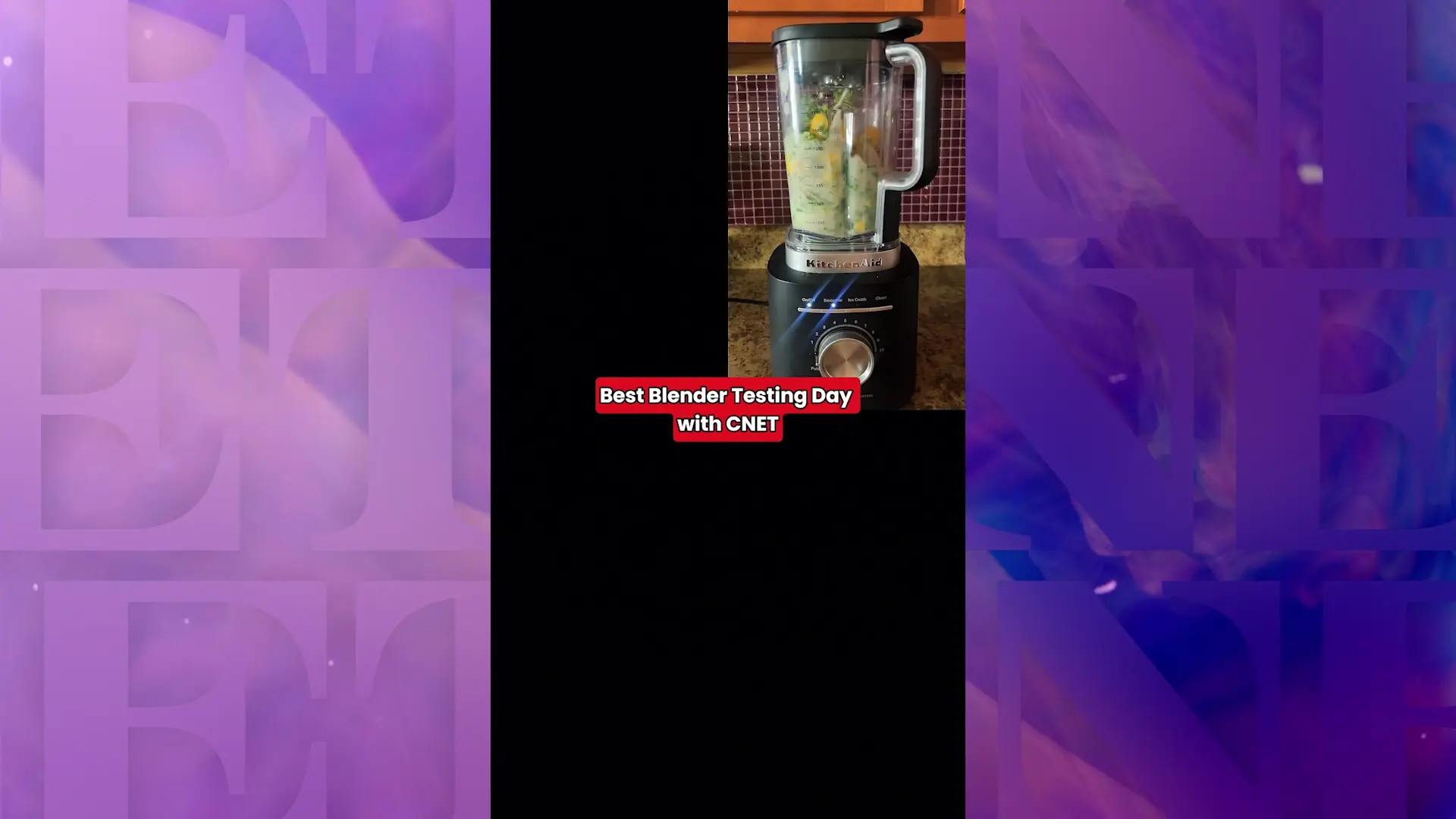
We created a test to see how well each blender could blend both wet and dry ingredients, hot recipes, dips, and crush ice.
Ice test
 Corin Cesaric-Epple/CNET
In a test of pure crushing power, we placed four cups of ice cubes into each full-sized blender and two cups of ice into each personal-sized blender to see how they’d do. We timed how long it took each model to pulverize the ice, if it could handle the task at all, and looked to see if there were any chunks left over. The Ninja Professional’s and Ninja BlendBoss’s impressive performances during this test vaulted them on to the list.
Smoothie

Next, we used a classic green smoothie recipe to see how the blenders would handle a common, everyday blending task. This shouldn’t be a big stress test for any decent blender and so it came down to speed and consistency.
While many of these tests yielded similar results, some did the job faster than others. Not all blenders come with presets, but the ones that do almost always include a smoothie function. When possible, this is the mode we used. This is a relatively easy test and most blenders handled the frozen ingredients well, especially once liquid was added.
Below are the ice and smoothie results for our winners. Although the results are slightly subjective because smoothness comes down to personal preference, the results still gave us a helpful baseline for each model.
| Ice test | How long to blend a green smoothie | Average decibels when blending a smoothie | |
| Vitamix VX1 | 26 seconds, several large cubes left over | 1 minute, 26 seconds | 88.8 |
| Ninja BlendBoss | 13 seconds on ice crush, no chunks | 55 seconds | 92 |
| Ninja Twisti | 10 seconds on frozen setting, no chunks | 1 minute, 10 seconds | 94 |
| NutriBullet Power Core XL Blender | 30 seconds, several large cubes left over | 1 minute, 11 seconds | 94 |
| Breville Super Q | 9 seconds on crush, no chunks | 58 seconds | 84 |
| Ninja Professional | 7 seconds on high speed, no chunks | 58 seconds | 87 |
Almond butter
Blenders aren’t all about beverages. There are plenty of other uses, including grinding dry ingredients. For our dry ingredient test, we used 3 cups of almonds to make homemade almond butter. This was a bit of a challenge for some blenders, but the Vitamix VX1 really impressed us with its performance: It took less than a minute to complete the task, and the included baton was extra helpful.
 Corin Cesaric-Epple/CNET
Other models that did well with this task include the Breville Super Q, Ninja Twisti, KitchenAid Pure Power Blender and the Ninja Professional, although it took just over 4 minutes for the latter pick.
In previous years, we’ve also blended an 8-ounce block of cheese and pancake batter to put the models through their paces.
We measured noise during operation because no one likes a loud blender

We measured the decibels of each blender since some models can be exceedingly loud during operation. While noise isn’t a total deal-breaker, especially considering blending tasks typically take a few minutes or less, the level factored into our final picks.
To test noise, we used a highly rated decibel reading program on our phones. We placed the microphone exactly six inches from each model in an otherwise quiet kitchen. Next, we ran each unit on high during our smoothie test and recorded the highest decibel reading.
Blender buying tips
Like most kitchen appliances, you should think about how often you’ll use it and what tasks it will be tackling the most. Many budget blenders could handle a few smoothies every summer, making them worthy of a spot since it isn’t usually worth spending hundreds on a blender you’ll only use occasionally. If you’re mixing batters, grinding dry ingredients and crushing ice on a regular basis, however, it might be wise to invest in a quality model.
Accessories
With a conventional blender, accessories can make all the difference. A blender that comes with a tamper, like the Vitamix VX1, is great for getting those last stubborn bits into the blender blades, and it’s one item I would highly recommend checking for when you buy a blender.

If you’ll be making smoothies and frozen drinks, a blender with a special set of travel blender cup containers makes getting out the door one step easier.
Full-size versus personal blenders
If you’ll only be making single-serving drinks, you may prefer having a personal blender instead of a larger, full-size one. One of the biggest advantages of a personal blender is that it takes up significantly less space in your kitchen so it’s ideal for smaller kitchens or those who want to reduce appliance clutter. They also often come with different size blending cups.
Preset preference
Next, consider your preference for specific modes versus speeds. We found some modes to be effective and helpful, while other blenders worked better when we took over and chose a speed for my ingredients, watching for when to stop. Some models offer simply low, medium and high modes. Others, like many Vitamix models, are variable, with speeds 1 to 10 on a dial. While it comes down to preference, in my opinion, you’ll have more control over your result without a preset. Yes, you’ll need to keep watch and be a bit more hands-on, but it’s easier to be sure things don’t get too blended, overheated or stop before everything is truly mixed.
Design

Blenders don’t have to be boring. Ninja’s BlendBoss, for example, comes in a rainbow of fun colors, so don’t forget to consider aesthetics if this appliance will live on your countertop.
We also recommend measuring the clearance between your countertop and your upper cabinets if you plan to leave your blender out on display. A few models we tested, including the Breville Super Q, may not fit beneath standard cabinets and would inhibit you from sliding it to the back of your counter when not in use.
Blender FAQs
What are the different types of blenders?
There are several types of blenders and each is designed for a specific use.
Full-sized blenders: This is the blender you probably imagine when someone says the word “blender.” These are the most versatile of the bunch, but they are also generally the most bulky, with blending jars as large as 72 ounces. If you do a lot of blending — soups, dips, smoothies, sauces, frozen drinks and nut butter — you’ll want a good full-sized blender.
Personal blenders: This term refers to smaller blenders such as Ninja’s BlendBoss, NutriBullet, Beast and others. These blenders have less capacity, around 24 to 32 ounces, give or take. They’re great for soups and smoothies but often have a bit less power — between 900 and 1,000 watts — so they’re not as good for dense ingredients like nuts.
Immersion blenders: These handheld versions of the blender have one main use: to puree a soup or sauce that’s already in a pot. An immersion blender saves you from having to transfer hot liquids from a pot to a blender jar. Though some cost a pretty penny, many serviceable immersion blenders start as low as $30.
Portable blenders: These blenders are so small that you can take them with you on the go. They often run on battery, so you can blend anywhere — the beach, at your desk or after the gym. BlendJet is a popular brand and its teeny-weeny blenders cost around $60.
What is the difference between a blender and a food processor?
While a blender and food processor are similar at first blush, they are used for distinctly different kitchen and cooking jobs.
Blenders generally have one fixed blade designed to puree or whip ingredients into a liquid or smooth paste. Classic examples are smoothies, soups, sauces and nut butters. Food processors, on the other hand, generally have a set of blades for different tasks — they’re best when they step in for your knife. Most food processors can chop, dice and mince. They can also grate and shred if you need a lot of cheese or are making coleslaw from scratch.
While they won’t do each other’s tasks well, you can buy blenders with food processor attachments, including this $200 Ninja MegaSystem (includes blender) or this $250 Vitamix food processor attachment (does not include blender) that works with Ascent and Venturist models.
How much power should a blender have?
Wattage and horsepower are the two most common ways to measure a blender’s power. 1 horsepower is equal to roughly 746 watts. According to Vitamix, “most countertop blenders get the job done with 1-2 horsepower.”
Wattage in premium and super-premium blenders can go as high as 2,000, though most are somewhere between 1,400 and 1,800 watts. This amount of power means you’ll likely get a longer life out of the blender since it won’t have to rely on full power to do the easier, daily blending jobs. It also means faster blending since the blades can reach higher speeds.

See full bio

See full bio

See full bio