dailynewsnblog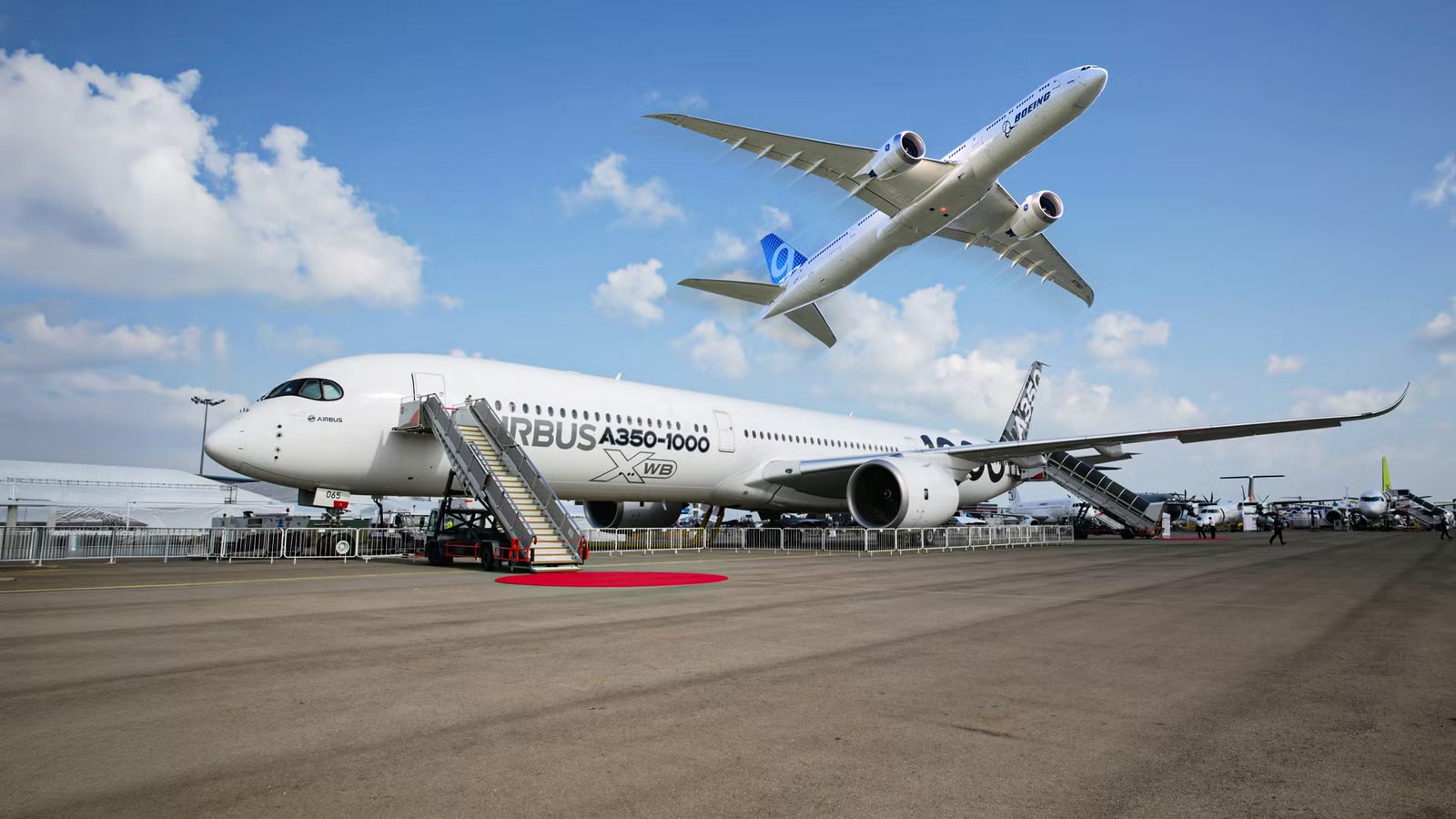
When the Boeing 777-9 finally enters commercial service, it will become the largest twin-engine airliner ever built. By then, however, its main rival will already have spent nearly a decade carrying passengers, building a global customer base, and proving itself on some of the world’s longest routes. That unusual timing means the contest between the 777-9 and Airbus A350-1000 is not about which widebody aircraft is better on paper. It is about whether Boeing’s larger, higher-capacity design can overcome Airbus’ years-long operational head start.
We will compare the two aircraft by looking beyond seat counts and range figures. Capacity, operating economics, engine technology, certification timelines, real-world route suitability, and airline order books all point to different strengths, explaining why some carriers have committed to the 777-9 while others continue expanding their A350-1000 fleets. Together, those factors reveal which aircraft holds the advantage on paper, which already delivers in service, and how the rivalry is likely to shape the long-haul market throughout the 2030s.
The Spec Sheet: What 426 Seats And 700 Nautical Miles Actually Buy You

On its official specifications page,  Boeing lists the 777-9 with a two-class capacity of 375 to 450 seats, depending on airline configuration, while Airbus lists the A350-1000 at 350 to 410 seats in a typical three-class layout. On range, Boeing recently bumped its advertised figure for the 777-9 up to 8,000 NM (14,816 km), from the long-standing 7,285 NM (13,492 km). The A350-1000 still edges it out at up to 8,700 NM (16,112 km), per Airbus and
  British Airways fleet documentation.
Do the math on that capacity gap, and it works out to roughly 16% more seats on the 777-9, which is a meaningful margin in seat-mile cost, per aviation analysis firm AirInsight. Airbus counters with weight and materials. The A350-1000 relies heavily on advanced composites, with Airbus stating that 53% of the aircraft’s structure by weight uses carbon-fiber reinforced polymer, helping reduce weight, fuel burn, and maintenance requirements over the aircraft’s lifetime. Neither advantage cancels out the other: Boeing’s larger cabin spreads costs across more seats, while Airbus’s lighter airframe reduces the cost of moving the aircraft itself, which is why the 777-9 and A350-1000 remain closely matched rather than producing a clear winner.
There’s also a trick Airbus can’t match. The 777-9’s wingspan of 235 feet, 5 inches (71.75 meters) is the largest ever fitted to a commercial jet, wide enough that it wouldn’t fit standard Code E airport gates built to a 213-foot (65 meters) limit. As previously written on Simple Flying, Boeing’s solution is a hinge roughly 11 feet from each wingtip that folds upward on the ground, shrinking the span to 212 feet, 9 inches (64.85 meters) in about 20 seconds, enough to slot into any gate built for a 777-300ER or A350. Airbus never needed the trick, since the A350-1000’s 64.75 m span already fits Code E without modification, but Boeing says the extra wingtip length in flight is worth roughly 20% lower fuel use and emissions versus the 777-300ER it replaces.
Six Years And Counting: The Delivery Gap That’s Already Decided Half The Market

 Qatar Airways put the A350-1000 into service in February 2018. The 777-9 first flew in January 2020 and, as of Farnborough International Airshow 2026 report, still isn’t certified. Boeing is now targeting first delivery to launch customer
  Lufthansa in 2027, about seven years behind the original schedule.
That delay is a big inconvenience for Boeing as it has changed how carriers are planning their fleets, according to Simple Flying’s comparison of  Emirates, Qatar Airways, and
  Singapore Airlines‘ first class products tracks in detail. Airbus has spent the wait selling jets: as of June 2026, the A350-1000 had racked up 367 total orders and 114 deliveries, with
  Air Canada adding eight firm orders as recently as February 2026.
Specification |
Boeing 777-9 |
Airbus A350-1000 |
Typical capacity |
375-450 (2-class) |
350–410 (3-class) |
Range |
Up to 8,000 NM (14,816 km) |
Up to 8,700 NM (16,112 km) |
Engines |
2x GE9X, 110,000 lbf each |
2x Trent XWB-97, 97,000 lbf each |
MTOW |
~352 tonnes (776,000 lb) |
~308–322 tonnes (679,000–710,000 lb) |
In service since |
Not yet (targeting 2027) |
February 2018 |
Boeing’s test program isn’t standing still either: more than 4,800 flight hours across roughly 1,700 test flights, and a noticeably more confident tone from Boeing executives at this year’s Farnborough than in prior shows. Certification itself happens in stages: function-and-reliability testing, extreme-weather trials, and FAA/EASA joint sign-off all have to close out before Boeing can hand over a single jet, and the 777-9 is still working through the tail end of that sequence as of mid-2026. But confidence doesn’t fill a delivery slot, and every extra month of certification is a month the A350-1000 spends with no direct competitor in this size class.
Inside The Engines: 110,000 Pounds Of Thrust Vs. An Efficiency Bet

The General Electric GE9X is the largest and most powerful jet engine ever certified for airline service, rated at 134,300 lbf (597 kN) — its fan is physically wider than a 737 fuselage. A previous Simple Flying article broke down exactly why that scale exists: nothing else on the market generates enough thrust to move an aircraft the size of the 777-9, which is why Boeing, unlike with the earlier 777, offers no alternate engine option here.
That scale came at a cost. Simple Flying has also reported on an engineering flaw inside the GE9X that grounded test flights during certification, a reminder that record-setting thrust and fan diameter don’t come free.
The Trent XWB-97, at 97,000 lbf (431 kN), looks modest by comparison, but it’s a known quantity. It’s derived from the Trent XWB-84 already flying on the Airbus A350-900, sharing a maintenance network, spare-parts pool, and mechanic training pipeline with fleets that have racked up millions of flight hours. That shared DNA matters commercially: airlines that already operate A350-900s can bring A350-1000s onto the same maintenance contracts and technician pool, something no 777-9 operator will be able to do until GE9X-rated shops exist at scale. Airbus never tried to build the biggest engine. It built the one that was already working.
Catch what other flight trackers miss
Emergency squawks, holds, NOTAMs — live signals, no signup.
Open tracker
Catch what other flight trackers miss
Emergency squawks, holds, NOTAMs — live signals, no signup.
Open tracker
Where Each Aircraft Actually Wins: The Route-Length Crossover

Most coverage flattens the topic into “bigger versus more efficient.” It’s really about route length. On dense trunk routes running near-full—  Dubai International Airport (DXB) to
  London Heathrow Airport (LHR), DXB to
  New York JFK Airport (JFK), the kind of corridors Emirates built its whole model around — the 777-9’s extra 50 to 80 seats lower the cost of flying every passenger, full stop. If the seats sell, the math favors Boeing, with aviation consultancy AirInsight arguing that the aircraft’s roughly 16% seating advantage translates directly into lower seat-mile costs on high-demand routes.
Stretch the route, though, and the math flips. Simple Flying’s own range analysis shows the A350-1000 still beating the 777-9’s advertised range even after Boeing’s recent revision, and that gap matters enormously on routes where filling 426 seats isn’t realistic but covering the distance is non-negotiable. It’s why Qantas picked the A350-1000ULR, not the 777-9, for  Sydney Kingsford Smith Airport (SYD) to LHR under Project Sunrise. The Flying Engineer’s 2026 comparison of the two aircraft also highlights another advantage Airbus enjoys today: maturity. It notes that the A350-1000 has established dispatch reliability above 99% after years of airline service, while the 777-9 has yet to build a comparable operational record because it has not entered commercial service. Until that service history exists, airlines with limited tolerance for schedule disruption have one fewer reason to wait.
Put real distances on that crossover and the pattern becomes clearer. Dubai to London is roughly 2,900 nautical miles (5,370 km), comfortably within both aircraft’s range, so seating capacity becomes the deciding factor, giving Boeing the advantage if demand supports it. Perth to London, by contrast, is approximately 7,800 NM (14,450 km) one way, pushing into the territory where maximum range becomes the primary design constraint. That is precisely the mission profile Qantas reserved for the Airbus A350-1000ULR under Project Sunrise, underscoring Airbus’ focus on extreme endurance rather than maximum passenger capacity.
The Order Book Vote: Who’s Buying What, And Why

Order books are the closest thing this industry has to a live poll, and right now they favor Boeing. The 777-9 has more than 520 firm orders, led by Emirates (270 aircraft) and Qatar Airways (124), with Singapore Airlines, Cathay Pacific, All Nippon Airways, Lufthansa, British Airways and Korean Airalso among its customers.
The A350-1000, meanwhile, has accumulated around 370 firm orders, with more than 110 already delivered and the remainder still in Airbus’ backlog. Recent commitments from carriers including  Riyadh Air and Philippine Airlines continue to expand that total.
Metric |
Boeing 777-9 |
Airbus A350-1000 |
Firm orders |
350–400 |
367 |
Delivered |
0 |
114 |
Top customer |
Emirates |
Qatar Airways / Cathay Pacific |
Simple Flying’s breakdown of the most spacious widebody business class seats illustrates why Gulf carriers keep competing for the largest twin-engine jets they can get certified: more cabin real estate means more room to install the wider, more private suites that justify premium pricing — and premium pricing is where widebody economics actually work.
What This Means For The 2030s

Neither jet wins outright, whatever the headlines want you to believe. The 777-9 will own the highest-density trunk routes, the ones Emirates and Qatar Airways already fly full today. The A350-1000, and its ultra-long-range ULR sibling, keeps the thinner, longer sectors — Simple Flying’s coverage of the A350-1000ULR’s range advantage covers exactly how much extra range that variant unlocks over the 777-9.
Remember this one number: by the time Boeing delivers its first 777-9 in 2027, Airbus will likely have well over 150 A350-1000s flying, each with close to a decade’s worth of reliability data no order book can buy. That head start, not the spec sheet, is what will actually shape fleet decisions through the 2030s.
What happens after that first delivery is the more interesting question. If Boeing hits its 2027 target and the GE9X’s early reliability holds up under real airline schedules, the order gap could widen further in its favor by the early 2030s, especially as Emirates and Qatar Airways start replacing aging 777-300ERs at scale. If it slips again, expect more carriers to quietly do what several already have: extend older jets a little longer and let Airbus keep filling the gap.