dailynewsnblog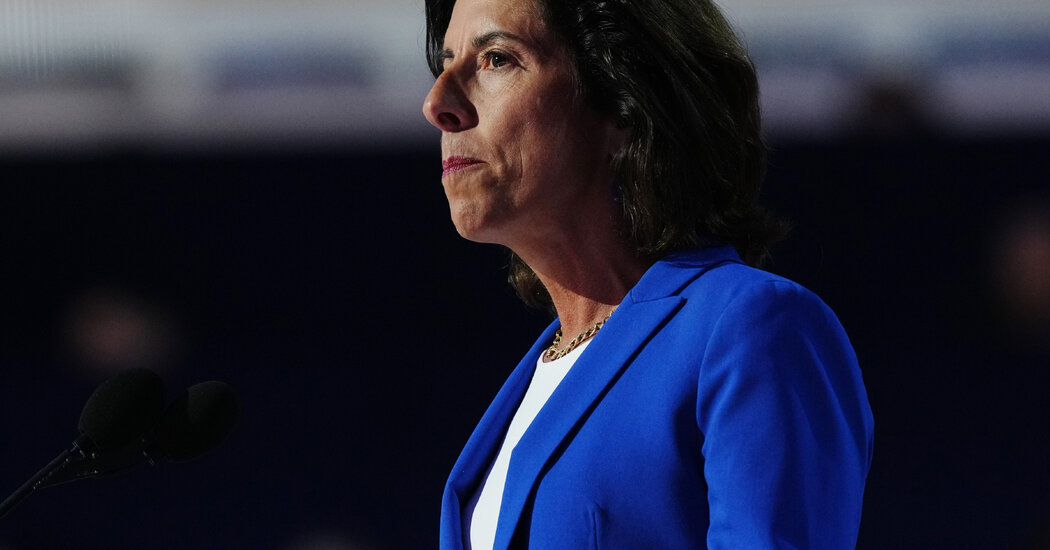
Congress has failed to address the work force disruption that artificial intelligence could generate. The White House, excited about the upside for stocks and investment, has downplayed the potential for widespread job losses.
Now, amid growing public anger over A.I. and a debate over how to regulate it, a group of employers, state governors and foundations has raised $500 million to try to answer some of those questions themselves.
The funders include A.I. labs preparing to go public, like OpenAI and Anthropic, as well as established corporate giants such as Bank of America and Amazon. Their new nonprofit, called Raise Us, is led by Gina Raimondo, a former commerce secretary and Rhode Island governor who since leaving office has called for companies and the government to do more to orient American workers in a new A.I. era.
“This is an independent effort,” Ms. Raimondo said. “It’s the first one I know of where competitors in the tech industry have put aside their competition to say, ‘We’re going to write big checks and, in the service of our country, do what we can to figure out this transition.’”
Estimates of the magnitude of job dislocation in store for the American work force vary widely, from half of all entry-level white-collar jobs to a few thousand jobs here and there. Although layoffs are currently very low across the economy, the employee ratings site Glassdoor has found that worker sentiment toward A.I. has been worsening. Companies have made headlines by citing A.I. as a reason for deep job cuts. They include Workday and IBM, which are part of the new nonprofit, as well as Meta and Oracle, which are not.
The organization will work primarily with governors, starting with those in Utah, Arkansas, Maryland and Connecticut. The theory: States generally control their community college systems, which can translate work force policy through course offerings and industry partnerships. The bulk of the budget will fund pilot programs overseen by about 15 staff members and consultants.
For example, Maryland will establish a “service year” for recent high school graduates to provide experience in fields where there are shortages, such as health care. In other states, Raise Us hopes to offer “wage insurance” for workers who take lower-paying jobs rather than dropping out of the work force entirely.
The group plans to furnish technical assistance for companies that want to retain workers as A.I. changes their roles, rather than eliminating them. Microsoft, one of the companies backing the organization, said it had already found a promising model: cross-training its entry-level lawyers in different parts of the organization and equipping them with A.I. skills in order for them to be repositioned as technology evolves.
“You can think of doing that with almost any job we have,” said Brad Smith, vice chair and president at Microsoft. “It creates an opportunity to transfer people from jobs that are being eliminated to jobs that are being created.”
Retraining displaced workers has always been a difficult task, and historically not a very successful one. Ms. Raimondo called past efforts “ineffective.”
Sam Manning, a senior research fellow with GovAI, a think tank, said the new group’s work offered a new opportunity to learn about what could work best.
“This model — of let’s work within states and try to do pilots and demonstration programs, build more evidence, learn what works for different types of workers with different constraints — does seem to me like a pretty good thing to do,” Mr. Manning said.
Congress has slashed funding for its flagship work force development law since passing it in 1973. Planned overhauls of the statute have sputtered out. Research has found that while federal work force programs do help place workers in new jobs, their long-term success is limited by the lack of high-paying positions for workers without college degrees.
Jane Oates ran the Labor Department’s Employment and Training Administration under President Barack Obama. Despite funding cuts, she said, states as disparate as Texas and Massachusetts have found ways to raise private capital and work with employers to meet their talent needs.
“I don’t know that she’s been anywhere else to look at the amazing, innovative things that are done in small and large places around the country,” Ms. Oates said of Ms. Raimondo.
Part of the Raise Us mission is to adapt existing budgets to the particular challenges of A.I.-driven disruption. The nonprofit includes a policy lab, funded by philanthropies rather than corporations, that will incubate new ideas that governments may carry out down the line.
Ms. Raimondo also serves as a chair on a commission, organized by the right-leaning American Enterprise Institute and the left-leaning Urban Institute, that will come up with policy recommendations to address the effect of A.I. on the work force and the demands it may create. That effort is funded by Google.
On the policy front, the groups join a crowded landscape. The air has been thick in recent months with proposals for minimizing the potential downsides of A.I. while harnessing its benefits.
Senator Bernie Sanders of Vermont has suggested confiscating half of the stock value of top A.I. companies and depositing it in a publicly owned fund. Others have floated the idea of shifting the tax burden from payroll taxes to the computing power that is necessary to run sophisticated A.I. models. The Raise Us board includes Liz Shuler, president of the A.F.L.-C.I.O., the labor federation, which has a technology institute that has emphasized protections for workers as A.I. develops.
Ms. Raimondo’s initiatives, underwritten by corporations that have much at stake, may seem ill positioned to make recommendations that would burden the engines of America’s A.I. dominance. But Harry Holzer, a professor of public policy who is part of the joint American Enterprise Institute-Urban Institute commission, said its members would not shy away from doing so.
“I don’t think we’re going to hesitate to talk about resources,” Mr. Holzer said. “If the A.I. companies and tech companies start making money hand over fist, there might be an excess-profits way of dealing with that.”
Ms. Raimondo and her colleagues are not fans of a universal basic income, an idea that has gained popularity in Silicon Valley as an answer to job disruption. They emphasize that work provides more than just wages, and plan to focus on helping people find pathways to new jobs.
But it’s unclear whether A.I. will create jobs at the rate that it will destroy them. Jack Malde studied work force policy for the Bipartisan Policy Center and is now going to work for the Windfall Trust, another A.I.-focused think tank. He said long-term income support might be necessary, even if better models for transitioning workers were found.
“The truth is, there’s still a lot of uncertainty,” Mr. Malde said. “What we think is resilient now might not be resilient later. We’re not going to get everything right, so we’re going to need those strong safety-net programs.”
Eventually, the backers of Raise Us think, federal action will be necessary to replicate successful policies across states and employers who aren’t early adopters. Ms. Raimondo said she had been in touch with the acting labor secretary, Keith Sonderling, whose department is establishing its own data hub for A.I. effects.
But at the moment, she thinks that there’s no time to wait for alignment from Washington. As a historical parallel, she cited the Committee for Economic Development, an organization formed by big businesses in 1942 with the goal of absorbing American soldiers back into the economy after World War II ended and defense production was scaled back. It encouraged ways to fight inflation and foster full employment, helping to head off postwar stagnation.
“I think this technology will lead to more productive people, new jobs and new industries, and I want to get there,” Ms. Raimondo said. “But I also worry about the transition, and a window where people could get hurt. The politics could get uglier. So I just want to get started now to build the infrastructure to be prepared to manage the transition.”