dailynewsnblog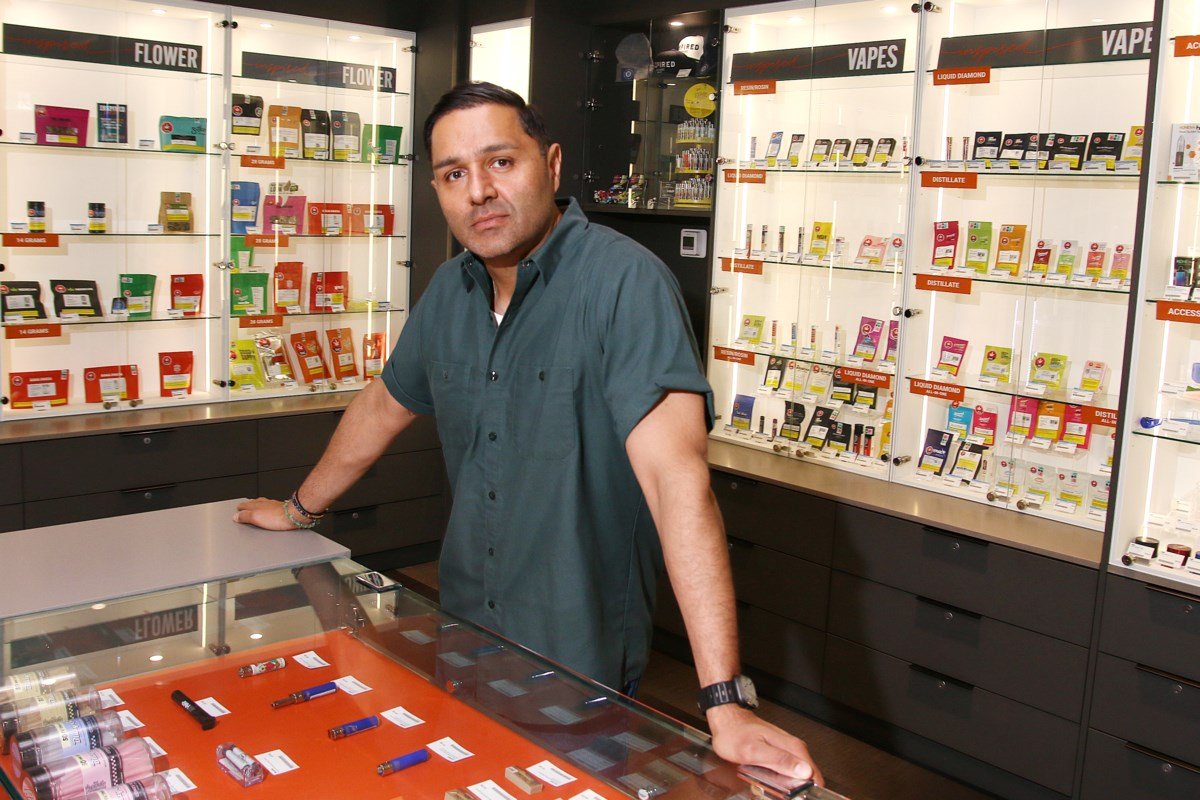
Data hints that buying legal weed in B.C. may have lost the cache of being an exciting novelty.
Overall cannabis wholesale sales and volume in the province in the first quarter of this year was down slightly, following years of significant growth.
The trend coincides with a decline in consumer eagerness to join cannabis protests, or celebrations.
Before Canada legalized recreational cannabis sales in 2018, the Vancouver Sun estimated crowds of up to 25,000 people celebrated 4-20 Day on April 20 by congregating at Vancouver’s Sunset Beach.
This year, that celebration of weed was far smaller.
A crowd that CTV estimated to be in the hundreds gathered on the north plaza at the Vancouver Art Gallery, to mark the day.
“It’s not a major event for us,” president of Inspired Cannabis Co. Mandesh Dosanjh said of the April 20 celebrations.
His company has a store less than two blocks from Robson Square.
“It’s becoming less of a ‘holiday,’ so to speak,” Dosanjh said.
The government’s cannabis distributor, the British Columbia Liquor Distribution Branch (BCLDB), released data that quantifies waning excitement about buying legal cannabis.
Its data shows the gram equivalent of all cannabis products sold wholesale to retailers in B.C. in the three months ended March 31.
Those wholesales were down 0.1 per cent by volume and 0.8 per cent by dollars, compared with the same quarter in 2025, BCLDB data showed.
This indicates the era of big sales gains is at least taking a pause.
Go back to the first three months of 2025 and the gram equivalent of all cannabis wholesales was up 12.7 per cent by volume and nine per cent by dollars, compared with the first quarter in 2024, and 36.2 per cent by volume and 20.3 per cent by dollars compared with the first three months of 2023.
Waning sales has come as retail competition intensifies.
There were 528 legal retail cannabis stores operating in B.C. at the end of March, up 2.9 per cent year over year, according to the BCLDB.
Some stores closed, but 28 cannabis retail stores were newly licensed between April 1, 2025, and March 31, 2026, and remained active as of April 30, 2026, B.C.’s Ministry of Agriculture said in an email.
Dosanjh said his company opened two of those new stores in late 2025 to reach the maximum eight stores that any one operator can own within the province. His company has a total of 25 cannabis stores across Canada.
Inspired Cannabis’ stores were both in Surrey, and were long planned, so the decision to open them came when cannabis wholesales provincewide were booming.
The problem in opening them was that the City of Surrey did not allow legal cannabis store applications until April 2024, and did not approve any legal cannabis stores until April 2025.
“We had those leases for over a couple of years,” Dosanjh said. “It was a bet we made early on. We knew that at some point Surrey would open up, so we made a strategic decision to secure some leases. In some cases we were paying rent for quite some time.”
Alcohol remains British Columbians’ preferred legal intoxicant
Many anticipated that when the federal government legalized adult cannabis use that wholesales and tax revenue from them would be substantial.
The B.C. government sold $561,127,019 worth of cannabis wholesale in the fiscal year ended March 31. Its most recent budget estimate was that the federal government would provide $128 million to B.C. as the province’s share of federal excise tax collected for cannabis sales in B.C.
Dollars spent wholesale on cannabis is far less than equivalent spending on alcohol in B.C.
The value of all wholesale cannabis products—dried flower, edibles, vape-sticks, pre-rolls, drinks, lotions, seeds and others —in the first three months of this year totalled $142,853,711, according to the BCLDB.

Wholesales for beer in B.C. in those months totalled $216,669,105, which was 51.7 per cent higher, according to the BCLDB.
Wholesales for wine—$227,557,679—were 59.3 per cent higher than cannabis wholesales in that time period.
Even spirits wholesales in B.C. in that quarter were 35.3 per cent higher than cannabis wholesales, at $193,288,607.
Refreshment beverages, which generated $89,024,921 in wholesales in the first three months of this year, were the only alcohol category to have wholesales that failed to exceed those of cannabis.
In total, alcohol wholesales in B.C. in the first three months of this year were $726,540,312, or more than five times that of cannabis, according to the BCLDB.
Microproducers see huge sales spike
A glance at recent BCLDB cannabis wholesales data leaves the impression that small craft cannabis producers are making proverbial hay.
Producer Josh Beckett, who co-owns Magi Cannabis on Salt Spring Island, said the reality is more nuanced.
The B.C. government started allowing growers who annually produced up to 3,000 kilograms of cannabis, and who held certain federal licences, such as one for microproducers, to sell directly to retailers starting in August 2022.
The idea for producers was that by bypassing the BCLDB distribution system, their cannabis could be delivered faster, and be fresher.
They still need to pay the BCLDB the same fees as they would if the government distributed their weed, but many small producers still saw advantages to doing their own distribution.
The B.C. government in August 2022 also allowed those producers to sell directly to consumers via on-site stores.

Wholesales under this so-called “direct delivery” program steadily gained traction, and then started to skyrocket in recent quarters.
They rose 684.7 per cent year-over-year in the last three months of 2025, when for many weeks product deliveries were not possible through the BCLDB because of BC General Employees Union picketing during its strike.
That meant microproducers’ cannabis was the only supply line for stores.
That phenomenal growth continued in the first three months of this year even though there was no BCGEU strike.
While only comprising $17,751,975, or about 12.4 per cent of all cannabis wholesales to retailers in the province in the first three months of 2026, the direct-delivery category’s growth rate was a staggering 643.3 per cent. It was up from a mere $2,388,142 in the same quarter one year earlier.
Beckett said the federal government deserves credit for fuelling this phenomenal growth.
It increased the amount of cannabis that licensed microproducers could annually produce: from 600 kilograms to 2,400 kilograms, starting in March 2025.
It also increased the permitted growing area that these producers could use, from 200 square metres to 800 square metres, starting in March 2025.
That means that microproducers were under different regulations in the first three months of this year, versus the same period last year, explained Beckett.
Some small producers might have expanded production but not many, he said. That is because the cost to expand is significant, and it can still be a challenge to find financial institutions willing to lend to legal cannabis growers, he said.
“What you saw instead was standard [licensed] facilities, which were small enough to fit within the new micro-licence class, change their licenses,” Beckett said.
Changing licence classes gave those businesses tax advantages and newly enabled them to sell into B.C.’s direct-delivery program, he said.
The microproducer licence class is increasingly popular.
Of 920 active federal cannabis licences at the end of 2025, 485 were microproducer licences, according to Health Canada.
Microproducer licences were also the most common type of new federal cannabis licence issued in 2025, with 76 of 102.
Consumers shift to edibles, pre-rolls, away from dried flower
Long before a wide array of cannabis products evolved to be convenient to buy, most people who thought of cannabis likely envisioned dried flower buds.
That may now be passé.
Only about 28 per cent, or $40,033,224, of all cannabis wholesales in the first three months of this year were for dried cannabis flowers, or buds.
Dried flower wholesales have also waned in popularity.
Wholesales for that product category fell 9.1 per cent in the first quarter of this year, compared to the same quarter last year.
Today, the cannabis category attracting the biggest share of wholesale dollars, at more than 38.3 per cent, or $54,762,503, is inhalable extracts. This was also one of the few cannabis categories where wholesales in B.C. increased: 1.7 per cent year-over-year in the first quarter of 2026.

Leading the way in that broad category are vaporizer cartridges. They comprise more than one-third of the inhalable extracts category, are popular and are misused, said Evergreen Cannabis owner Mike Babins.
“They are tolerance killers,” he said of the vaporizers.
“People don’t realize with these pens that one puff is the same thing as smoking a whole joint. People go to town on them. One cartridge should last the average person a month but most users go through a cartridge in two days. It’s more [of the active ingredient] THC than you could actually absorb. So it’s in your head and it is not getting you any higher but people just burn through them and keep spending more and more money.”
Infused pre-rolls are another sizable component within the inhalable extracts category that is growing.
They are much like regular pre-rolled cannabis joints but they come infused with flavours, such as watermelon.
Whether customers buy infused pre-rolls or standard ones, Babin said, they are often doing it for convenience.
He urged customers against buying pre-rolls because he said he believes the quality of the ingredients is substandard.
“I could sell you a whole flower, a nice fresh bud,” he said. “If it’s a pre-roll, producers could literally take the scraps that we would have swept away, roll it up and charge an outrageous premium.”
To encourage dried flower sales, he said his Kitsilano store has a rolling station and staff to help novice customers roll joints.
Dosanjh, in contrast, said he believes pre-rolls have a bad rap.
Quality has markedly improved, he said, adding that the number of complaints he has had about pre-rolls has sharply declined.
That goes for infused pre-rolls and regular ones, he said.
Regular pre-rolls, which are not infused, netted $31,216,368, or about 21.9 per cent of cannabis wholesales in the first quarter. They remain popular, enjoying 4.8 per cent year-over-year quarterly wholesales growth, according to the BCLDB.
Edibles only generate 6.5 per cent of wholesale dollars spent on cannabis, but it is the fastest growing category, with wholesales increasing 12.8 per cent year over year in the quarter, to $9,257,047.

Health Canada has helped fuel edibles’ sales growth, Babins said, because in March 2025 it started allowing producers to combine up to 10 individually wrapped 10-milligram THC edibles into a single larger package—something that could entice consumers seeking volume discounts.
Previously, customers could still have bought 10 of those edibles, but they would have had to buy 10 individual packages, Babins added.
Gummies or chewable edibles are by far the biggest component of this category, according to BCLDB data.
Babins backed that up, saying customers far prefer a chewable edible to chocolates, brownies or other products.
He said most cannabis he sells is craft cannabis through the direct delivery program.
In some cases that means his store can have exclusive products.
Obtaining that cannabis has also become more convenient for Babins because in some cases multiple craft-cannabis producers collaborate to use the same sales platform.
Business at Babins’ Evergreen Cannabis has been challenging due to the economy, he said.
“It’s been really rough,” said Babins. “It’s no surprise that people do not have a lot of money to spend these days, and they’re being very careful with it, and nobody knows what the future holds financially, so people are being very careful.”
[email protected]
Bluesky.com/glenkorstrom.bsky.social