dailynewsnblog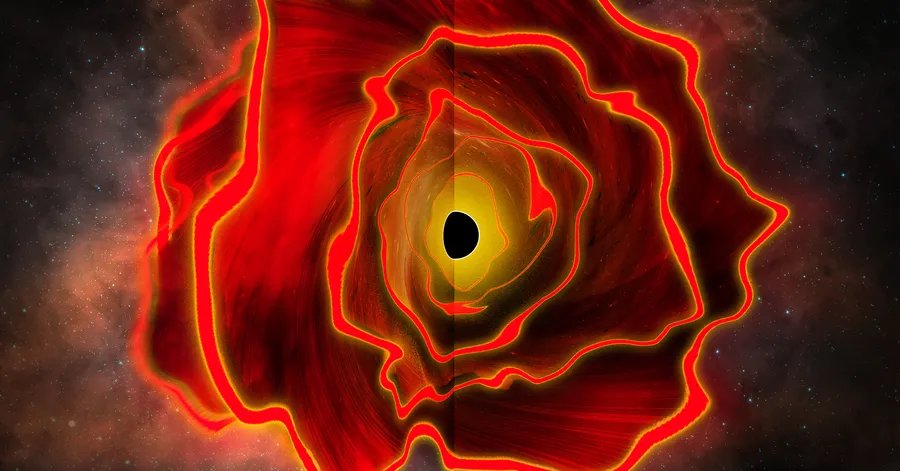
When Soundgarden Wrote “Black Hole Sun,” they may have inadvertently been onto something.
In a new paper in Nature, scientists have chronicled a “black hole star” that’s the size of our solar system and glows bright red in the depth of space. The findings are based on observations from the James Webb Space Telescope, which continues to change how astronomers think about the cosmos.
Researchers focused on some of the most distant observable phenomena in the universe, which appear to be something like a star in disguise. Based on the light they emit, they appear to share some characteristics with giant stars, but astronomers suspect they are actually black holes shrouded in an extraordinarily dense and luminous gas.
These hypothetical objects have been dubbed black hole stars, and the new research, published Wednesday, lays out the case for them.
The signal that’s at the center of the study comes from a time when the universe was just 660 million years old. (It’s now almost 14 billion years old.) In the JWST images, the object appears as one of the many bright, reddish spots that the telescope has found in the early universe.

From a distance of billions of light-years, this phenomenon appears to be a gigantic star. But the object, known as MoM-BH*-1, has a few curious properties. It emits about 100 billion times more energy than any star could produce through nuclear fusion, according to the team. Even for the era in which it formed—during the early universe—it is an extremely bright object.
Furthermore, part of its light abruptly disappears. Stars can produce a similar signal when their atmospheres absorb certain wavelengths, but in MoM-BH*-1, the effect is too intense to be explained as normal star behavior. Researchers believe that an enormous amount of extremely dense gas is absorbing that light.
These clues led scientists to the black hole star hypothesis. At the center of MoM-BH*-1, there would be a black hole devouring matter and releasing enormous amounts of energy. Surrounding it, a massive gas envelope. The energy would pass through that gas before escaping into space and, in the process, would acquire some of the characteristics we would normally expect to find in starlight.
The hypothesis could help address another mystery uncovered by the JWST. The telescope finds, with surprising frequency, small red spots in the early universe whose origins remain uncertain. They don’t fit neatly into the usual categories of objects in deep space. Scientists have put forward a number of explanations, including that they’re compact galaxies teeming with stars, black holes hidden by dust, and systems completely different from those we observe in the present-day universe.