dailynewsnblog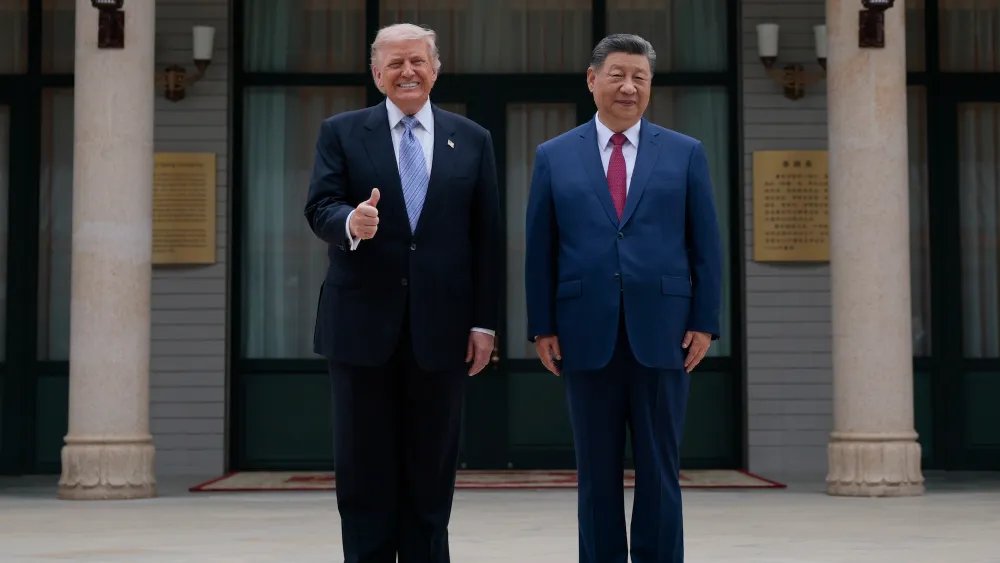
Even as the high stakes meeting in Beijing concluded on Friday, and President Donald Trump boarded Air Force One having established a veneer of friendship with Chinese President Xi Jinping, describing it as an “incredible visit” in which “a lot of different problems” had been settled, business heads and economists across Asia were watching with some unease.
Countries around the region have been trying to gauge how a thaw between the two economic superpowers could affect them—both in terms of destabilizing the regional balance of power and in terms of trade. Given an already fragile global situation, with the Middle East war affecting energy and gas prices, Asian nations worry that unpredictable shifts in the U.S.-China trade war or sudden tariffs could trigger another regional economic downturn.
It is no secret that U.S.-China hostility redirected apparel and manufacturing orders away from China, with Vietnam and Bangladesh becoming major beneficiaries. India, Cambodia, Sri Lanka and other sourcing nations have also been among the winners. Asian exporters now fear that any Trump-Xi stabilization could slow that momentum or push some sourcing back toward China’s larger industrial ecosystem.
Since President Trump’s last state visit to Beijing in 2017, the stakes have become much higher for the region, as U.S.-China geopolitical friction intensified, including economic hostility marked by threats of reciprocal tariffs of up to 140 percent on Chinese goods.
The last two days appear to signal a possible change in tone.
Speaking at the Great Hall of the People before meetings began in earnest, Xi Jinping noted that the world had arrived “at a new crossroads.”
“We should be partners rather than opponents, achieve success for one another, prosper together, and forge a correct way for major countries of the new era to get along with each other,” he said.
President Trump exuded reciprocity and, at the state dinner, spoke warmly, using words like “united” and “together.”
Yet manufacturers across the region said they had long assumed that U.S.-China tensions were structural and long-lasting. This was clear from the fact that U.S. brands had been aggressively diversifying sourcing, while Chinese manufacturers rode the wave by shifting operations into Vietnam, Cambodia and Thailand to bypass tariffs and retain access to U.S. consumers.
According to data from the Office of Textiles and Apparel (OTEXA) under the U.S. Department of Commerce, Chinese apparel exports to the U.S. dropped sharply by approximately 53 percent, falling from $3.61 billion in the first quarter of the previous year to $1.70 billion this year.
Much of that decline has been offset by a sharp increase in exports from other Asian countries.
As the U.S. and China show signs of warmth, manufacturers said there is another reality to consider: China still posted a record global trade surplus of $1.2 trillion last year, underlining its continued dominance in world manufacturing.
Indian business heads have been looking at the present bonhomie in Beijing with trepidation.
The U.S. accounts for about 28 percent of India’s textile exports, worth roughly $10 billion annually.
Raja M. Shanmugam, president of the Tirupur Exporters’ Association (TEA), and owner and founder of Warsaw International, a leading apparel manufacturing and export company based in Tirupur, told Sourcing Journal that the “China plus one” strategy after Covid had initially raised hopes for Indian exporters.
“China plus one policy after Covid did bring prosperity to the business. But unfortunately, it became short-lived because of other issues—the Russia-Ukraine war and other things. The prospects could not be properly gained. Now we’re facing a lot of ups and downs. With the energy crisis, market consumption goes down for garment products,” he said.
There was growth in Tirupur—one of the biggest export clusters in India—which recorded exports of $4.2 billion in the financial year ending March 31 this year. But, he argued, the China plus one policy did not fully percolate through the sector.
“The prosperity could have been much bigger, the happiness could have been much bigger, but it’s happening in a haphazard way,” he said, attributing it to shifting geopolitics, the Russia-Ukraine war, as well as huge uncertainty around tariffs over the past year.
He added that the present situation should not be viewed as definitive in any way.
“We all know about Trump’s swinging decisions, and that things are often reversed or changed around. For us there has also been an additional factor—the domestic market has grown rapidly, and was close to $4 billion in the last financial year as well, which has been a great reassurance.”
In other countries where there has been a bigger step-up in manufacturing, the fears that U.S. brands and retailers will rebuild direct relationships with China rather than continue fragmented supply chains are very real.
Vietnam became one of the world’s fastest-growing manufacturing hubs, attracting billions in foreign direct investment from both Western and Chinese firms. Cambodia’s garment industry, employing hundreds of thousands of workers, also rode the shift. Vietnam now holds roughly 22 percent of the U.S. apparel market.
For countries like Cambodia, where Chinese investment heavily funds factory construction and industrial parks, the situation creates a delicate balancing act. Cambodia’s apparel exports to the U.S. grew 17.6 percent during the same period.
“There’s concern that buyers could consolidate again,” said a Dhaka-based apparel exporter who supplies major U.S. retailers and requested anonymity. “China still has the best infrastructure, fastest turnaround and deepest supplier networks.”
In Bangladesh, the apparel sector—which accounts for roughly 80 percent of export earnings—benefited heavily from the migration of sourcing away from China. Even as apparel imports to the U.S. declined sharply in the first quarter of this year, Bangladesh exported $2.04 billion worth of apparel to the U.S., compared to China’s $1.70 billion during the same period.
“There has been a 56 percent decline in apparel imports from China by the U.S., so obviously there is some impact. But China is shifting from the lower-priced apparel segments anyway,” Professor Mustafizur Rahman, distinguished fellow at the Dhaka-based think tank Centre for Policy Dialogue (CPD), told Sourcing Journal.
He held the view that there was no immediate cause for fear.
“There is a hunger for peace, and an end to the rush of business wars set off in the region by the U.S. reciprocal tariffs outlined by President Trump last year. My perception is that if there is a reconciliation between the two, it will have a positive impact on us as well. The global environment, which is becoming very disruptive, may see some sobering effect,” he said.
“But I also don’t expect they will become bosom friends. Some tempering of the current heat is what we can expect. They know where the lines should be drawn,” he added.
“China is controlling the supply chain anyway—whether direct or indirect—through Bangladesh, Vietnam and other countries,” said Mohiuddin Rubel, former director of the Bangladesh Garment Manufacturers and Exporters Association (BGMEA).
He echoed Rahman’s view that China was unlikely to continue focusing on lower-end manufacturing.
“The lower-priced apparel categories were already shifting to Bangladesh, India and Pakistan. Chinese labor costs have increased a lot. It is not profitable for them to focus on the apparel sector unless it is value-added or specialized items. Bangladesh is no longer just an alternative, but a primary supplier in these categories,” he said.
Overall, he agreed with other voices across the region that global stability had become the larger priority at this moment.
Labor unions and worker representatives also pointed out that this was not simply about rival superpowers meeting in Beijing, but about how thousands of factories across Asia—and millions of apparel workers in the region—would sustain their livelihoods in the years ahead.
For all the warmth and symbolism on display in Beijing last week, much of Asia’s manufacturing sector remains unconvinced that the deeper strategic rivalry between Washington and Beijing has disappeared.
But after years of tariffs, trade wars and abrupt shifts in sourcing patterns, even a temporary easing of tensions is being watched closely in factories and export hubs across the region.