dailynewsnblog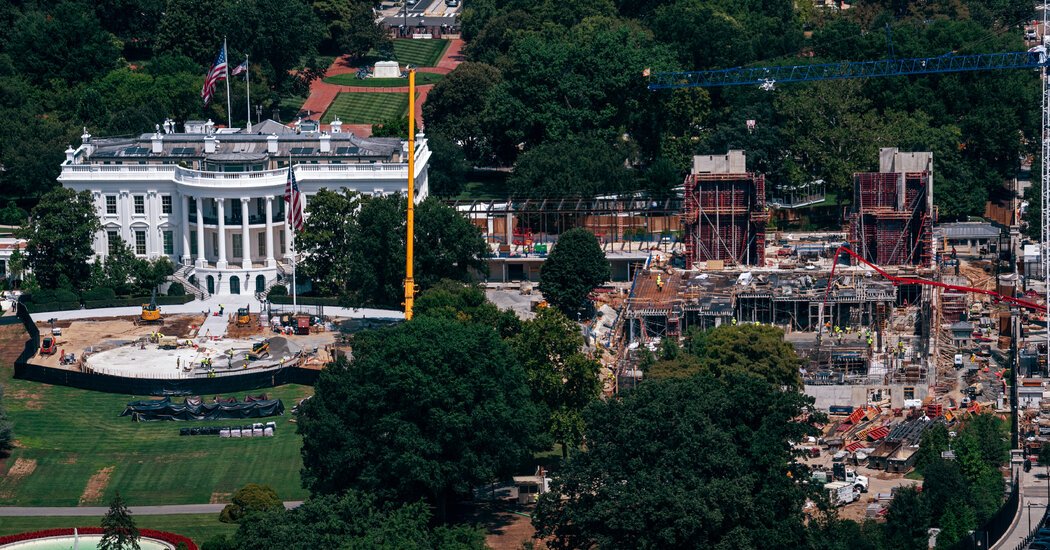
President Trump cannot continue building the ballroom he planned as a replacement to the East Wing of the White House without explicit approval from Congress, a federal appeals court panel ruled on Friday.
The ruling, by judges from the U.S. Court of Appeals for the District of Columbia Circuit, dealt a blow to the president’s efforts to press ahead with the project and all but guaranteed that the Supreme Court will decide the ballroom’s fate. It upheld a lower court’s findings that no law or authority gave the president the power to raze and replace sections of the White House without congressional authorization.
The decision does not mean construction will halt immediately. The judges paused their ruling briefly to give the administration a chance to appeal. The lower court judge had similarly suspended his ruling to allow time for an appeal, and Mr. Trump has continued building uninterrupted, inviting reporters to tour the site and showcasing progress toward completion of the ballroom despite the court order.
Friday’s ruling was split, with Judge Patricia Millett, an Obama appointee, and Bradley Garcia, a Biden appointee, forming a 2-to-1 majority, and Neomi Rao, a Trump appointee, dissenting.
A spokeswoman for the Justice Department did not immediately respond to a request for comment.
Judge Richard J. Leon, an appointee of George W. Bush, ruled in April that the ballroom project far exceeded the scale of the kind of minor changes presidents have traditionally made to the White House grounds, entering territory that required collaboration with Congress.
Judge Leon wrote that Mr. Trump had relied on claims that the construction was intended to bolster security at the White House to justify an extreme rebuild that would dramatically alter the grounds.
“National security is not a blank check to proceed with otherwise unlawful activity,” he wrote then.
Judge Leon nevertheless deferred to Mr. Trump on what he has claimed is a critical upgrade of the military bunker below the White House, writing that he would allow construction below ground but not on the ballroom above it.
Since the ruling, Mr. Trump has seized on a series of security risks, describing them as evidence for the need for a secure facility where the East Wing stood. Those included an attempted assassination of Mr. Trump and other cabinet officials at an annual press gala and the arrests of several people in June who were charged with plotting to attack a mixed martial arts fight held at the White House on Mr. Trump’s birthday.
After the attempted shooting at the White House Correspondents’ Dinner, the Justice Department submitted an unusual filing, written partly in the president’s distinct style rather than in drier legalese, insisting the order be lifted. It renewed those arguments again in a letter to the appeals court after.
“The ‘National Trust for Historic Preservation’ — which, again, is not a government agency of any type — never once denies that its lawsuit is motivated by an irrational desire to stop anything associated with President Donald J. Trump, which even Democrat elected officials have labeled as ‘Trump Derangement Syndrome,’ or T.D.S.,” the first filing said.
During oral arguments, the panel appeared uneasy with the Justice Department’s argument that the president could tear down public monuments.
In June, seven Republican senators joined Democrats in voting to block the construction on the project until Congress had formally authorized it, but the measure failed to secure the 60 votes needed to pass.
Senate Republicans aligned with the president also previously proposed, but ultimately retreated from, providing as much as $1 billion in public funds to help finance the ballroom and other security upgrades, a move that would put Congress on record as supporting the project. The Justice Department has argued in court that congressional efforts to set aside funds amounted to implicit approval of the project.
Mr. Trump had long maintained that the ballroom, estimated to cost at least $400 million, would be built at no expense to the public. But in June, the administration transferred roughly $350 million from the Secret Service to cover security upgrades at the White House, which appeared to be destined for the combined East Wing project.
An assortment of wealthy donors and corporations had pledged hundreds of millions to back the project, drawing warnings from watchdog groups about corruption. A report by the good governance group Public Citizen in May documented more than $50 billion in government contracts flowing to corporations that donated.