dailynewsnblog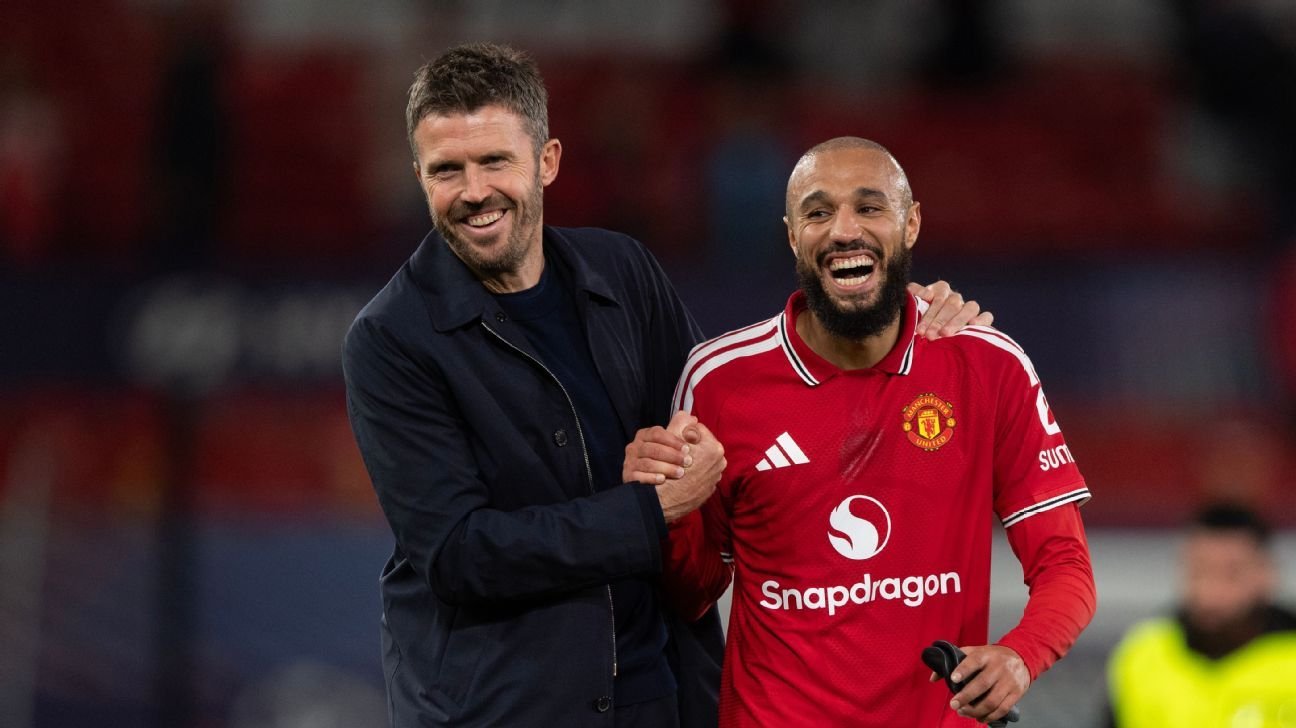

Ryan O’Hanlon

Multiple Authors
While we’ve been heading in this direction for a while, we truly entered a new era of Premier League managing this past summer.
With the corporatization of Premier League front offices, the all-powerful manager who picks the squad, scouts transfers, cuts the grass and selects the color of the table linens in the canteen has nearly become extinct. Whether this is a good thing is up for debate. Whether this is actually happening is not.
Of the league’s 20 managers, only one of them has been with his current club for at least four years. Only nine have been in their current position for a year or more. And half of the current coaches haven’t even had the gig for 200 days. Michael Carrick was named Manchester United’s full-term manager in late May, and he’s more tenured than half of the other coaches in the Premier League.
As clubs have moved away from the manager-decides-all model, they haven’t just stripped away responsibilities from the man on the sideline. They’ve seemingly decided that the person in that position is disposable, too. Ten different managers were fired during last season, and then six more left their positions after the season ended.
What this all means, among many other things: It’s never too early to check in on the Hot Seat Index. We’ve played only four games, but as the numbers suggest, someone is going to get fired soon, and then a bunch of other guys are going to lose their jobs soon after that.
This is not a celebration of rising unemployment rates; it’s a check-in on the state of play across all 20 Premier League clubs. Who is the safest on the sideline? And who might be gone with one more stale result? We’ve ranked all 20 manager jobs in the league, from least likely to be fired to the most likely.
The last of his kind
20. Mikel Arteta, Arsenal
It’s not an exaggeration to say that we’re never going to see another Premier League manager like Mikel Arteta. Arsenal showed extreme patience over his first few seasons with the club, including eighth-place and fifth-place league finishes — and now they’ve got a Premier League title, look to be sizable favorites to grab another, and are simply just one of the best teams in the world.
At six-plus years with Arsenal, Arteta is — by far — the longest-tenured manager in the league, and he’s the only coach in the Premier League to win the league. But he’s also the second-youngest manager to win the Premier League after Jose Mourinho’s first two titles with Chelsea.
It’s not just the longevity, though. As more and more clubs are making a point of hiring “head coaches” rather than “managers,” Arteta was eventually promoted from head coach to manager.
He’s the most powerful manager in the league, as it seems pretty clear that he’s the one driving the club’s recruitment over the past two seasons. After years of building up the roster by signing early- and pre-prime talent, they’ve shifted toward acquiring the kind of win-now players (mid-to-late 20s) whom managers tend to favor.
Given how almost every club functions at this point, it’s really hard to see any other coach ever again reaching Arteta’s current perch: controlling most of the major decisions at one of the richest clubs in the world.
Managers at clubs where managers don’t matter
19. Keith Andrews, Brentford
The impact of coaches on performance across all professional sports is both hard to measure and almost definitely overstated. Brentford and Brighton are aware of this, but despite that organizational knowledge, they don’t take it to mean that you should hire and fire coaches for fun.
18. Fabian Hurzeler, Brighton
Instead, clubs such as Brentford and Brighton value their coaches as, well, coaches. They have structured recruiting systems and preferred styles of play, and then they have a list of guys who they think will fit into it.
This doesn’t lead to job insecurity for their coaches. Rather, it means that they already have a sense of who they might hire if the current coach decides to leave or gets scooped up by a bigger club.
It’s way too early
17. Enzo Maresca, Manchester City
Despite playing their toughest game of the season with only 10 players for 70-plus minutes, Man City have been every bit as good as Arsenal through the first four matches.
They’re going to challenge for the Premier League title, and they’re going to challenge for the Champions League title. Barring some unforeseen downturn, Maresca isn’t going anywhere anytime soon.
16. Andoni Iraola, Liverpool
Liverpool are one of the most patient clubs in the league — or, at least, they were. Then they fired Arne Slot just a year after he won the club’s second Premier League title, and now they have a new, sizable minority-ownership group.
But for all the question marks over this summer’s transfer strategy, it certainly seems like the club is aware that they’re in the middle of a rebuild. They’re definitely not trying to maximize performance for this season, at least. While it has been quite a “meh” first four matches, things would have to go really poorly for Iraola’s job to be at risk.
They wouldn’t … right?
15. Unai Emery, Aston Villa
Ironically, the two longest-tenured Premier League managers are Arteta and the guy Arteta replaced at Arsenal. The reason Emery isn’t earlier on this list — despite his team overachieving their resources and talent year after year — is that there’s at least the chance the bottom falls out. Villa have replaced basically every key player from the best Villa side of the Premier League era, and they’ve done it all in one summer.
Through four games, they’ve been arguably the worst team in the league. By adjusted goal differential (70% non-penalty xG difference, 30% goal difference), they rank dead last:
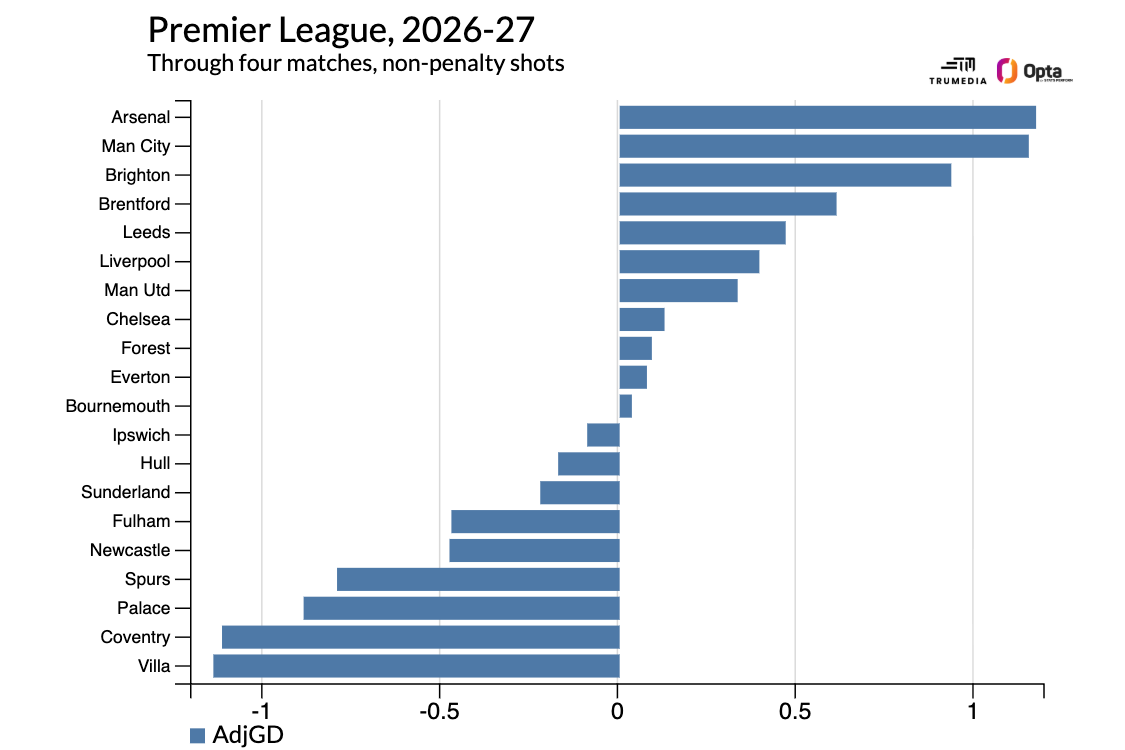
At the same time, they started last season in the exact same way … and then finished fourth.
Totally fine … for now
14. David Moyes, Everton
This club was battling relegation not too long ago, and now they’re as close to league average as it gets. Expected goals, shots, penalty area touches — they’re creating almost exactly as many as they’re conceding through four matches.
13. Daniel Farke, Leeds United
Only Emery and Arteta have been in their jobs longer than Farke, who has been at Leeds for three years and change. And for the second season running, Leeds look competent. They’re fifth on the adjusted goal differential chart, after finishing roughly even last season.
Longer term, there’s the question of whether this ownership group, with the built-in commercial power at the club, is happy with competence, but that’s a question for the offseason.
12. Regis Le Bris, Sunderland
The schedule hasn’t been particularly hard, but after surviving — and frankly, thriving — last season thanks to an unsustainable run of hot finishing, they’ve outshot their opponents across the first four matches and played Arsenal way more tightly than anyone else has so far this season.
Le Bris is the fourth-longest-tenured manager in the league, and his team looks safer than it did at the start of the season.
11. Marco Rose, AFC Bournemouth
We’re splitting the difference here. Rose’s high-wire style has the potential to completely fall apart, and three points from four matches is relegation-level form. But they’ve outshot their opponents, and their adjusted goal differential is right around league average.
If they’re able to stick to this process, things should turn around, but that’s one of the tricks of managerial success: knowing what you’re doing is working despite poor results, and then convincing your players, and your bosses, that it’s true.
10. Matthias Jassle, Newcastle United
Newcastle under Jassle are sometimes maybe good, sometimes maybe lose to Leeds 4-1.
They’ve come back to earth after four points from the opening pair of matches against Liverpool and Spurs, and they’re fortunate to be where they currently are in the table. But the Public Investment Fund of Saudi Arabia, maybe the richest ownership group in all of sports, doesn’t seem to feel much urgency around Newcastle. They’ve said goodbye to all of their best players and replaced them with a bunch of year-away-from-being-a-year-away prospects. As long as they don’t drift into the relegation battle, Jassle should be safe.
Can a promoted manager ever be safe?

9. Sergej Jakirovic, Hull City
They’re still one of the favorites to be relegated, with greater-than-50% odds of going down wherever you look. But they’ve already played Manchester United and Chelsea … and they’re currently in third place. As in, behind only Manchester City and Arsenal.
And sure, the eight points from four games is fluky — a plus-3 non-penalty goal differential from a minus-3 xG differential — but this was supposed to be one of the worst teams in Premier League history. So far, they’re not even close to the worst team in the Premier League this season.
8. Gary O’Neil, Ipswich Town
Ipswich’s outlook is even better; their relegation odds have already dipped below 50% after wins in two of their first four matches. But this is about as high as you could reasonably put Jakirovic and O’Neil. Both teams are still very likely to end up in a relegation battle, and when that’s the case, your seat never really cools down.
Can the manager of these clubs ever be safe?
7. Xabi Alonso, Chelsea
Sure, he’s signed through 2030, and yeah, Chelsea are currently in fourth place. But this team still hasn’t played a convincing 90 minutes of soccer. After a wild first three matches in which Chelsea barely had any possession but scored lots of goals, last weekend’s home game against Hull was an opportunity for Chelsea to show that they could dominate a game against a theoretically bad team.
Instead, uh …
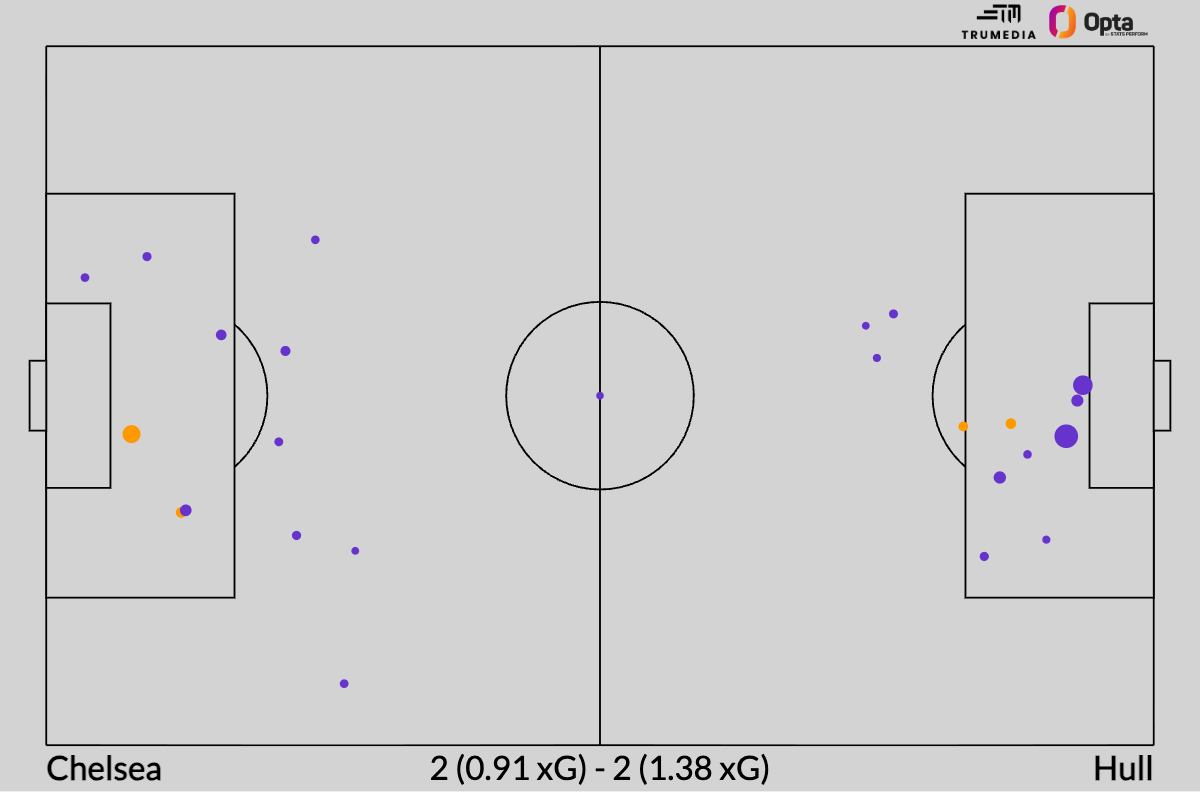
Purple are shots, orange are goals, and the larger the circle, the higher the xG.
They don’t have a midweek Champions League game to point to as an excuse, either. Under current ownership, I’m not sure any Chelsea manager could be higher than, say, 10th on this list. And Alonso’s team needs to stabilize before he moves up any higher.
6. Michael Carrick, Manchester United
Man United are unlucky to have only four points from their first four matches. They’ve turned a plus-2.5 non-penalty xG difference into a minus-1 goal difference. And they’ve attempted 83 shots and conceded just 41.
At the same time, they’ve faced one of the easiest schedules in the league: Hull, Ipswich, Everton, and then 70-plus minutes with an extra man against Manchester City.
United signed Carrick to only a two-year contract — essentially the minimum level of commitment you can show to a non-interim manager. And with the added burden of Champions League matches this season, things aren’t going to get any easier from here on out.

5. Oliver Glasner, Nottingham Forest
Forest have been quite good so far. They’ve edged their opponents on xG, shots and penalty touches. They’re already, pretty clearly, an Oliver Glasner team: low possession, but aggressive without the ball and frightening whenever they win it back. At most clubs, he’d be somewhere in the top 10 (or even top five) of this list.
Unfortunately, Forest have the most volatile, unpredictable owner in … all of professional sports? A couple of unfortunate results, and Glasner could be out of a job before Christmas.
The hottest of hot seats

4. Alvaro Arbeloa, Fulham
They have one point, and his Fulham players are already staging protests on Instagram. This comes just months after his players were brawling in the training room at Real Madrid. We continue to have zero evidence that Arbeloa is a good manager, and we continue to have zero evidence that he’s able to control a locker room.
But he was also allowed to sign a bunch of his former Real Madrid players, so Fulham seem somewhat committed. And two of his first four matches were against Chelsea and Liverpool.
3. Pierre Sage, Crystal Palace
By any metric, this is the worst defensive team in the league. Palace are last in goals conceded, xG allowed, shots conceded and penalty-area touches allowed.
A lot of that has to do with the fact that three-fifths of their defense from the Glasner Era are no longer with the club. But the balance is off; can Sage, who had a fantastic season with Lens last year, figure out a way to fix it?

2. Roberto De Zerbi, Tottenham Hotspur
After spending $400 million to avoid another relegation scare, Tottenham … are right back where they were last season. They’ve yet to win a match, yet to score a single goal, and have the fourth-worst adjusted goal differential in the league through four matches.
For all of his talents in building unique possession systems, De Zerbi has never shown the ability to manage his way out of adversity. The news conferences are already getting testy, and although he’s signed through 2030, this one feels like it’s a few more bad results from getting really bad.

1. Frank Lampard, Coventry City
Zero goals? Zero points? Yep, that’ll do it.