dailynewsnblog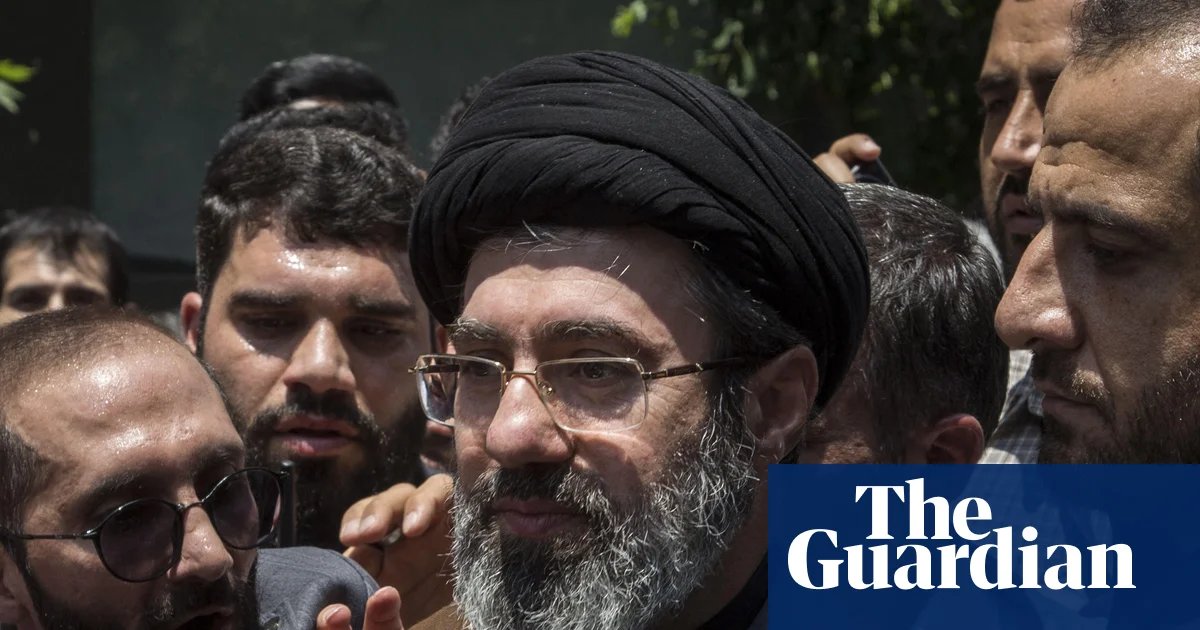
Mojtaba Khamenei, the second son of the late Iranian supreme leader Ayatollah Ali Khamenei, has been chosen as his successor.
Members of the clerical body responsible for selecting Iran’s highest authority announced the decision on Sunday, calling on Iranians to rally behind him and preserve national unity.
In a statement carried by state media, the assembly said Khamenei had been chosen through what it described as a “decisive vote”.
The body urged citizens across the country, “especially the elites and intellectuals of the seminaries and universities”, to pledge allegiance to the new leadership and safeguard unity at a critical moment for Iran.
The appointment was welcomed by Yemen’s Houthi rebels, who are backed by the Iranian regime.
“We congratulate the Islamic Republic of Iran, its leadership and people, on the selection of Sayyid Mojtaba Khamenei as Supreme Leader of the Islamic Revolution at this important and pivotal juncture,” the group said in a statement on Telegram.
It called his selection “a new victory for the Islamic Revolution and a resounding blow to the enemies of the Islamic Republic and the enemies of the nation”.
The move could lead to a further escalation of the war, given Donald Trump had already acknowledged that Mojtaba Khamenei was the most likely successor and made clear he considered such an outcome unacceptable.
Mojtaba Khamenei’s elevation marks the first time since the 1979 Islamic revolution that Iran’s supreme leadership has passed from father to son. It is a development likely to ignite debate inside Iran about the emergence of a dynastic system in a state founded explicitly to overthrow hereditary rule after the shah.
Ayatollah Ali Khamenei, who ruled for 37 years, was killed in a US-Israeli strike on Tehran on 28 February, on the first day of the war with Iran.
Across Iran’s political and security establishment, officials swiftly moved to welcome the appointment of Mojtaba Khamenei as the country’s new supreme leader.
State media reported the leadership of Iran’s armed forces pledged allegiance to him, while the speaker of parliament hailed the decision and described following Mojtaba Khamenei as a “religious and national duty”.
The country’s security chief said the new leader was capable of guiding Iran through the current sensitive moment, and the Revolutionary Guards declared they stood ready to follow him, signalling broad backing from the country’s core institutions.
Trump said earlier on Sunday that Iran’s next supreme leader was “not going to last long” if Tehran did not get his approval first. He has called Mojtaba Khamenei an “unacceptable” choice.
The US president dismissed the prospect of Khamenei’s leadership and insisted that Washington should have a say in Iran’s future political direction.
Earlier in the day, in a post on X in Farsi, the Israeli military said it would continue pursuing every successor of Ali Khamenei and would pursue every person who sought to appoint a successor for him.
For many analysts, Mojtaba Khamenei’s appointment is a symbolic move designed to make the regime still appear strong and determined not to bow to western pressure.
The 56-year-old cleric has never held elected office nor formally occupied a senior position within Iran’s government. He has spent much of his life at the centre of power in Iran while remaining largely out of public view.
Born in 1969 in the north-eastern city of Mashhad, Khamenei was raised within the political and clerical world that emerged after the 1979 revolution. As a young man he studied theology in the seminaries of Qom and reportedly took part in the final stages of the Iran-Iraq war.
Unlike many figures in Iran’s leadership, Khamenei never pursued elected office or a prominent government role. Instead, he gradually became an influential presence inside his father’s office, where he was widely seen as part of a small circle managing political access to the supreme leader.
Over the years he cultivated close relationships with conservative clerics and elements of the Islamic Revolutionary Guards Corps (IRGC), a connection analysts say strengthened his standing within the system.
His name surfaced publicly during the disputed 2009 presidential election, when reformist figures accused him of playing a role in supporting the security crackdown that followed mass protests. But he has never discussed the issue of succession publicly.
To his supporters, Mojtaba Khamenei represents continuity with the ideological line established by Ayatollah Ruhollah Khomeini and maintained by his father. To critics, his rise raises uncomfortable questions about the concentration of power – and the possibility of hereditary leadership in a state founded in revolt against monarchy.
Iran has threatened to attack oil facilities in neighbouring countries after Israel struck at least five energy sites in and around Tehran, smothering the city in black smoke and escalating fears that the conflict will result in significant disruption to the world economy.
“If you can tolerate oil at more than $200 per barrel, continue this game,” said a spokesperson for the IRGC on Sunday.
The US sought to calm markets as oil prices surge by pledging not to target Iran’s energy infrastructure.
A fresh wave of Iranian strikes hit the Gulf on Sunday, with Saudi Arabia, the United Arab Emirates, Qatar, Bahrain and Kuwait all reporting attacks. Saudi Arabia said it had intercepted 15 drones; while strikes in Bahrain caused “material damage” to an important desalination plant.
Two people were killed on Sunday and 12 others injured after a projectile fell on a residential location in Al-Kharj, a city in Saudi Arabia, the Saudi civil defence said.