dailynewsnblog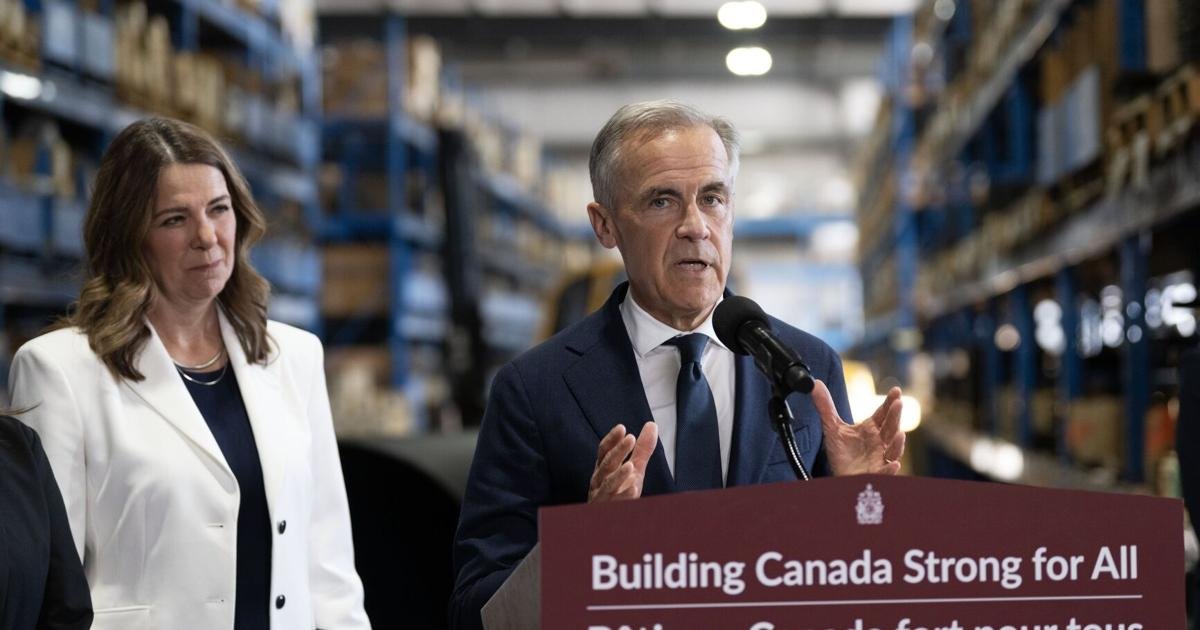
OTTAWA — Should questions about Alberta’s place in Canada be left only to Albertans?
Or is it a national issue that should engage other Canadians, especially those with the skill to make a passionate argument for unity? Is that unwanted meddling?
Ask a few Albertans who they believe has standing to litigate the existential questions at play and even those on the same side — for unity — will offer different answers.
With just 14 weeks to go before the vote and no clearly organized or co-ordinated campaign on the federalist side, it’s as if the rest of the country is on the outside watching in, fingers crossed for the best.
Who should lead the unity argument?
The prime minister’s plan to deliver a unity speech in Edmonton on Canada Day was thwarted when thunderstorms grounded his plane. Two days later, he held up his decision to pay — along with the Alberta government — 90 per cent of the potential $44-billion cost of building a new oil pipeline as a key proof point that his brand of federalism works, and that Alberta is central to his longer-term ambitions for Canada.

Alberta Premier Danielle Smith and Prime Minister Mark Carney unveiled a new pipeline proposal
It’s an argument his MPs make as well.
The only two MPs elected as Liberals from Alberta, cabinet minister Eleanor Olszewski from Edmonton and Calgary’s Corey Hogan, who is parliamentary secretary to the energy minister, say the federalist charge should be led by people within or from the province, not by outsiders.
And in their eyes, Carney — born in the Northwest Territories, raised in Alberta and a globally recognized former investment and central banker — is perfectly suited to carry the pro-Canada message.

The province of Alberta is now within spitting distance of a vote on independence.
From the time he entered political office, Olszewski said, Carney and his team sought to address alienation in Alberta not just by championing a new oil pipeline but by offering supports for businesses to take advantage of new defence spending and offering aid to tariff-hit sectors.
“We wanted to make sure that we reset that relationship, and we worked very hard to do that,” said Olszewski, Carney’s minister for emergency management and Prairie economic development.
But is there a role for others? “I don’t think people from outside the province should be leading the campaign, if that’s the terminology we’re using,” she said.
“I think the last thing a lot of Albertans would want to hear is people outside the province telling them why they should think a certain way, why they should vote a certain way. That’s not going to be my message.”
“I don’t think it should be restricted to Albertans,” he said in an interview, adding, “I think Albertans need to lead the conversation. I do consider the prime minister to be one.”
Hogan acknowledges the potential for a pro-separatism vote is a fraught one.
“What the separatists are proposing doesn’t just affect people who live in Alberta, it affects the whole country,” he said, “and it affects the ability of those people in a fundamental sense to travel, to work, to enjoy the entire country that they are citizens of.
“So of course it should involve everybody, but the people who live here need to lead it.”
A growing federalist coalition
So far, there are diverse efforts by a range of concerned people making the unity argument.
Jason Kenney, the former Alberta premier and cabinet minister in the Harper government, has debated separatism advocates — like constitutional lawyer Keith Wilson, who advised participants in the 2022 Freedom Convoy at public events in Alberta.

After a separatist group said they’d picked up more than 300,000 signatures to support a
Stephen Harper, the Toronto-born-and-raised former prime minister who built his political career as an advocate of Western interests and represented a Calgary riding in the House of Commons for years, is expected to step forward.
Thomas Lukaszuk, a former Alberta deputy premier, mobilized a pro-unity group called Forever Canadian, which he said gathered 486,000 signatures on a pro-Canada petition and has since signed up 200,000 volunteers and distributed 45,000 lawn signs.
Lukaszuk welcomes support from other Canadians. “I think it helps the cause,” he said in an interview.
“I think separatism in Alberta is a national issue. It’s not exclusively an Alberta issue.”
There are other smaller groups promoting the federalist cause in Alberta, Lukaszuk added, and their common goal — to promote unity — could do with voices of other Canadians.
”I think it’s time for other municipal leaders and provincial leaders and just rank-and-file Canadians to speak out about how they feel about the separatism movement and the potential of Alberta somehow separating itself,” he said.
However, he hastened to add, messages from outside the province should be positive and sidestep warnings about the negative impact of separatism or threats of what might ensue “because then that will be counterproductive.”
The Forever Canadian group is “definitely not avoiding the topic,” he added.
Like Britain’s split from the European Union, he said, “This is not a revolving door, and you don’t get to use Canadian currency and passports and banks and all that if you separate.
“Internally, that message is being definitely dissipated by our campaign, and I don’t think it should be coming from the outside. That’s just common sense.”
Questions over campaign rules
Lukaszuk claims that because his group is promoting a simple pro-unity message, rather than an answer to a particular referendum question, that puts its activities outside financing or spending constraints imposed by Elections Alberta. Canadians, he says, can donate unlimited amounts to the group’s cause.
Elections Alberta said any message would be judged by its “specific content” to determine if it amounts to referendum advertising or not. So would events that “promote or oppose a question” in order to determine what their “significant purpose” is. Money for advertising for or against a particular referendum question is limited to Alberta-based residents, companies and unions, so Lukaszuk’s claim may not be entirely accurate.
But he is nothing if not optimistic.
He said Carney’s announcement of billions of dollars in public money for a new oil pipeline the private sector shied away from has already “made an impact in the segment of separatists who want to use this referendum to send a message.”
Many concede now that their message “actually has been heard,” Lukaszuk said.
Same side, different messages
NDP Leader Avi Lewis has criticized Smith for catering to what he called the province’s “MAGA-aligned separatist movement.”
But the NDP’s lone Alberta MP, Heather McPherson, stepped carefully around that criticism, saying in an interview the “very loud” people leading the movement “are very different than folks that are expressing deep frustration with their relationship with Ottawa.”
Increasingly, ordinary Albertans are mobilizing against separation, angry that the Smith government has landed a referendum in their laps, said the Edmonton MP, who welcomed the range of efforts underway to make Canada’s case. McPherson said that’s the only way to ensure it remains a genuine grassroots movement. “We want to have these diverse voices,” and the charge cannot be led by one party or politician because then it becomes a partisan argument, she said.
Alberta MPs have a particular role, especially those residents in the province who have a vote to exercise, but McPherson said “all Canadian politicians should be speaking about this issue” because the implications are widespread. She added progressives are looking to the Carney Liberals to shore up unity by strengthening not just pipeline networks but also social programs like the Canada Pension Plan and health care.
As for the Conservatives, Leader Pierre Poilievre — an Alberta MP who will not vote because he lives in Ottawa — is walking a fine line as he tries to deliver a national unity message in a province where his base includes a large cohort of would-be separatists. In a speech to a Calgary Stampede crowd, Poilievre devoted his first 21 minutes to a partisan critique of Ottawa’s failures. In the last three minutes, Poilievre praised unity based on “our common values, common history, common bonds, and common sense.”
“We will fight for Canada, including in the upcoming referendum to win back Albertans, to win back Albertans through hope, not by wagging our fingers or lecturing them, nor by threatening,” he said, emphasizing that when “this is all over, we will once again be fully united as citizens.”
The Star, simplified
Breaking news, interactive polls, video, and voice
notes. Star stories you’ll want to share, delivered where you’re
already chatting. Follow the Star on WhatsApp.
According to Abacus Data, most Canadians are not indifferent to the debate, with 76 per cent saying they want Alberta to remain part of the country.
But Hogan said the debate itself is having repercussions.
A poll by the Calgary Chamber of Commerce of its members showed nearly half — 48 per cent — were prepared to relocate their businesses if Albertans vote to begin the formal process towards separation from Canada. Only 39 per cent indicate they are unlikely to do so, the poll said.
“This is a drag on our economy,” said Hogan. “This is a drag of investment and, you know, it’s also going to really hurt communities if it goes forward.”
While broader polls show that, depending on the question, only 20 to 30 per cent of Albertans might be likely to support separation, “the risk has always been that 70-30 becomes 60-40, and then this never goes away (and) we’re just talking about it forever as a province,” he said.
“So if you’re a separatist, that’s the model. If you’re a federalist, that is a fear.”
Correction – July 9, 2026
This article was updated from a previous version to reflect that Eleanor Olszewski and Corey Hogan are the two MPs elected as Liberals. A third Liberal MP, Matt Jeneroux, was elected as a Conservative but crossed the floor to become a Liberal months after the election. As well, Hogan is parliamentary secretary to energy minister Tim Hodgson, not the prime minister.