dailynewsnblog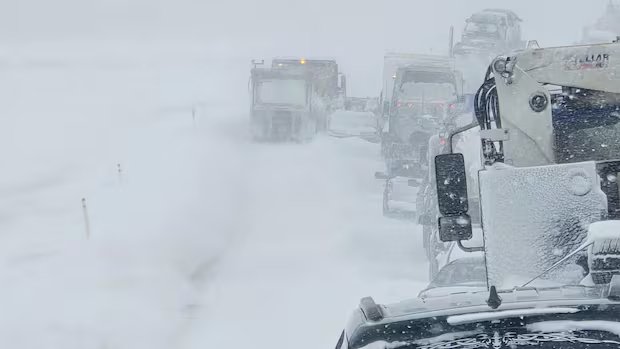
Judith Iwaszkiw is used to Alberta’s unpredictable snow storms, and even more used to driving during them.
“We travel in inclement weather all the time. It’s just part of living up here,” said Iwaszkiw, an emergency services professional from Fort McMurray, Alta.
But her drive on Friday, up from Medicine Hat, Alta., was unlike any other. Iwaszkiw was in one of around 300 stranded vehicles on highway 63, the only major route in and out of Fort McMurray.
Highway 63, and the nearby highway 881, reopened Saturday after heavy snow and strong winds led stranded motorists and a road closure on Friday. Some people that were stuck, like Iwaszkiw and Diana Noble, said it took the province, local government and RCMP too long to act.
Noble spent 13 hours in a car with strangers on Friday after she was run off the road by another driver while travelling to the northern Alberta city.
A family of five, with two seats to spare, picked up Noble and a woman she met on the side of the highway in hopes they could make it back to Fort McMurray together.
But then, just 100 kilometres from Fort McMurray, the car went to a standstill, she said.
Radio Active8:04Stuck on Highway 63
The blizzard-like conditions turned into a nightmare for 300 motorists on Highyway 63 Thursday night, stranding many overnight. Lance Kane left Edmonton for Fort McMurray around 3 p.m. Thursday, and came to a standstill at 7 p.m., about 100 kilometers south of the northern Alberta city. When spoke with Radio Active 22 hours later, he was still in the same spot.
“I’m going to consider myself lucky because I got picked up by a really great family. I made a couple of new friends … We went through this together,” she said.
“But the reality is there were people that were stuck for 24 hours without food, without gas, without water. There were people reportedly having medical issues. There were moms that were travelling with infant children that had no resources available,” Noble said.
“This is an absolute travesty for the residents of Fort McMurray.”
‘We deserve better’
Noble and Iwaszkiw told CBC News Saturday they received very little communication from law enforcement and local and provincial governments about the standstill and efforts to get people off the road.
Nobel said she called RCMP four times and was not given any information.
“We were not met with any compassion. The last time we called the RCMP, they actually hung up on us,” she said.
“This is gross negligence at best with how this situation was handled and we deserve better. I would like some answers from the RCMP. I would like some answers from the province.”
In a statement to CBC News Saturday, Husam Khalo, spokesperson for the minister of transportation, said the province is reviewing the highway maintenance contractor’s response, as it does after all major weather events.
The delays happened because of the storm’s severity, not a lack of preparedness, Khalo said.
“The safety of motorists and workers is always the top priority, and resources are deployed accordingly based on real-time conditions,” he said.
CBC News reached out to the Alberta RCMP and the Regional Municipality of Wood Buffalo for comment, but did not receive a response by publication time.

The situation was “infuriating,” said Iwaszkiw, with different institutional bodies, such as the RCMP, the province and the local government, directing questions from their group to another.
“There’s this hot potato game of nobody wanting to take the lead and take the charge,” she said.
But this isn’t the first time Iwaszkiw has been frustrated by institutional responses to urgent situations in Fort McMurray, noting her experience Friday was reminiscent of the 2016 Horse River fire and the 2020 Fort McMurray flood.
“When some of those catastrophes hit, the frustration was felt then too, in the same way it was felt yesterday,” Iwaszkiw said. “There needs to be some accountability.”
The power of community
Brad Shearing, who got stuck on the highway while travelling from just outside Edmonton in Fort Saskatchewan, Alta., to Fort McMurray, said the community came together to work through the situation.
Shearing said he tried to keep the spirits of others up during his 23 hours stuck on the road.
“I did my rounds, getting out of the vehicle, just walking up to people, kind of checking out a few people,” he said. “The gentleman that was parked behind me didn’t have social media, so I was talking to him every now and then, filling him in on what I was reading.”
While stranded on the highway, a helicopter carrying jerrycans of gas and Tim Hortons coffee landed near Shearing.
“I was quite floored,” he said, noting that he and others who were stranded passed out coffee to the people around them.

The community came together to get through the standstill and the unclear road conditions.
“There could be a lot of red tape with municipalities getting resources to people, especially in that location,” Shearing said. “But the Fort McMurray people, whenever there’s an emergency scene … they band together to help out the community and surrounding areas.”
“That’s pretty remarkable,” he said.
Despite this, both Noble and Iwaszkiw said it shouldn’t be up to residents to do this heavy lifting — that responsibility should lie with the government and law enforcement.
“The people that should have cared did not care fast enough until it was too late,” Noble said.