
 dailynewsnblog
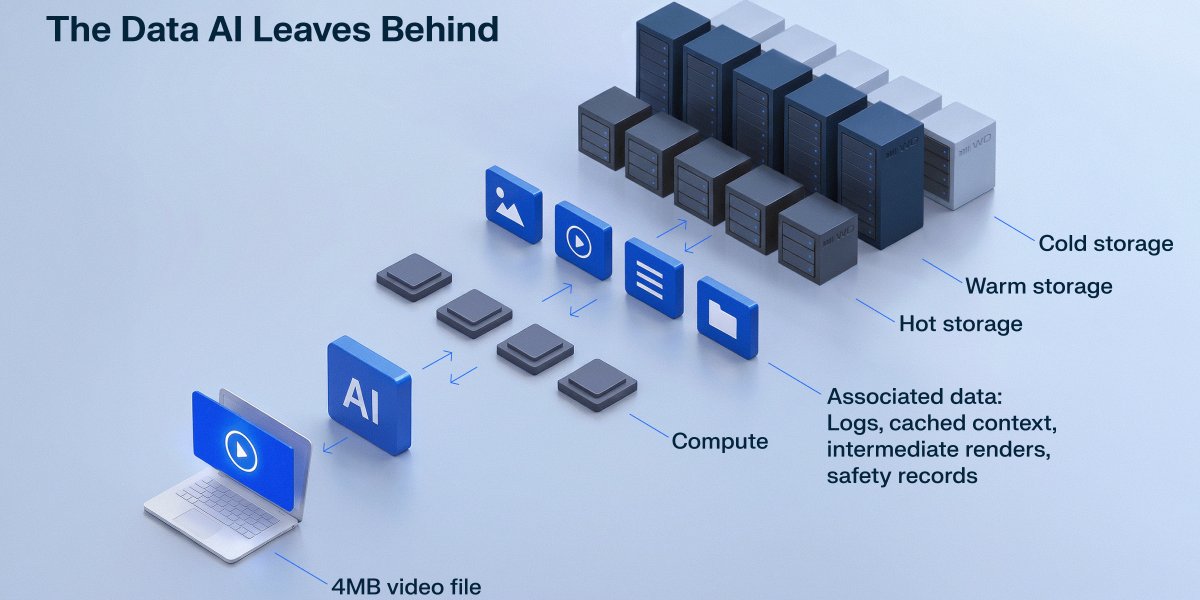
As inference scales, the data footprint grows with it
Traditionally, AI infrastructure conversations have centered on the compute-intensive process of training a model. Training is finite: a run starts, burns through compute, and ends. But inference runs continuously, every time a model answers a prompt. For infrastructure planning, that difference matters: A training run is a project you can budget for and retire. Inference doesn’t retire; every inference request leaves something behind.
Take AI-generated video. In this workload, the back-end spend can be significant. From internal measurements, WD found that an 8-second clip (returned to a user as a 3.97MB 720p file) left more than 500MB of associated data behind on the back end, including logs, cached context, immediate renders, backups, and safety records. That’s a 130x increase over the output file size the user saw. Scale this to an enterprise generating longer, higher resolution video and the back-end footprint grows into the hundreds of gigabytes per clip.
And that back-end footprint is growing fast. McKinsey projects AI inference demand will grow at a 35% CAGR through 2030, versus 22% for training, making up more than 40% of total data center demand by the end of the decade.
A recent WD-sponsored IDC global white paper that surveyed 763 IT and business decision makers found that nearly 95% of respondents reported an increase in data volume due to generative AI over the past 12 months, with roughly 61% reporting growth of 25% or more.
“You can think of having more storage as an optimization for keeping the GPUs busy,” said a senior product manager of a hyperscale cloud service provider quoted in report. “The biggest challenge is to ensure that the GPUs are not idle, waiting for data to show up—hours of GPU idle time becomes very expensive, very fast.” Put in dollar terms: if your storage spend is growing 25% year over year while your compute budget grows in the more predictable cyclical way, storage ends up outpacing the budget line that receives the most attention.
Matching storage to the AI data life cycle
Compute demand rises and falls with training cycles, product launches, and hardware refreshes. But the volume of retained data doesn’t fall back down with it when compute demand slows. Model logs, synthetic outputs, inference results, and more keep accumulating, and organizations are holding onto more of it for longer.
This changes the role of retained data. Information that once moved into an archive and rarely surfaced can now become an input to future AI workloads. As more data is retained, retrieved, and reused, storage must support not only growing capacity, but increasingly dynamic access to it. The same WD-IDC survey found 96% of respondents anticipate needing faster archive retrieval to support inference or retrieval-augmented generation (RAG).
AI workloads require both performance and capacity, with different technologies serving different needs across the data lifecycle. And for the vast volumes of data that must be retained and revisited, HDDs provide a cost-effective, high-capacity foundation, with a significant cost-per-terabyte advantage