dailynewsnblog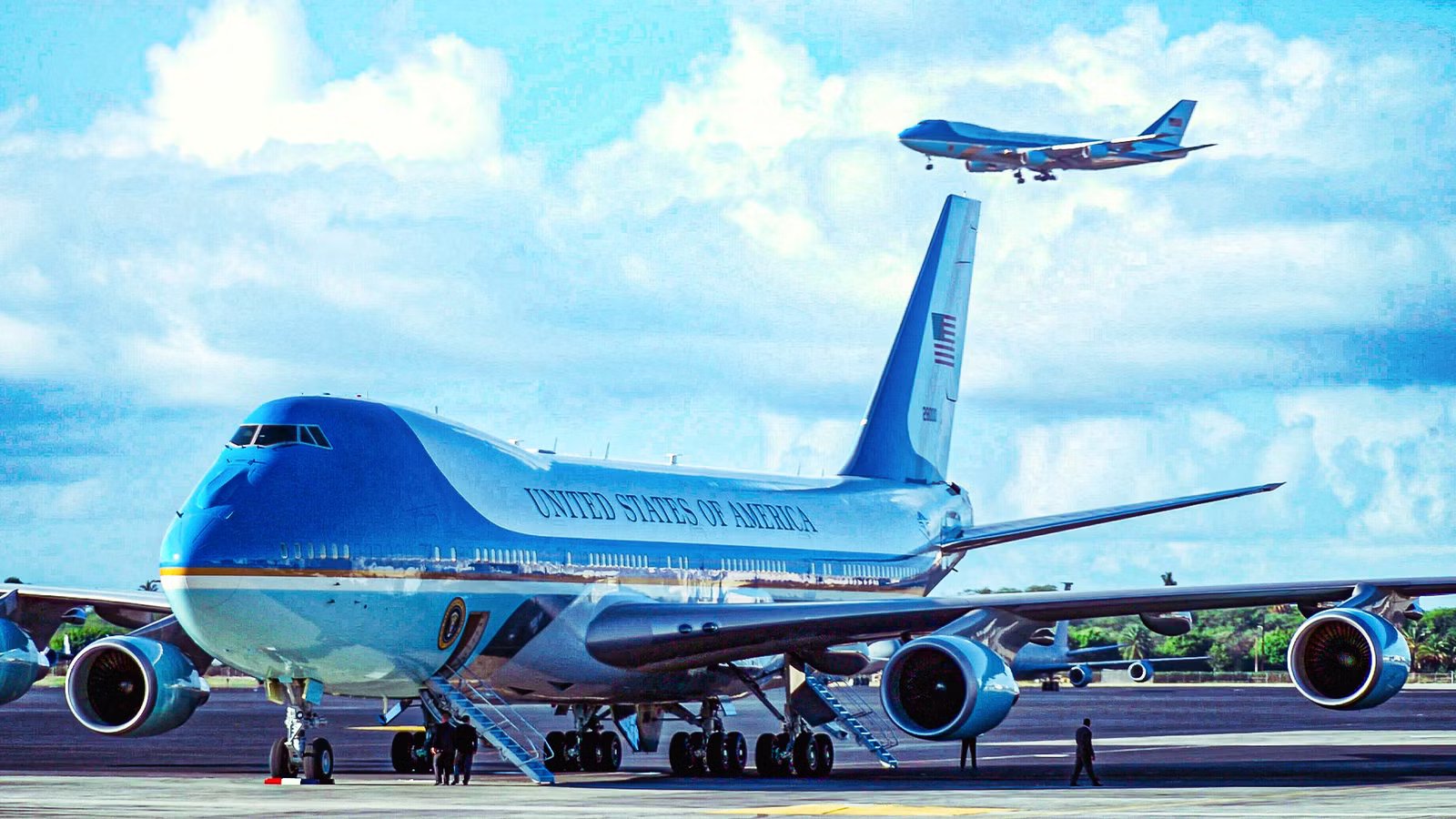
The United States Air Force(USAF) is the owner of the world’s most advanced Boeing 747. The VC-25A, known by the callsign ‘Air Force One’ when flying the President, boasts a long list of incredible technological aspects. One of the most essential features of the aircraft is the ability to aerial refuel from the large fleet of USAF tanker jets. However, it rarely ever uses this feature and is even said to have never done so with a President on board.
Air Force One was designed to be able to receive fuel in the air to make it essentially unlimited in range. This was to allow the aircraft to loiter for an indefinite period of time in the worst-case scenario and make it the most survivable mobile command post in the US Armed Forces. However, the jet already has an intercontinental range without fueling. Refueling two massive aircraft flying just feet apart at high speeds is inherently risky.
For the security of the President, standard ground refueling at secure military bases is always preferred. In fact, its rare use led to a highly contentious design choice over the successor, the VC-25B. The Joint Chiefs and top brass argue that its absence severely diminishes the aircraft’s ability to serve its role as a survival command post in a doomsday scenario like nuclear conflict.
The Philosophy For Air Force One’s Aerial Refueling

In a doomsday or nuclear scenario, the VC-25A, or Air Force One, and the E-4B Nightwatchfunction as a high-stakes team: the VC-25A serves as a secure mobile office for the President’s immediate safety, while the E-4B ‘Nightwatch’ acts as the Flying Pentagon. Mid-air refueling is the literal lifeline for this coordination, allowing both aircraft to stay airborne for days or even a full week to ensure the US government remains functional even if all ground-based command centers are destroyed.
While both are modified Boeing 747s, they have distinct mission profiles that complement each other. Air Force One gets the President safely out of a target zone. It is a VIP transport with advanced communications, but it is not built to hold the massive battle staff required to run a global war. Meanwhile, the Nightwatch acts as a National Airborne Operations Center. It carries a joint-service battle staff of up to 112 people, including advisors and specialized operators who can direct nuclear retaliation and coordinate civil authorities.
Mid-air refueling ensures the President never has to land and expose themself to ground-based threats. Maintaining this core survivability system ensures that the commander-in-chief can always exercise control over the nation’s nuclear deterrent. With tankers providing fuel, the plane’s flight time is limited only by crew fatigue and onboard supplies, like food and engine oil, rather than fuel capacity.
Why The VC-25A Doesn’t Use Aerial Refueling

Pilots for the 89th Airlift Wing regularly practice aerial refueling to maintain proficiency, but these flights are conducted without the President on board. Aerial refueling is a complex and dangerous maneuver, even more so for an aircraft as large as a Boeing 747. The turbulence and steep descent/climb patterns typical of a refueling maneuver are also notoriously uncomfortable, often causing nausea even for seasoned personnel.
Jimmy Carter is reportedly the only President to have been aboard an aircraft during mid-air refueling. This occurred in 1980 during a flight on an E-4B Nightwatch (rather than the primary VC-25A), as part of a demonstration of the Doomsday Plane’s capabilities. There is unverified speculation regarding President George W. Bush’s secret 2003 Thanksgiving flight to Iraq, which some believe may have utilized refueling due to its extreme range, though the Air Force has never confirmed this.
Every gallon of fuel loaded onto Air Force One must be pre-tested and guarded by a Secret Service team. Delivering a gallon of fuel mid-air is estimated to be up to 17 times more expensive than ground refueling, factoring in the cost of the tanker, its crew, and the extra fuel burned just to get the tanker to the rendezvous point. Reality is that it simply isn’t required for the regular mission of Air Force One, nor is it worth the cost to use in virtually any peacetime scenario.
How It Works When Air Force One Gets Gas On The Go

While a standard Boeing 747 has its fuel tanks in the wings and belly, the VC-25A is modified with a hardened intake and a complex internal plumbing network that allows it to receive thousands of pounds of fuel per minute while in flight. Unlike fighter jets that often use a probe-and-drogue system (a flexible hose), the VC-25A uses the Flying Boom method favored by the US Air Force. The aerial refueling system on the VC-25A is a specialized Universal Aerial Refueling Receptacle Slipway Installation.
The receptacle is located on the upper fuselage, just forward of the cockpit windshield. In normal flight, the receptacle is hidden behind flush-mounted slipway doors to maintain aerodynamics. When activated, these doors slide open to reveal a funnel-shaped slipway that guides the tanker’s rigid boom into the fueling port. Once the boom tip enters the receptacle, high-pressure hydraulic toggles snap shut to lock the boom in place, creating a pressure-tight seal for high-speed fuel transfer.
The fuel lines running from the nose to the main wing and body tanks are heavily shielded. This protects the fuel from the effects of a Nuclear Electromagnetic Pulse and provides extra fire suppression. Receiving fuel at the high flow rates of a boom (up to 6,000 lbs per minute) requires a reinforced internal structure. The system includes high-speed venting and surge tanks to prevent the massive pressure of incoming fuel from damaging the aircraft’s standard internal plumbing.
The process is a three-way technical ballet between the receiving pilot, the tanker pilot, and the boom operator. When the boom is physically locked into the VC-25A, a direct, secure intercom link is established through the boom hardware itself, allowing the crews to communicate even if radio silence is mandated. On the belly of the tanker (like a KC-135), there are two rows of colored lights. These act as a visual docking system, telling the VC-25A pilot whether to move up, down, forward, or aft to stay in the refueling envelope.

How Many Hours Can A C-17 Globemaster Fly Without Refueling?
A closet look at how far the Globemaster can go without topping up.
What Aerial Refueling Means For Air Force One’s Survivability

Aerial refueling is not just a convenience: it is a core survivability requirement for both the VC-25A and E-4B. These aircraft can stay in safe sectors for extended periods by refueling in midair. In a catastrophic event, fallout might contaminate or destroy ground airfields. The necessity to land at a possibly vulnerable base is eliminated by mid-air refueling. With refueling, the E-4B can theoretically fly for more than 150 hours, or around a week, with the main restrictions being the quantity of food and engine oil on board.
In an actual emergency, the President might initially take off in the VC-25A and then rendezvous with an E-4B in safe airspace. The E-4B also has a five-mile-long trailing wire antenna for communicating with submerged nuclear submarines. This antenna performs best when the jet is flying in specified high-altitude patterns for extended periods of time, which is only achievable with regular refueling.
At least one E-4B is always on alert, around the clock. Both planes would take off in the event of an impending attack in order to travel to a safe altitude and distance from possible ground zero targets, such as Washington DC. The original VC-25A may serve as a high-value decoy, and the E-4B becomes Air Force One as soon as a President joins the Nightwatch. At secret rendezvous locations, many tankers, such as the KC-135 Stratotanker or KC-46 Pegasus, are assigned to meet the command planes.

Boeing Workers No Longer Need Top Security Clearance To Work On Air Force One
Boeing has been under pressure from President Trump to deliver the latest version of Air Force One as quickly as possible.
Why Aerial Refueling Was Dropped From The VC-25B

The forthcoming VC-25B aircraft (the next Air Force One) will not have aerial refueling capabilities. This decision was taken as a cost-saving strategy during the program’s reorganization, and while it has sparked heated discussion, it remains the current engineering norm for the two aircraft being converted by  Boeing.
The new VC-25B will have an unrefueled range of approximately 8,900 miles (7,730 nautical miles), which is about 1,100 miles farther than the older VC-25A. It is being converted from existing commercial Boeing 747-8 airframes. Adding a nose-mounted fueling port and the necessary internal plumbing for a plane of this size is a massive engineering feat that requires complex structural reinforcements and weight-balance adjustments.
The absence of refueling is a limiting factor that would need altered strategic planning for emergency circumstances, according to military authorities, including former Joint Chiefs of Staff Chair Joseph Dunford. The main plan is based on the assumption that the President would probably be moved to the E-4B Nightwatch, which still has complete aerial refueling capabilities, in the event of a serious nuclear emergency where remaining in the air is necessary.

How The US Navy’s MQ-25 Stingray Drone Would Support Carrier Strike Groups
US Navy’s MQ-25 Stingray drone enhances naval aviation with unmanned aerial refueling and flexible support to project power from sea to the shore.
Play By Play With Air Force One In A Doomsday Scenario

The US military offers an extensive, multi-layered support network in the event of a doomsday to guarantee that these aircraft continue to be safe and operational. In order to detect and direct escorts toward any impending airborne threats, the North American Aerospace Defense Command maintains continuous radar monitoring. Meanwhile, to guarantee that a fuel source is accessible even in the event that key hubs are destroyed, tankers would launch from scattered, high-readiness locations, some of which are distant from the main attack targets.
While the VC-25A and E-4B have internal defenses, they rely on the broader force for fuel, security, and the ability to strike back. In a crisis, fighters like the F-22 Raptor or F-15 Eagle would be scrambled to create a sanitized bubble of airspace around the high-value aircraft. Other military aircraft may use similar flight patterns or electronic signatures to act as decoys, confusing enemy tracking systems.
Before and during a crisis, ground units ensure the planes can actually get into the air. Elite Air Force Security Forces protect the alert aircraft 24/7 at bases like Offutt Air Force Base. In a period of high tension, the military may move these aircraft to shadow bases or civilian airports that have been pre-surveyed for secret operations.