(Bloomberg) — Search for “finance analyst” and you’re likely to find around 80 vacancies in London, according to a prominent recruitment website. If that seems like a surprisingly low number for one of the world’s biggest banking and corporate hubs, it’s because it is — four years earlier, the same website featured more than 350 of these roles.
Most Read from Bloomberg
The job has become one of the main victims of artificial intelligence. It’s a fate shared with other white-collar positions as the suit-clad workers that once packed into London’s offices, pubs and Tube carriages increasingly look like ghosts of the Square Mile’s past.
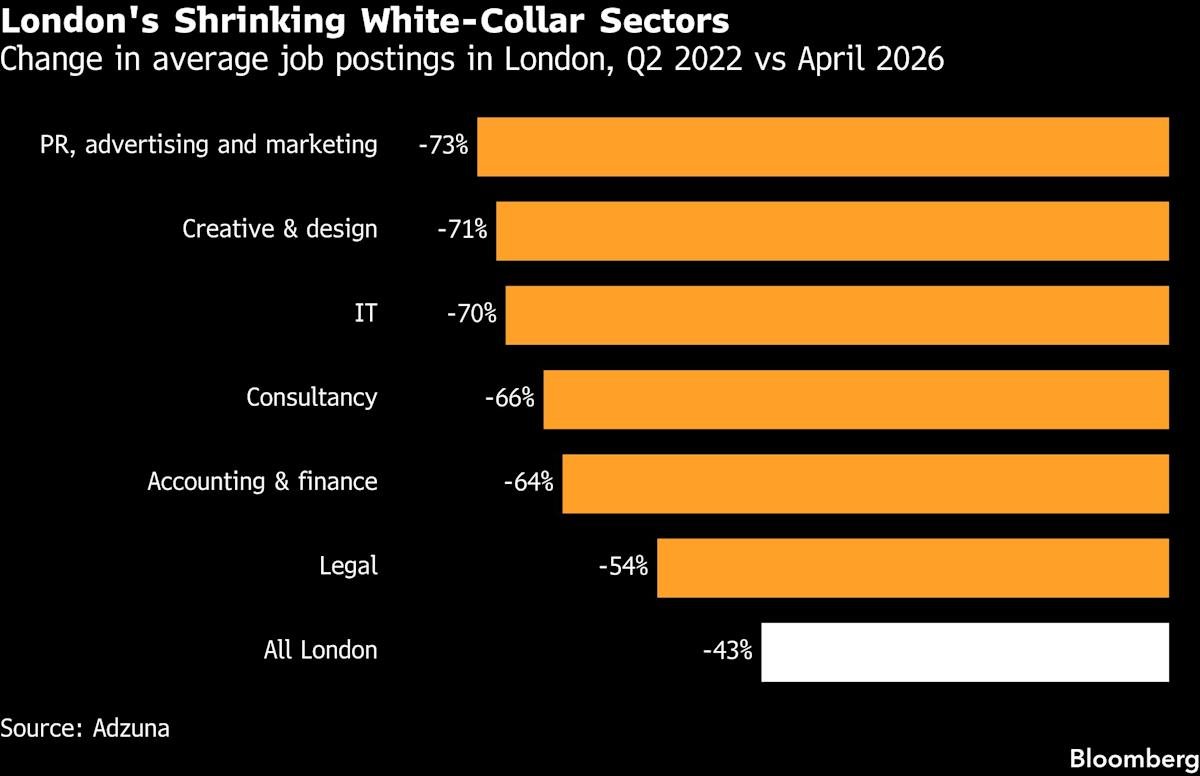
An international hub for professionals, the UK capital is ground zero for the AI jobs shift, and data from Adzuna — the aforementioned recruitment website — reveals which listings have suffered the steepest drop-offs. Once in the hundreds, postings for the City’s corporate lawyers, software developers, management consultants and digital marketing managers have all slumped into the double-digits.
White-collar sectors now account for only a quarter of total London vacancies, Adzuna said, down from almost half in 2022.
Hedge funds that once hired three junior analysts to sift through company filings now need only one person to oversee an AI model. Consulting firms are cutting executive assistants, as tasks such as booking travel and managing partners’ diaries become easier to automate. And banks are shrinking junior analyst classes and letting go of back-office roles, as AI takes over functions such as customer service and transaction monitoring.
“An enormous shift is unfolding across offices, hospitals, classrooms, film studios, public services, and all the things that might define our city, and it’s happening fast,” said Martha Lane-Fox at an AI conference at King’s College London. The entrepreneur, known for founding lastminute.com during the dot-com boom, has been appointed by mayor Sadiq Khan to lead the capital’s response to AI.
Adam Banaszek, a 39-year-old graphic designer, is one of the white-collared Londoners whose jobs are being pulled from under their feet. A six-month search failed to yield a job, while giving a clear picture of how artificial intelligence and economic turbulence are reshaping creative work.
“They want a graphic designer who is also a copywriter, who is also a videographer and who is also animator — basically Renaissance people,” said Banaszek, who now works freelance. “And then they offer you really funny money,” he added, citing London salaries of about £35,000 ($47,100) a year.
The shift is not just in job postings. Banaszek has already had his work rejected in favor of designs made AI, twice.
Research commissioned by the Greater London Authority showed that about half of the capital’s workers, the equivalent of 2.4 million people, are in jobs where AI can automate some of their tasks, a higher proportion than the UK average.
The technology can help many of these workers become more productive, particularly those in multifaceted roles that require judgment, creativity and relationship-building.
By contrast, some bookkeepers, brokers and administrative staff are deemed to be at high risk of losing their jobs to AI tools. In London, there are more than 300,000 of workers in this category. Another 748,000 fall into the next-highest risk category. This includes economists, software developers and accountants.
Take hedge funds. “The demand for great portfolio managers has never been higher,” Sean Sweeney, founder at CW Talent Solutions, said. “But the layer of people underneath them is disappearing fast. Firms aren’t building teams around PMs anymore, they’re handing one person an AI tool and calling it a day.”
It’s a similar picture elsewhere. In marketing, AI tools can analyze campaigns, track website activity and generate instant insights, reducing the need for teams of six to 10 junior analysts. Much of the “boring” audit work of reviewing financial records or checking transactions can be automated, leaving human judgment primarily for the final sign-off, said Shamus Rae, a private investor in AI businesses and former head of innovation at KPMG UK, speaking at the same KCL conference as Lane-Fox.
At retail-robotics business Ocado Technology, CEO James Matthews said AI is helping software engineers complete tasks such as restructuring existing code to make it easier to understand and update, as much as 10 times faster.
Bank executives are talking more openly about using AI to reduce costs and increase revenue. London-based Standard Chartered Plc is set to cut about 8,000 roles due to AI-driven efficiencies. HSBC Holdings Plc is considering eliminating around 20,000 jobs on the expectation that AI will allow it to reduce staffing across its middle and back offices, Bloomberg reported earlier this year.
Businesses have invested a lot in AI in recent years, but the radical gains many hoped for have yet to materialize. A recent Accenture study showed executives still mainly look at the technology as a way to cut costs rather than deliver a step change in productivity.
“Companies are still trying to figure it out and then, if you see your competitor eliminating five or 10% of jobs and you are a publicly listed company, you’re like, ‘okay, we have to do the same’,” said Tomas Chamorro-Premuzic at advisory firm Russell Reynolds Associates. He added that very few companies have come up with a three-five year plan for their workforce.
Those cuts tend to come from entry-level jobs, which risks creating problems down the road.
“If you’re not going to take a cohort of young people to train and develop over the next two to three years, how are you going to feed that pipeline of middle management in years to come?” Andrew Hunter, Adzuna co-founder, said. “I’m not sure anyone has a great answer for that.”
Banaszek, the graphic designer who worked in Paris, Berlin, Munich and his native Warsaw before moving to London a year and a half ago, said he is “constantly thinking about what else to do.”
“I’ll maybe apply to a coffee place to work as a barista because I never did it and it seems like they have a lot of fun,” he said. “I also want to go and explore a bit of painting on canvas, working with my hands.”
Most Read from Bloomberg Businessweek
©2026 Bloomberg L.P.


 dailynewsnblog