dailynewsnblog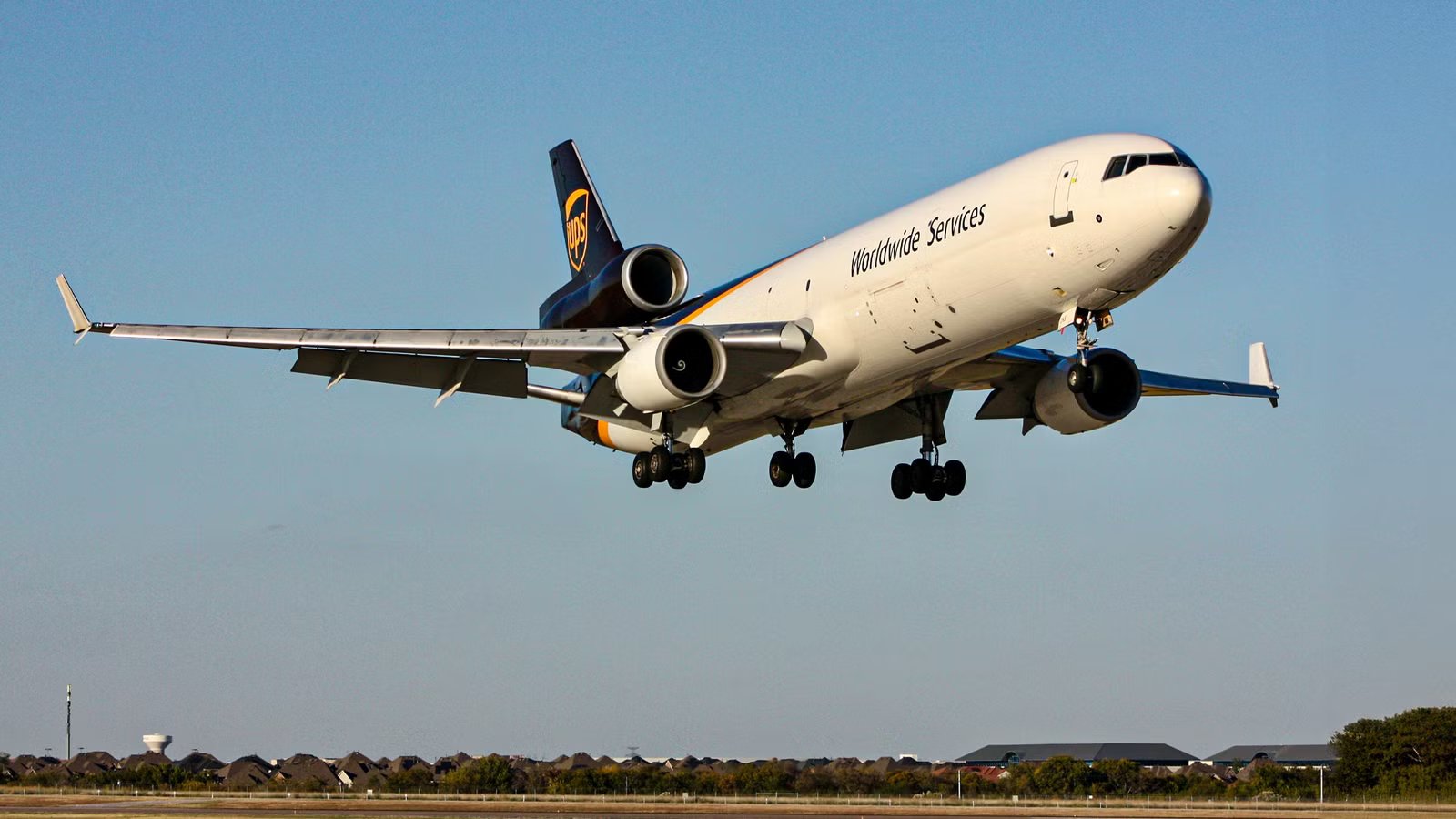
After  UPS Airlines Flight 2976 crashed in Louisville in November 2025 due to a left engine pylon separation, it triggered an abrupt split across global supply chains. Rather than using the downtime for long-term airframe overhauls, UPS recorded a $137 million after-tax write-off to permanently retire its entire fleet of 27 McDonnell Douglas MD-11 freighters in January 2026. Across the runway in Memphis, FedEx chose the opposite path, funding mandatory structural pylon inspections and returning its grounded trijets to service, pushing the type’s final retirement horizon out to January 2032.
The split has brought to light an operational dilemma for global logistics networks. Replacing an airframe capable of lifting 187,393 lb (85,000 kg) across intercontinental routes is not a simple one-for-one swap, because no active production freighter sits in the exact payload slot previously occupied by the McDonnell Douglas trijet. This article looks at how airlines are mapping out their next steps following the accelerated retirement of the MD-11 fleet.
A Two-Track Solution?

Main-deck cargo operators are replacing the McDonnell Douglas MD-11 with two aircraft, rather than just one, with a view to use both types in unison with each other. Because no single twinjet identically matches the MD-11’s combination of 187,393 lb (85,000 kg) payload capacity and lower acquisition cost, carriers have split their replacement strategy between high-frequency regional widebodies and ultra-long-haul intercontinental freighters. This strategy pairs the Boeing 767-300F for medium-range express lines with the larger Boeing 777F for heavy transpacific and transatlantic trunk routes.
This bifurcated approach became urgent following the January 2026 withdrawal of UPS’s remaining 26 active MD-11 airframes, which abruptly removed roughly 9% of the carrier’s global main-deck airlift fleet, according to Yahoo Finance. To stabilize its primary hub in Louisville, UPS accelerated its delivery schedule for 18 new Boeing 767-300Fs, taking 15 of those airframes in 2026 alone to aid regional and domestic express flights. Meanwhile, international heavy-lift routes were shifted toward larger Boeing 777 freighters, a pattern mirroring Lufthansa Cargo’s earlier fleet transition, which explicitly phased out its final MD-11F in favor of a unified, all-777F fleet.
Adding more 777Fs solves the long-haul intercontinental payload side. However, deploying a high-capital flagship widebody on shorter regional legs is not the best idea from an economics standpoint, as there are far more efficient aircraft now on the market that would fit the bill. That reality leaves regional express networks heavily reliant on smaller twinjets to handle daily volume.
Far Better For Efficient Operations

Picking up the daily volume of a heavier trijet with a smaller twinjet relies on operational frequency and network agility rather than single-flight payload capacity. By replacing two daily MD-11 trips with three 767-300F rotations, express cargo operators align main-deck uplift directly with package sorting cycles at major hubs like Louisville, Memphis, or Cologne. As a result, integrators can dispatch packages in smaller, time-sensitive waves throughout the day, smoothing out sorting delays at central air hubs and maintaining overall package throughput.
The 767-300F provides a maximum structural payload of 116,100 lb (52,662 kg), which is 71,293 lb (32,338 kg) less than the 187,393 lb (85,000 kg) baseline capability of a converted MD-11. However, express logistics providers frequently run out of volumetric cargo space before reaching maximum structural weight limits. The 767-300F accommodates 24 main-deck pallet positions compared to 26 on the MD-11, helping carriers preserve essential containerized volume metrics while cutting block fuel burn by roughly 35% per flight hour.
Scaling up 767-300F flight schedules stabilizes high-density regional networks, which is the main purpose for its inclusion in fleets like that of UPS. The problem is that a smaller twinjet like the 767 struggles on long intercontinental corridors. With a full-payload range of 3,225 nautical miles (5,972 km), the 767-300F cannot be used for deep transpacific or transatlantic routes without needing costly intermediate refueling stops.
Perfectly Taking Charge On Longer Routes

The job of handling heavy intercontinental routes where smaller twinjets lack the range and payload capacity falls to the 777F. Connecting transpacific corridors like  Shanghai Pudong(PVG) to Memphis(MEM) or transatlantic passages like
  Frankfurt(FRA) to
  Chicago O’Hare(ORD) requires an airframe that matches or exceeds the heavy payload of the trijet without needing an intermediate technical refueling stop in Anchorage(ANC) or Shannon(SNN). In daily operations, substituting a 777F for an MD-11 allows air carriers to reduce fuel burn by roughly 20% per flight hour while gaining extended nonstop capability.
Built upon the high-gross-weight airframe of the passenger 777-200LR, the 777F delivers a maximum structural payload of 224,900 lb (102,013 kg) across a full-payload range of 4,970 nautical miles (9,204 km). This capability allowed operators such as Lufthansa Cargo to fully retire their remaining MD-11F fleet, transferring high-density long-haul routes to its mainline 777F fleet and joint venture partner AeroLogic. Holding 27 main-deck pallet positions, one position more than the MD-11, the 777F accommodates 10 feet (three meters) tall main-deck pallets, giving cargo planners the volume clearance needed for heavy industrial machinery and high-density freight containers.
The 777F ultimately provides an ideal heavy-lift replacement on long-haul transoceanic lanes, though getting these airframes into global fleets is not going smoothly at the moment. Production delivery schedules for new-build freighters alongside impending ICAO environmental noise and emissions regulations create a growing fleet supply problem as aging trijets approach end-of-life faster than factory replacement lines can deliver new twinjets.
Retirement Was Always Near

The MD-11 phase-out was in the works long before incidents accelerated the process. Operating a trijet means dedicating significantly higher maintenance hours per flight hour compared to modern twin-engine airframes, amplified by the mechanical complexity of servicing the center engine mounted in the vertical stabilizer. Heavy airframe structural checks, combined with mandatory airworthiness directives targeting engine pylon assemblies and critical bearing wear, dramatically increase indirect operating costs. Concurrently, the International Civil Aviation Organization (ICAO) Annex 16, Volume III carbon emissions standards enforce strict fuel-efficiency thresholds for aircraft operating in global commerce, which the aircraft is not designed to meet.
Carrier fleet strategies reflect distinct operational trade-offs as they balance these regulatory and maintenance pressures. UPS Airlines accelerated the complete retirement of its MD-11F fleet following fleet-wide pylon bearing inspections, opting to reallocate volume to its 767-300F and 777F airframes. Conversely, FedEx adjusted its retirement horizon, extending the operational timeline for select MD-11Fs from 2028 out to 2032 to support its deferred international freight network while taking delivery of new factory-built freighters. Charter and ACMI operators like Western Global Airlines face a more uncertain future, as higher C-check inspection costs and sudden fleet groundings create capacity constraints before secondary market twinjet conversions can be sourced.
With current-generation freighter production facing ICAO deadline limits at the end of 2027 and next-generation models like the Boeing 777-8F still awaiting entry into service, air cargo carriers cannot retire heavy trijets without triggering strong transoceanic airlift shortages. Consequently, the whole industry seems to be moving toward the two-tiered freight model, where ultra-long-haul heavy corridors rely on high-capacity twinjets, while mid-range and regional feeder routes absorb converted narrowbody and medium widebody freighters.
The Ambitious Newcomers

The main reasons modern cargo jets are so desired are their carbon fiber composite airframe construction, optimized cargo door placement, and full compliance with 2028 ICAO CO2 emission standards. Rather than simply matching the volume of legacy trijets, the Airbus A350F and Boeing 777-8F have structural weight reductions that allow higher payload-to-fuel ratios over ultra-long-haul routes. This means transoceanic trade lanes can retain high-density main-deck capacity without exposing operators to environmental penalty surcharges or tightening airport noise restrictions.
The technical profiles of these next-generation freighters illustrate how aircraft manufacturers are building airframes around modern freight realities. The A350F provides a maximum structural payload of 245,000 lb (111,000 kg) and features a 14.7-foot (4.5-meter) wide main-deck cargo door situated behind the wing. Meanwhile, the 777-8F uses composite wing technology derived from the 777X program to deliver a structural payload of 260,800 lb (118,000 kg) across a range of 4,410 nautical miles (8,167 km). Both designs allow freight operators to lift heavy industrial machinery across intercontinental distances using two engines while burning significantly less fuel than a three-engine McDonnell Douglas trijet.
As global logistics integrators commit billions of dollars to secure early delivery slots for these composite flagship freighters, the air cargo market is now clearly split between old and new. With capital acquisition costs for factory-built next-generation widebodies exceeding $200 million per unit, smaller charter operators and secondary freight carriers may find themselves priced out of new airframe orders. As a result, it could usher in a new era of air cargo operations, one where an airframe’s age carries far more weight than it ever did before.
The New Face Of The Air Cargo Industry

The retirement of the MD-11 comes at a time when its absence has far more meaning for the future of air cargo operations. Its departure coincides with a critical turning point in the industry, as capital expenditure and the ability to afford the latest jets have finally reached cargo operations. The era when independent charter carriers could acquire low-capital, heavy-lift trijets from secondary passenger operators seems to be over, reshaping the financial barrier to entry across international trade corridors.
The 767-300F and current-generation 777F production will end by December 31, 2027, leaving the industry with a narrow operational bridge. Airbus targets initial customer deliveries for the A350F in late 2027 following its 2026 flight-test program, while Boeing has slated entry into service for the 777-8F in 2028. Whether global supply chains avoid transoceanic capacity shortages depends entirely on whether factory assembly lines can meet delivery targets before structural fatigue checks force remaining trijets into permanent retirement.
Time is almost up for the MD-11 after decades of passenger and, more recently, cargo service. Its departure was inevitable, but the speed at which it has approached has been a little faster than many expected. After its final flight, attention will shift to the future, when the fleets of global air cargo operators will likely be more dissimilar than ever.