dailynewsnblog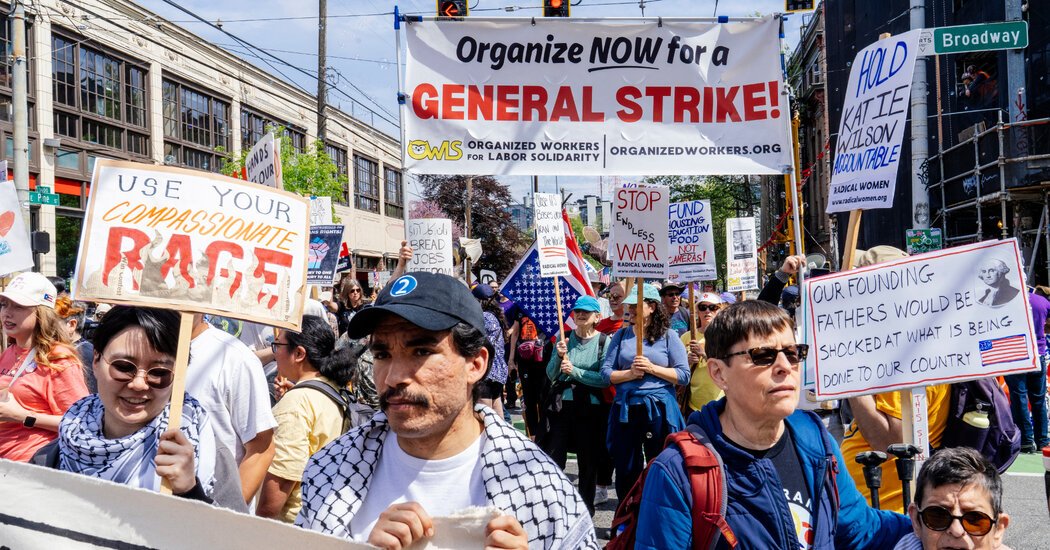
Seattle’s mayor, Katie Wilson, gave a long, thoughtful response a few weeks ago when conversation at a Seattle University forum turned to the current economic climate and her support for higher taxes on wealthy residents and large businesses.
Then Ms. Wilson, a democratic socialist in her first year in office, went off the cuff: “I think the claims that millionaires are going to leave our state are super overblown,” she said. “And the ones that leave? Like, bye.”
Ms. Wilson’s comments generated applause and laughter in the room. But outside, the remarks drew a swift reaction and highlighted how political leaders and business executives are increasingly uneasy about Seattle’s changing relationship with the companies that helped transform the city into a global hub for entrepreneurial innovation. Her “like, bye,” and the wave she gave with it, also pulled Seattle into a broader debate in liberal cities about how to solve rising housing prices and economic disparity without driving away investment, employers and affluent residents.
In Seattle, the current debate centers on one company at the heart of its modern identity, Starbucks, which recently announced plans to create a 2,000-employee corporate hub in Nashville. Even before Ms. Wilson’s comments, anxiety was rising that the coffee giant — or at least more of its operations — could drift away from its hometown.
“I am gravely concerned,” said Rob Saka, a Seattle City Council member whose district includes West Seattle neighborhoods where many Starbucks executives live. “This is real.”
Ms. Wilson’s comments have drawn national attention to the worry among business leaders that Seattle doesn’t appreciate them, first from right-wing influencers, then mainstream outlets. Last week, Starbucks co-founder Howard Schultz singled out the mayor in a Wall Street Journal column accusing Ms. Wilson of “socialist rhetoric” that “vilifies employers, even while she continues to rely on them for revenue.”
Republican states like Tennessee have taken advantage of the tension, making overtures to executives like Starbucks’ Brian Niccol, who has no ties to Seattle but was hired in 2024 to pull the company out of a post-pandemic malaise. Under his leadership, the company has seen earnings rise but has also cut around 2,000 jobs, including 300 corporate positions Starbucks announced it would be trimming last week as part of an ongoing restructuring effort.
Pro-business sentiments in Nashville and Middle Tennessee are not necessarily matched around the Puget Sound. Last fall, voters in the region elected a slate of candidates, including Ms. Wilson, that promised more taxes on the wealthy. This spring, the state legislature created a new “millionaire’s tax” on personal income over $1 million, and recent polls have shown a majority of potential Washington voters, including Republicans, support the tax, which opponents are trying to force onto the November ballot.
“The mayor made a flip and unwise comment,” said Jon Scholes, president of the Seattle Downtown Association, but her remarks reflected a broad sentiment.
Starbucks has been a part of Seattle’s basic fabric since the first Pike Place Market store opened 1971, but its rise as a national brand coincided with the era of Nirvana and “Twin Peaks,” when the Northwest “presented this kind of moody, bourgeois cool,” said Bryant Simon, a historian at Temple University.
Starbucks shed that perceived brand coolness as it grew to more than 40,000 stores and became as ubiquitous as McDonald’s. Mr. Schultz has retired and, like Mr. Bezos, recently left Washington for Florida.
Starbucks officials have framed the Nashville investments as a natural next step in their efforts to grow, particularly in the South and the Sun Belt. In an April 21 letter to employees, Sara Kelly, the company’s chief partner officer, described the Nashville expansion as a “complement to our global and North America presence in Seattle.”
Still, Tennessee, which has no state income tax, a lower cost of living and right-to-work laws that make labor organizing more difficult, is pointedly offering itself as a refuge for companies weary of higher taxes, tighter regulations and soak-the-rich sentiments. Mayor Freddie O’Connell, a Democrat, has helped encourage corporate moves to Nashville, even as he confronts concerns about higher costs pushing local businesses out.
“We don’t get into the blues and the reds and the political side of things,” said Stuart C. McWhorter, Tennessee’s economic and community development commissioner.
At least one store in Nashville, in the Green Hills neighborhood, is affiliated with the union, where workers had watched an uptick in corporate visits with interest before the expansion announcement.
Elected leaders in Seattle and Washington, almost all of them Democrats, are navigating challenges that include rising costs that are outpacing revenue growth and voter frustration over affordability and wealth inequality. The median home price in Seattle, $860,000 in April, was almost double Nashville’s.
Ms. Wilson’s election was a direct response. Before running for mayor, she ran a small nonprofit that advocated for public transit riders, and business interests spent almost $2 million trying to defeat her.
Now she is learning on the job at a time when Seattle’s political mood and the broader economy may be misaligned, with job cuts and slower growth harming labor markets. Last fall, she capped her election win by visiting a barista union rally to declare: “I am not buying Starbucks, and you should not either.” Today, she says that was a mistake and a rough spot on the learning curve between liberal activist and elected leader.
“Those comments were not productive in the sense that they caused more harm than good,” she said in an interview.
The mayor said she understands now that everything she says will be parsed for potential anti-business sound-bites and that she should have “a multidimensional relationship” with companies like Starbucks.
Seattle has experienced versions of this anxiety before. During the bruising 2018 debate over a proposed tax on large employers to fund homelessness services, Amazon temporarily halted planning on a new downtown office tower and publicly questioned its future in the city. Boeing moved its headquarters to Chicago from Seattle more than two decades ago, before moving again to Arlington, Va.