dailynewsnblog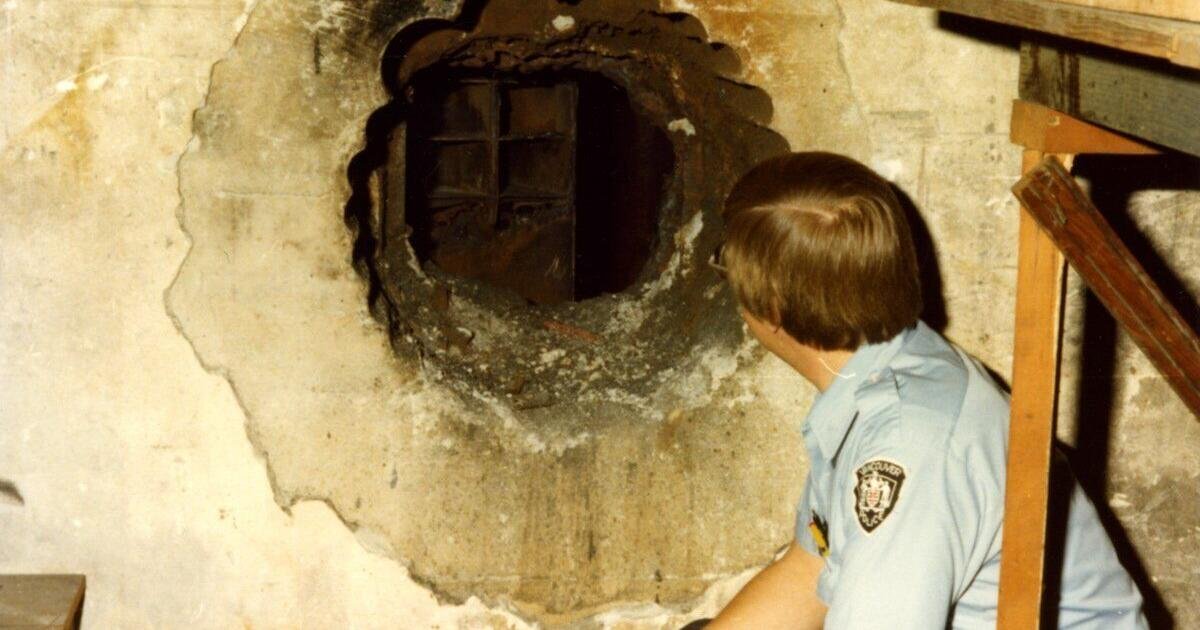
As burglaries go, it was a staggering accomplishment. The 1977 break-in at the Vancouver Safety Deposit Vaults required cutting through more than two feet of concrete wall and four inches of armour plating. The total haul was unclear but more than a million dollars, and five men were quickly arrested. But as laid out in the new book “The (Almost) Perfect Heist: The Incredible True Story of the Vancouver Safety Deposit Robbery,” there are questions that have never been answered.
Monday, January 10 began as a typical morning at Vancouver’s safest vaults. Custodian Andy Easton arrived at his usual time of 7:45, headed directly downstairs to the main vault, and prepared to open its seven-inch-thick door at the programmed time. When he did, he was stunned.
Doors on hundreds of deposit boxes were missing or hanging askew from their hinges, while a majority of the top nine rows of boxes appeared to be intact and locked. Discarded papers, including insurance documents, mortgages, and stock certificates, littered the floor, and empty deposit boxes were stacked haphazardly. Easton immediately called the Vancouver Police Department.
Upon arrival, detectives Vern Campbell and George Barclay immediately noticed the discoloration around the vault door. Like Easton, they soon realized it was a thin layer of rust. Authorities later confirmed this rust was probably caused by oxidation from using a thermal lance to cut through the vault wall.
According to Campbell, the floor was absolutely littered with gold coins. Krugerrands (iconic South African gold coins) were scattered haphazardly amongst the debris. Sacks of old coins were piled in a corner and were later confirmed to contain a very high silver content. “You couldn’t move in this fifteen-by-forty foot room without stepping on things,” Campbell said. “There were Bearer bonds, hundreds and hundreds of thousands of dollars’ worth, left lying on the floor.”

A bag of gold loot from the 1977 Vancouver Safety Deposit Vaults heist.
Don Levers Sutherland House photo
Crime lab officer Jeff Hilton declared, “I was knee-deep in valuables.” In a later story, one investigator recalled, “They just tore everything asunder and grabbed what they considered the most valuable.”
In a Vancouver Police report dated Jan. 25, Detective Bob Desmarais wrote, “A large amount of Stock, Bonds, Coin Collections, Stamp Collections, Currency (both Foreign and Canadian) were strewn about the floor to a depth in places of approximately two feet.”
The Vancouver Sun ran several headlines about the heist in its paper on Jan. 11, 1977, including one with the tag line: “Loot in ‘tens of millions.’ ” Hilton had an indelible memory: “I thought I had trodden on a piece of rubble, but when I looked, I found a diamond embedded in the sole of my shoe.”
Twelve hours before the break-in was discovered at the Vancouver Safety Deposit Vaults, another set of events was unfolding at the Vancouver International Airport.
CP Air’s Flight 68 was a DC-8 scheduled to depart that night for Toronto, with its final destination Montreal. It was configured to carry 12 first-class passengers and 129 in economy.

Tools left in the rubble of 1977 Vancouver Safety Deposit Vaults heist.
Don Levers/Sutherland House photo
Five men arrived at the CP Air counters in separate groups. Even though their flight was not scheduled to leave Vancouver until 11:59, Kenneth Fisher, travelling under the name Fields, and Robert Steve Johnston, using the name Ward, checked in after 9 p.m. Talbot Murphy, whose ticket was purchased under the name Harris, was observed standing in a check-in line behind Fisher (Fields) around 9. Ronald McCann and Paul Thomas Bryntwick would arrive less than an hour before their flight, using the names Jones and Weir, respectively.
Johnston’s luggage consisted of two tan soft-sided suitcases, a hard plastic Samsonite-style suitcase, also tan in colour and quite new-looking, and a small, zippered dark yellow sports satchel. After placing destination tags on the luggage, ticket agent George Siemens lifted the first two and found them remarkably heavy. He attached four colour-coded baggage tag stubs to Johnston’s ticket, put everything in a boarding pass envelope, and handed it back to him.
“What have you got in these bags? Ore samples?”
Johnston just shrugged and smiled as the other two bags were lifted off the scales. Then, in a friendly manner, Johnston said, “Do you get a lot of miners coming through here?”
“Oh, ya, we sure do,” came the chuckled response.
Johnston offered a quick, “Thank you,” then started walking toward the Air Canada section.
Around 9:40, CP Air ramp supervisor Jack Taliday was sitting at his desk when ramp attendant Ryan Lynch came in and said, “Jack, I’ve got some baggage out here … There’s something odd about it.”
When later interviewed, Lynch said, “I picked up a bag. It was heavy … The other members of the crew and I picked up a total of five bags; they were all heavy.”
Inside Taliday’s office, they opened the unlocked suitcase. Packed on top was some old clothing. Digging deeper, Jack felt two solid masses at the bottom. There were two heavy objects inside, wrapped in a plastic garment bag.
“I opened the garment bag and discovered two currency bags. I believe they were marked The Royal Bank of Canada … Both were tied shut with old socks.”
Lynch let out a shriek. “Close it; I know it’s money.”

A $1,000 bill (the equivalent of $5,000 today) recovered after the 1977 Vancouver Safety Deposit Vaults heist.
Don Levers/Sutherland House photo
It was approximately 10:20 p.m. when Taliday approached Constable Stone of the Airport Special Squad about the suspicious bags and asked her if she wanted to inspect them.
After opening each bank bag, Stone discovered that both contained gold coins and gold bars. A second suitcase was then brought in and inspected, then the rest.
Taliday noted the last one was lighter than the original five. Stone’s report indicates this bag contained old clothes and crumpled-up newspaper, and another bank bag and a large sum of paper money, consisting of twenties, fifties, and hundreds in current Canadian currency. There was also some American currency.
Taliday recalls that after Stone removed several gold ingots and wafers from another bag, she retrieved an item no one expected: a stack of 100 orange-coloured $50 bills still held together with a paper banknote strap. This type of note was not in circulation. The face design of the banknotes depicted King George VI. His likeness had been replaced in 1954 with a portrait of Queen Elizabeth, meaning these fifties were at least twenty-three years old.
On the evening of Jan. 10, charges of possession of stolen property were laid against all five individuals. To verify the identities of all five men, fingerprints were obtained and faxed to the RCMP headquarters in Ottawa. Notification from headquarters confirmed Johnston and Fisher were both residents of Montreal.
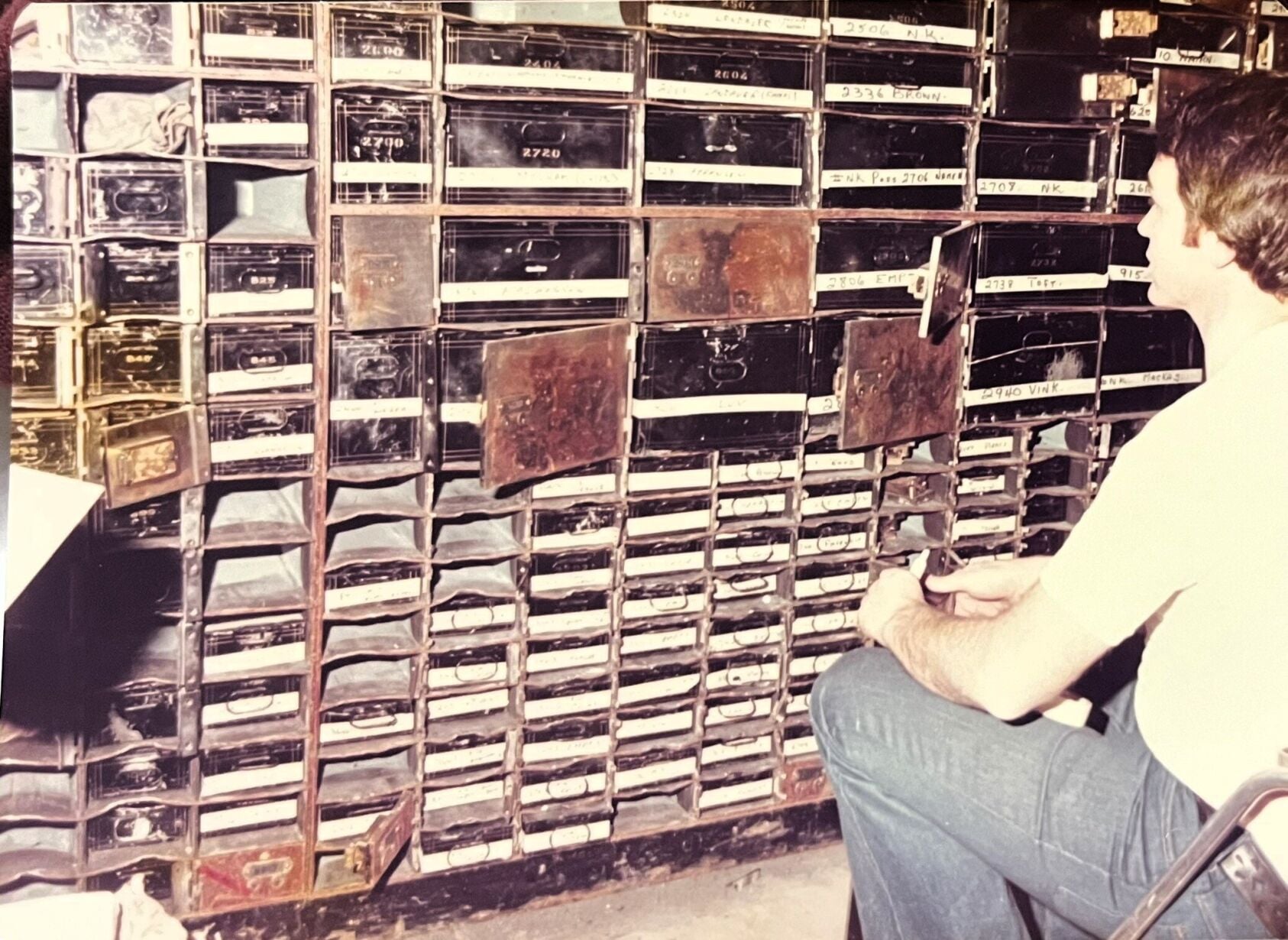
Safe deposit boxes found in the aftermath of the 1977 Vancouver Safety Deposit Vaults heist.
Don Levers/Sutherland House photo
McCann was an expert safe and vault man, well known in Montreal. Johnston, Fisher, and Murphy were considered prime suspects in an armoured car robbery that had occurred in Montreal. It had even caught the attention of The New York Times, which ran a story about five men hijacking a Brinks truck. The Times reported the amount stolen totalled $1.6 million in cash. The Montreal Gazette headline read, “Brinks bandits grab $2.8 Million.”
While the amounts varied, the details around the execution of the heist, accomplished with almost military precision, became the real story. An armoured vehicle had just loaded cash from a bank when two trucks, a small moving van, and a cargo-style unit pulled in front of it. A man with sunglasses tapped the driver’s window and pointed toward the cargo van. Its back doors were open, revealing two men manning a U.S. army-issued anti-aircraft gun. After ordering the driver out, the bandits overpowered him.
(Although Montreal police mentioned that Johnston, Fisher, and Murphy were suspects in the Brinks heist, there is no other evidence of their involvement, however. None of the men was mentioned again in connection with that robbery.)
On Jan. 14, the five men were further charged with breaking and entering and theft from the Vancouver Safety Deposit Vaults Company. Later that day, Bryntwick and Murphy appeared in court for a bail hearing.
Richmond Provincial Court Judge W.E. Campbell set Bryntwick’s bail at $25,000 cash or valuable securities, with the condition that he remain in B.C. until his proceedings were finalized. Fisher’s bail was double Bryntwick’s, with Judge Campbell stipulating that Fisher must also stay in B.C. Johnston’s hearing was set for Jan. 18, McCann’s on Jan. 19, and Murphy’s hearing was remanded until Jan. 28.
It seems neither Bryntwick nor Fisher followed the judge’s instructions concerning bail. On June 20, they were arrested with two others during a robbery dry run at Alliance Sécurité Blindé, an armoured car company in Montreal.
If Fisher and Bryntwick had pulled that one off, they may never have returned to face trial in Vancouver. Montreal police suggested the haul could have climbed upward of $30 million.

“The (Almost) Perfect Heist: The Incredible True Story of the Vancouver Safety Deposit Robbery”
Don Levers
Sutherland House Books
188 pages
$21.95
Shalomi Ranasinghe Sutherland House Books photo
On Monday, Oct. 31, Fisher, Johnston, McCann, and Bryntwick appeared in provincial court. (Talbot Murphy, who would skip bail before the other four men stood trial, would not be found for years.) In an unexpected plea deal, each man pleaded guilty to two counts of possessing more than $2.5 million in stolen goods. They were also facing 106 charges related to the breaking and entering, but the defence attorneys persuaded the Crown to drop them all. Judge Kerry Smith didn’t sound pleased: “I am concerned about the course of events resulting from the guilty plea worked out in talks between the Crown and defence lawyers.”
A lawyer for the accused told reporters, “The negotiations didn’t really constitute a plea bargaining in the accepted sense of the word. It was more a matter of crown and defence lawyers recognizing the crown had an almost insurmountable case of the possession charges but a very weak case on the breaking-and-entering counts.”

Author Don Levers.
Sutherland House Books photo
Talbot Murphy was the most experienced criminal on the crew that robbed the Vancouver Safety Deposit Vaults. After his arrest, he skipped bail. Legend has him heading to Rio de Janeiro. If so, did he spend his time there sipping Caipirinhas on Brazil’s Ipanema beach? Sitting too long in one place didn’t appear to be his style. It is no surprise that, six years later, he was back working at his chosen profession in the Bronx, New York. On June 27, 1983, The New York Daily News reported that eight men, including Murphy and a former police narcotics detective from New Jersey, had been nabbed in a $1.5-million heist. According to FBI spokesman Mike McDonnell, “It was a very professional job.”
Questions remain to this day about uncaught higher-ups, possibly in organized crime. Officers who worked on the Vancouver investigation speculate that there were probably seven men from Montreal’s West End Gang involved. Special Prosecutor John Hall in June 1980, regarding Fisher, Johnston, McCann, and Bryntwick, proved to be prophetic: “They were so close-mouthed that we may never know for certain who financed and organized the job.”
Excerpted from “The (Almost) Perfect Heist: The Incredible True Story of the Vancouver Safety Deposit Robbery” by Don Levers. Copyright © 2026 Don Levers. Published by Sutherland House Books. Reproduced by arrangement with the Publisher. All rights reserved.



![House of the Dragon season 3 episode 2 ending explained: Let’s talk about [SPOILERS] big death](https://dailynewsnblog.com/wp-content/uploads/2026/06/emma-d-arcy_0.jpg)