dailynewsnblog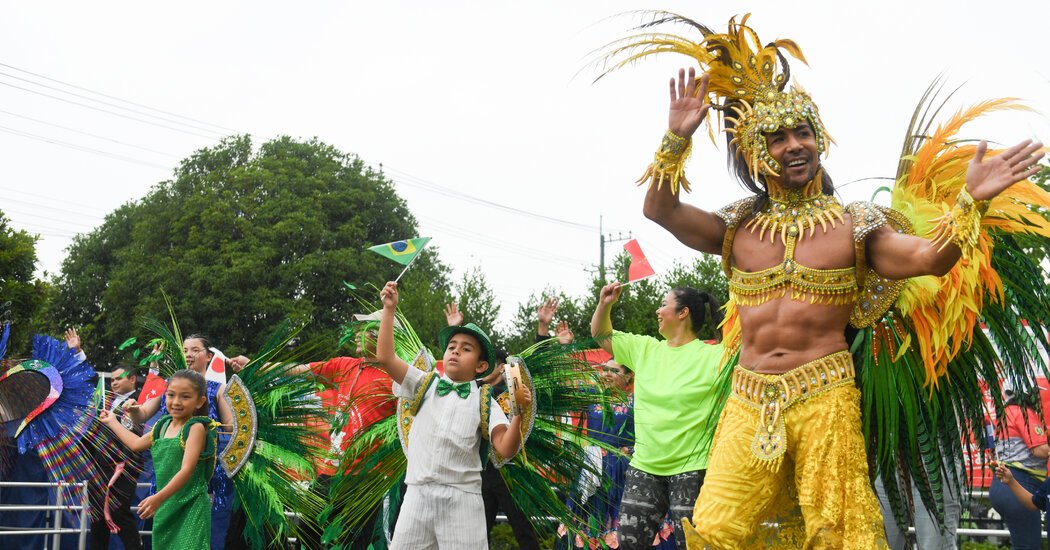
The music was blasting, the crowd was cheering and Carlos Eduardo Santos, 9, dressed in a glittering green-and-white carnival costume and waving a Brazilian flag, let out a shout.
“Vamos, Brasil!” he said from the stage of a Brazilian cultural celebration on Sunday in Oizumi, a Japanese town of nearly 42,000 people known as Little Brazil.
It was less than two days before Japan and Brazil faced off in the knockout stage of the World Cup and Carlos Eduardo, who was born in Oizumi to Brazilian immigrants and attends elementary school there, was cheering his team on. He made plans with his mother, Karen, who works at a nearby Mitsubishi plant, to wake up in the wee hours of Tuesday local time to watch the game live.
“It’s a bit sad because I’m here in Japan, but my heart is in Brazil,” he said after samba dancing in the rain. “It’s the biggest dream for every Brazilian to see Brazil win again.”
Oizumi, about 60 miles north of Tokyo, is one of Japan’s best-known Brazilian enclaves. It has about 4,800 Brazilian residents, many of Japanese descent, the result of migration between the two countries over nearly 120 years. It is a place where private schools teach both Portuguese and Japanese; churches stand next to Shinto shrines; and the smells of churrasco and ramen mix in the air.
Monday’s game in Houston — which will determine whether Japan or Brazil advances to the round of 16 at the World Cup — is testing the loyalties of Oizumi’s residents, many of whom feel connected to both countries.
Brazil and Japan have a history of warm ties and, over the years, there have been waves of immigration in both directions. The first group of Japanese, about 800 in total, arrived in Brazil in 1908 on a boat called the Kasato Maru to work on coffee plantations. At the time, Japan was suffering from rural poverty and overpopulation. Brazil was attractive in part because informal policies in the United States sought to limit the entry of non-Europeans.
By 1990, the tables had turned and Japan was looking for overseas workers to help in critical sectors like manufacturing and construction. The Japanese government, which generally maintains strict immigration policies, relaxed its policies to allow second- and third-generation Japanese Brazilians to work in the country.
Japan is now home to about 210,000 Brazilians, in places like Nagoya, Toyota City, Hamamatsu and Oizumi. Brazil hosts the largest Japanese diaspora in the world, totaling about 2.7 million people.
José Ricardo Rocha Dias, 44, immigrated to Japan more than two decades ago from São Paulo and works at a steel forging plant. He supports Brazil in the World Cup and has been teasing his Japanese co-workers lately by holding up an image of Brazilian soccer players on his cellphone with the caption, “Show your strength, Brazil!”
Mr. Rocha Dias said he hoped the game would help bring the community together. Like the rest of Japan, Oizumi, in Gunma Prefecture, has seen the rise of far-right movements that have targeted foreigners, including the Brazilian-Japanese immigrants who have enjoyed special status.
“It’s a moment for the two countries to come together — for the Japanese people not to see us as a threat or as an enemy, but as a brother,” he said.
At the cultural event on Sunday, a Japanese television crew asked residents for predictions; 20 out of 25 said that Brazil, which has won the tournament five times, would beat Japan. Despite a strong run so far, Japan is considered an underdog. The two teams previously faced off at the World Cup in 2006, when Brazil won 4-1.
Yohji Nakajima, 53, a professional dancer who took part in the samba performance, has no family ties to Brazil, but said he felt connected to the freedom and warmth of its culture.
“It’s so difficult, because I love both countries,” he said, wearing a feathered headdress. “This time, I will support Japan, because we have been dreaming for so long to be the champions.”
Oizumi is officially promoting neutrality. The town has put up posters showing Mayor Toshiaki Murayama wearing a jersey that is half Japanese and half Brazilian, alongside the phrases “Ganbare Nippon” or “Go, Japan!” and “Vamos Brasil” or “Let’s go, Brazil!”
“Japan and Brazil, let’s cheer for them both together,” the poster says.
Spirits are running high ahead of the game. Stores are selling Brazil jerseys and temporary tattoos that read, “We Are the Champions!” Some workers have requested leave.
Amanda Hashimoto, 36, who works at a care center, has roots in both Brazil and Japan. Before World War II, her grandparents emigrated from Japan to Brazil, where she and her parents were born. In this tournament, the family is supporting Brazil; Ms. Hashimoto’s daughter, Sophia, 12, is predicting a 5-0 win.
“In Brazil, we are crazy about soccer; life stops for the World Cup,” Ms. Hashimoto said. “We want Brazil to win. But however it turns out, life will go on.”
Kiuko Notoya contributed reporting from Tokyo.