dailynewsnblog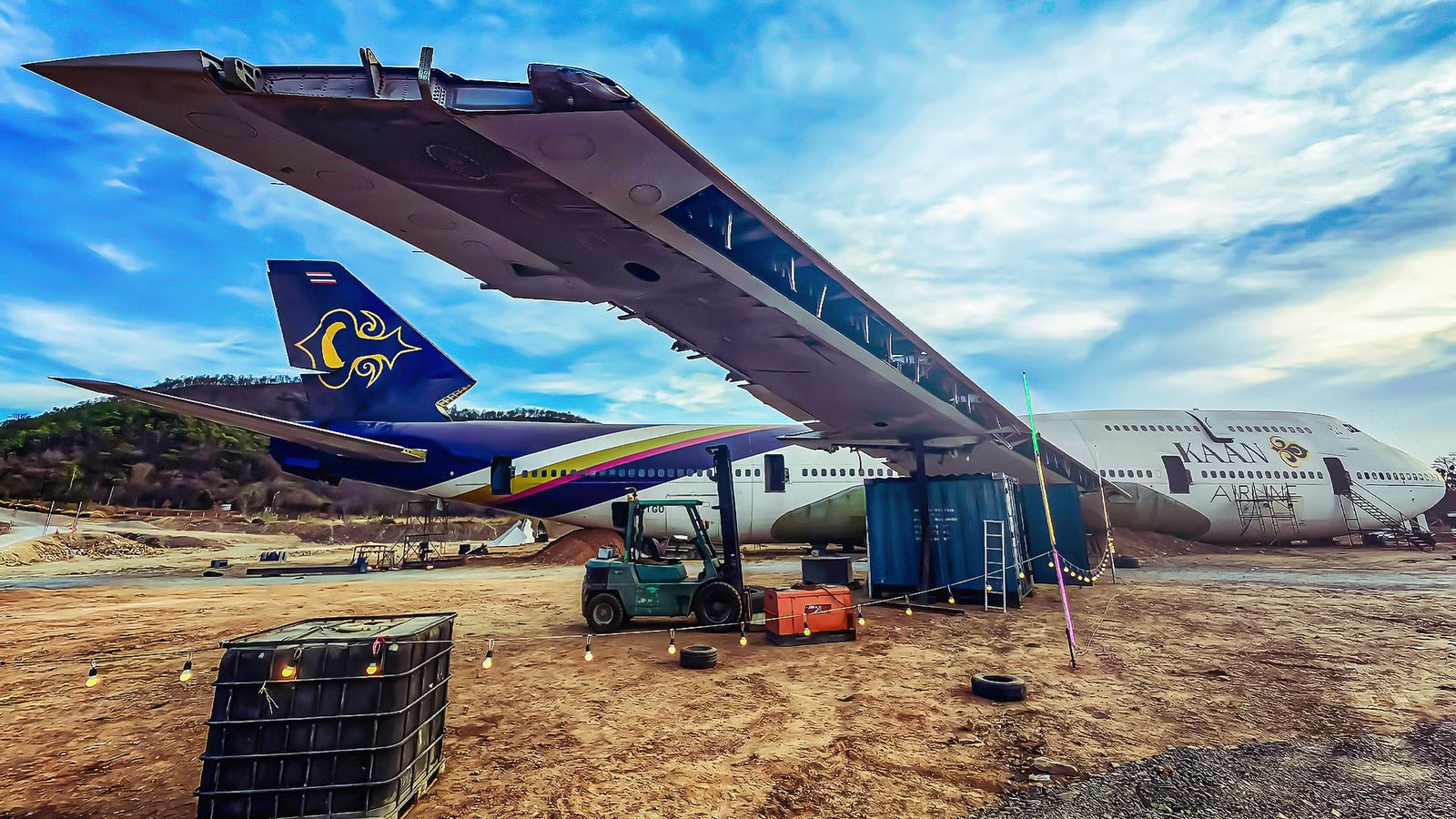
At the end of its life, a Boeing 747 is flown to a boneyard, where aircraft scrappers and recyclers follow a multi-stage process to safely dismantle the aircraft and sell its parts, either to support in-service 747s or to be recycled for other uses. Demand for parts from scrapped 747s is higher than you would think, as there is still a large fleet of 747 freighters in service, and the 747 has been out of production for over three years.
However, 747 part demand is far from even. A 747’s engines can be sold for roughly $2 million each, while its landing gear can go for close to $300,000. Its cockpit displays can be had for roughly $30,000 each, while its APU will typically go for around $25,000.
Meanwhile, the total value of the raw scrap metal from the rest of a 747 is usually worth close to $55,000, while it costs approximately $60,000 per month to store a 747 at a boneyard. This dynamic is not unique to the 747, and what it reveals is that, once you strip away these select components, the aircraft is worthless.
The Scrapping Of A Boeing 747

Before dismantling an aircraft, scrappers must first drain the aircraft of any fluids and deactivate explosives from evacuation slides. Next, the engines are removed, followed by other high-value parts that can be resold in the spare parts market, such as the landing gear and avionics. The airframe is then inspected to ensure that no hazardous materials are onboard.
If so, it can be stripped or crushed for scrap metal, to be reused for aircraft components or in non-aviation applications. A Boeing 747 is made up of roughly 6 million parts, 170 miles (274 kilometers) of wiring, and 147,000 pounds (66,680 kilograms) of aluminum. Approximately 30% of a scrapped 747’s parts get reused in an active 747, and only about 10-15% of an end-of-life 747 gets wasted.
Components from other scrapped aircraft types are also similarly reused so long as they remain airworthy, as airlines can acquire them for significantly less money and in less time than ordering new parts. In addition to parts, airlines often acquire used aircraft and engines specifically for use as parts donors.
n 2015, Richard Anderson (who was the CEO of  Delta Air Lines at the time) made headlines when he claimed that used Boeing 777s could be had for under $10 million, and it was later clarified that this was specifically referring to a parts donor (although Delta never pulled the trigger on it).
  United Airlines acquired several CFM-powered Airbus A319s in the late 2010s and never put them into service; instead, it used them as parts donors, sold the engines, and scrapped the planes.
The Economics Of Aircraft Components

Engines are by far the largest, most expensive, and most complicated components in any aircraft. While the Rolls-Royce RB211 is no longer a common engine, the General Electric CF6 and Pratt & Whitney PW4000, which were also offered on the 747, are still widely used on many in-service widebodies.
Parts that are common to other variants of these engines are highly desirable to a wide variety of operators, while existing 747 operators can gain tremendous value from purchasing 747 engine parts. Landing gear is also extremely complex and is heavily stressed, just like engines.
Acquiring new landing gear components can cost a fortune and often involves long lead times, so operators will simply buy the parts from an aircraft awaiting scrapping. Airliners are typically scrapped because they’re no longer economical for airlines, rather than because the plane and parts are no longer airworthy. As long as the components are inspected and verified to be airworthy, there’s no drawback to using them in another aircraft.
Avionics, APUs, flight control surfaces, electronics, as well as some interior, fuselage, and wing components, also hold value, but much of the rest of the airframe’s components are cheaper to procure new and may be less usable due to fatigue. As such, planes are taken apart for their valuable parts, but much of the aircraft remains as an increasingly empty shell, which is then turned into scrap metal, collectively worth less than the previously removed components.
Low Pricing For Airframes Even With New Aircraft

In an article published on Aviation Week discussing broader aircraft manufacturer pricing, author Scott Mikus discusses how engines, as well as high-value components, make up a huge portion of an aircraft’s value, positing that airframes themselves are being sold for almost no money.
Of course, it’s long been known that manufacturers offer significant discounts to airlines, and that list prices are mainly a selling point to inflate the total value of an order, but these components still make up a majority of an aircraft’s value, new or old. Mikus uses the Boeing 737 MAX 8 as an example, which is listed at $125 million by Boeing but typically sells for less than half that, with Mikus quoting $56 million as a typical market appraisal.
Current Narrowbodies On Sale | ||||
|---|---|---|---|---|
Airbus A319neo | Boeing 737 MAX 7 | Airbus A220-100 | Embraer E175 | Comac C919-100 |
Airbus A320neo | Boeing 737 MAX 8 | Airbus A220-300 | Embraer E190-E2 | Comac C919-600 |
Airbus A321neo | Boeing 737 MAX 9 | Embraer E195-E2 | Comac C919-800 | |
Boeing 737 MAX 10 | ||||
Meanwhile, orders for new CFM LEAP-1B engines, the model used by the 737 MAX 8, are also heavily discounted from their $15 million list price, but appraisals for spare CFM LEAP-1B engines are quoted at $20 million per unit, with a pair of spare engines setting airlines back $40 million.
Given that landing gear and avionics are also highly valuable components, Mikus suggests that the 737 MAX 8’s airframe, as well as those of other aircraft models, have almost no value. This is also evident with the competing Airbus A320neo, where young examples are being actively scrapped because their Pratt & Whitney PW1100G engines are far more valuable than the airframes themselves.
Why This Discrepancy Exists With New Aircraft

The Airbus A320neo family (as well as the A220) is a special case because its Pratt & Whitney engines have experienced significant durability issues. Airbus is having no issue producing these aircraft in high volume, but Pratt & Whitney is experiencing difficulty supplying the A320neo’s PW1100G and the A220’s PW1500G on time.
This is exacerbated by the fact that A320neos and A220s are grounded because of excessive wear and tear, requiring overhauls or replacements. There’s low demand for used A320neos, but airlines are in desperate need of new engines, independent of demand for the aircraft itself.
Although the CFM LEAP has not been hampered by the same durability challenges as the PW1000G family, it’s still experiencing supply chain delays, which have inflated market values for the CFM LEAP. In addition, it’s the only engine available for the hugely popular 737 MAX, while being one of only two options on the even more popular A320neo family, competing against the efficient but troublesome PW1000G.
New Airliners On Sale | Engine Options | New Airliners On Sale | Engine Options |
|---|---|---|---|
Airbus A220 | Pratt & Whitney PW1500G | Boeing 777F | General Electric GE90 |
Airbus A320neo family | CFM LEAP-1A Pratt & Whitney PW1100G | Boeing 777X | General Electric GE9X |
Airbus A330neo | Rolls-Royce Trent 7000 | Boeing 787 Dreamliner | General Electric GEnx-1B Rolls-Royce Trent 1000 |
Airbus A350 XWB | Rolls-Royce Trent XWB | Comac C919 | CFM LEAP-1C |
Boeing 737 MAX | CFM LEAP-1B | Embraer E175 | General Electric CF34 |
Boeing 767 | General Electric CF6-80 Pratt & Whitney PW4000-94 | Embraer E2 | Pratt & Whitney PW1900G |
Similarly, the PW1000G is the only option on the A220, while the A330neo and A350 only come with Rolls-Royce engines, and the 777-9 is only offered with the General Electric GE9X. Engine manufacturers hold fairly strong market positions, especially regarding supplying spare engines where they work directly with airlines, and they are operating with high profit margins as a result.
Meanwhile, Airbus and Boeing compete viciously against one another for aircraft orders, and they sell their planes at extremely low margins as a result. Instead, the majority of their profits come from servicing and parts after the sale.
The Shift Of Value Away From The Airframe

Increasingly, aircraft are no longer being seen as single assets. Instead, the industry views aircraft as a combination of various high-value assets, which has created strong demand for aircraft components on the secondary market, while the airframe itself has little to no value without them.
Because the parts can be reused, they’re the first to go once a plane has reached the end of its economic life, and the airframe itself gets left behind because it essentially serves as a platform for these valuable assets. This dynamic is notable considering that airlines purchase aircraft as a single asset, despite the secondary market valuing these planes as platforms for valuable assets.
This means, however, that high-value components are undervalued when these planes are sold, and that much of an aircraft’s value is only fully realized once it is no longer operational. This gives suppliers like engine manufacturers strong positions in the industry, while Airbus and  Boeing continue to fight tooth and nail for low-margin orders.
In scenarios where specific components are in high demand, like with the Pratt & Whitney PW1000G, an aircraft is essentially worth less than the sum of its parts. The result is that aircraft scrapping is hardly the end of an aircraft’s life, but rather, the point where its full economic value is realized.