dailynewsnblog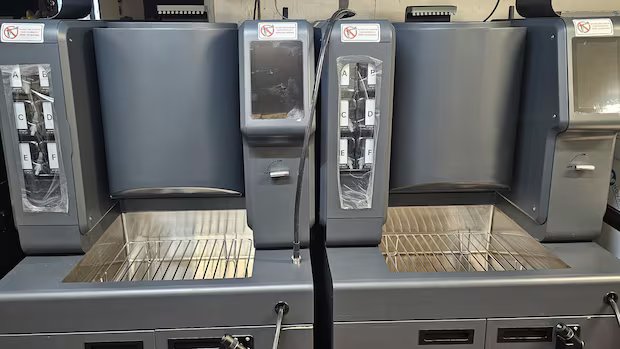
Would you be interested in eating a meal prepared by an AI-powered robot chef?
If you happen to find yourself in Vernon, B.C., it’s an option.
Royal Garden, the community’s oldest Chinese restaurant, has just installed a pair of AI-powered devices from a company called Botinkit that will be tasked with preparing stir fries, chow mein and chop suey dishes in just a couple of minutes.
Speaking with CBC’s Daybreak South, Royal Garden owner Susie Low said she had been researching the technology for several years before deciding to snap up the machines, which cost about $50,000 each.
“The purpose of it is not to replace any staff,” Low said.
“As a business, it is important that efficiency is maintained and consistency is maintained as every customer comes in. We would like to provide consistent service and product every visit.”
Low said the robots are programmed with recipes, and can be trained to refine their efforts until the dish tastes just right. That information is then saved in the cloud and can be replicated exactly by the same or another machine.
She said the restaurant’s kitchen staff remains in place, including her 70-year-old mother who still cooks.
“Having a robot helping her, it just allows her to less physical strain on the body,” Low said.
Appeal to restaurants
Ian Tostenson, president and CEO of the B.C. Restaurant and Foodservices Association, said he’s not surprised to see automation moving into kitchens.
Tostenson said the tools are appealing to an industry that’s currently short about about 15,000 cooks and chefs, and which is grappling with rising costs — including labour.
He believes the technology is more likely to take root in quick-service restaurants that deal in large volume and repetitive tasks, or that require high levels of consistency across multiple locations.
“If I’m having a quick service meal, I don’t really care that a robot cooked the bun … put the fries in the fryer,” he said.
“If I go to a fancy restaurant where [I have a] custom steak and some pasta and sauce and stuff, I can expect some human side of it — so the industry will will develop and they’ll split in terms of [who] does automation and robotics.”

P&P Optica’s Olga Pawluczyk, University of Guelph’s Mike von Massow, and Maple Leaf Foods’ Andreas Liris discuss whether AI and other technology could reduce the need for labour in meat-processing facilities
In the longer term, Tostenson suggested the technology may lead to new kinds of jobs in the food world.
Robots in the kitchen, he said, will need both “food engineering” type specialists in ingredient and cost control, while restaurants will always need creatives who develop recipes.
Automated kitchens a ways away
While the machines are here, one economics professor says it will likely be some time before AI-powered technology reshapes the professional kitchen world.
Ken Kikkawa, an associate professor of economics at UBC’s Sauder School of Business, pointed to AI firm Anthropic’s March labour market report, which found desk jobs to be the most exposed to AI automation, along with little evidence of major job losses — at least for now.
Kikkawa compared the current moment to the transition from steam to electric power, where it took years for firms to invest in the new technology and to physically reorganize physical spaces and workflows to accommodate it.
“You can easily imagine some chefs losing their jobs to these robots,” he said.
“The bigger change is going to come when some restaurants … try it out and see what’s optimal or not, and if it’s successful, other restaurants are going to adopt it … and then they’ll collectively figure out what the best configuration of the restaurants are going to be.”

Economist Armine Yalnizyan said artificial intelligence can be either ‘labour replacing or labour enhancing,’ during an exchange with Jeff Macpherson, director and co-founder of Xagency.ai.
One issue Kikkawa flagged was automation’s potential impact on entry-level work. If AI results in fewer of those positions, where people learn the trade, in the long term the industry could find itself with a shortage of higher skilled workers, he said.
In the end, Kikkawa said, it still remains unclear whether there is customer demand in the market for AI-driven kitchens.
“The whole experience of restaurant is to have a special, you know, vibe … to eat something that someone else cooked for you,” he said.
“If I know that it’s just an AI or a robot that did it, maybe my willingness to pay is not going to be as high.”
Back in Vernon, Low said the Royal Garden’s own experience has shown that robots aren’t necessarily job-killers.
“This is not our first robot. Three years ago we did purchase a serving robot and that was the same kind of response we got from the public,” she said.
“But … we actually have more staff now than we did prior to purchasing the robot.”