dailynewsnblog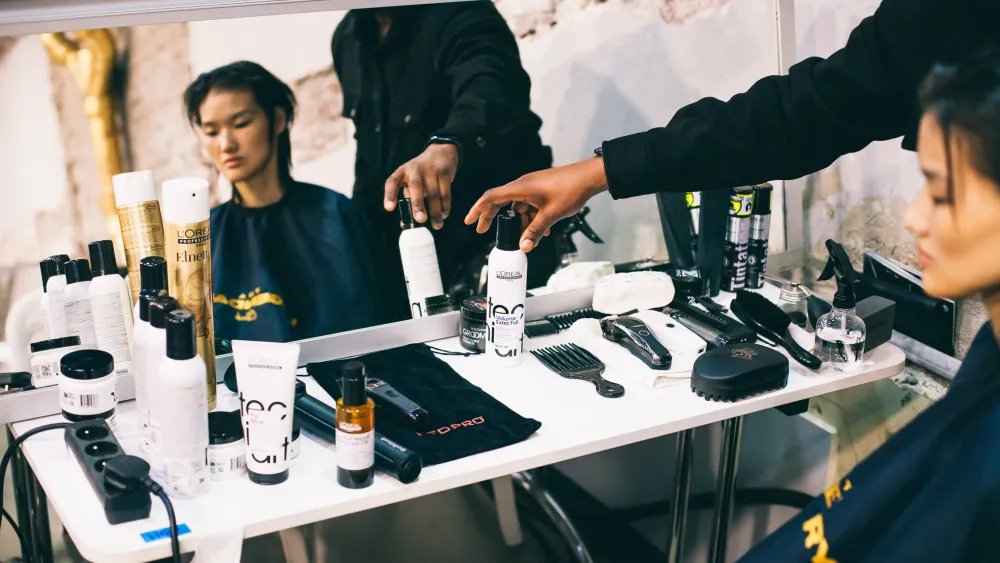
PARIS — L’Oréal Professionnel is delving deeper into fashion week, taking the hairstyling lead backstage at four Paris shows this spring 2027 season.
“The brand has had a longstanding partnership with fashion,” said Claire Le Bleis, global brand president of L’Oréal Professionnel. “So this time we wanted to be here for the Paris Fashion Week, but be here our way.”
The brand invented its own Transformation Backstage freestanding area, in Paris’ 11th arrondissement, where celebrities and influencers are getting their hair done.
The raison d’être, according to Le Bleis, is: “Hair is as important as clothes, and hair is fashion. Behind all of these creative hairstyles there is the creativity and the technicity of the best professionals and a few good professional products, as well.”
The backstage happenings are being shared on social media, including tips, trends and how-tos — “how to create for the hairdressers and for the consumers the hottest looks of fashion week,” she said.
L’Oréal Professionnel is partnering with the fashion brands Courrèges, Mugler, Weinsanto and Pressiat.
“It’s important for us to support younger designers and to support the designers that have a point of view and that break the codes of fashion,” Le Bleis said. “So it’s very different designers, but the one common point is that our hairdressers really partner with the designers to codevelop and cocreate the hairstyles that will be shown.”
L’Oréal Professionnel admires show backstages, as it’s where trends are created. “And also because for us it’s a place where we can really torture-test our product,” she said. “There is a lot of heat, a lot of repeated style and re-restyle, tension and traction.”
The Flex Pli spray is currently being trialed.
Transformation is at the heart of L’Oréal Professionnel’s strategy under Le Bleis. This was crystallized in a new event, called Transformation Day, which took place April 26 in the French capital’s Palais de Tokyo museum.

At L’Oréal Professionnel’s Transformation Day.
Photo by Stephane Sby Balmy/Courtesy of L’Oréal Professionnel
“We are here to invent new formats, new platforms for both our audiences, the hairdressers and women and men around the world,” Le Bleis said in separate interview. “We are born from transformation. We are born from the invention of the first inoffensive hair dye. Our mission is also to bring desire and professional beauty stimulus around the world.”
For Transformation Day, L’Oréal Professionnel gathered 100 celebrities and beauty, fashion and hairdresser influencers from 20 different countries, including India, Brazil, China and the U.S. They boasted more than 150 million followers combined and were paired with hairdressers to create live hair transformations. These were revealed and broadcast on social media, drawing more than 127 million social media views.
“It’s a giant showcase of tech and creativity,” Le Bleis said, referring to L’Oréal Professionnel leveraging its best hair care, styling and hair color technologies.
The next day, on April 27, the brand hosted a livestreamed Tech Talk master class for hair professionals to learn how hairstylists at Transformation Day created their looks. That garnered 24,000 viewers from 65 countries.
Such talks, which L’Oréal Professionnel holds a few times yearly now, “breaks the barriers of knowledge and expertise-sharing,” Le Bleis said.
She explained the talks stemmed from the brand’s mission “of being the market-maker, bringing desire to men and to women to project themselves into new looks — also breaking from uniformity. We are here to tell people that there are many opportunities offered to them, you can have different looks, different lives, and that we do [that] in a very expert and safe way.”
Le Bleis said L’Oréal Professionnel’s vision has always been about transformation, since it was born in 1909 with a harmless hair dye and then became the origin of the L’Oréal group.
She considers hair color to be the most transformative cosmetics category.
“We are the only hair brand in the world to carry all of the hair categories,” she continued. That includes alongside hair color, hair care, permanent and daily styling, plus professional tools.
“We are able to carry an end-to-end transformation,” Le Bleis said.

Claire Le Bleis
Courtesy of L’Oréal Professionnel
L’Oréal Professionnel increasingly creates hybrid products that leverage different categories. There might be a marriage between hair care and styling or texture and hair care, for instance. Hybrid services, adjacencies or categories are possible.
“Transformation with our technological innovations and the way we work with R&I is something that is not a trend for us but in our DNA,” she said, adding L’Oréal Professionnel’s forward-looking strategy also involves inventing the professional hair industry’s future.
The brand, which already crossed the 1-billion-euro sales threshold, has the muscle to do so. In the second quarter of 2026, L’Oréal’s Professional Products division, which includes the L’Oréal Professionnel brand, was key to bolstering the group’s strong growth overall.
And the brand’s strategy of transformation looks likely to strike a chord with consumers, not least the younger demographic.
“Transformation is really something that has become the dominant language for hair,” Le Bleis said. “When you look on social media, it’s all about transformation.”
She underlined that among all beauty categories, hair transformation is the most engaging and viral these days.
For her, L’Oréal Professionnel’s vision of transformation is articulated around three main complementary pillars: expansion, innovation and communication.
France and the rest of Europe remain the brand’s home base, but over the past five years it has become truly global. L’Oréal Professionnel keeps gaining market share in Europe and grows in all of its strategic markets. Its top three countries currently are France, India and the U.S., while some of the biggest growth contributors are India and Brazil.
“The emerging countries today are around 30 percent of the brand turnover,” Le Bleis said. “We are still growing in Europe, and we still have a lot of potential needs [to fill] and recruitment [there], especially among the Gen Z and men. Professional hair care in Europe is still super big and growing a lot. At the same time, we expanded our footprint in the emerging world and also in China this past year.”
Historically L’Oréal Professionnel was a B2B premium hair care brand.
“Now, we are B2B and B2C,” Le Bleis said, explaining the split is fairly even between the two and each is growing. The brand’s footprint makes it strong and resilient, the executive said.
Over the past four years L’Oréal Professionnel has almost doubled its hair care business, which ranks second in the category after another L’Oréal-owned brand, Kérastase.
“We kept growing in the salons, in the pro channels and gaining share [there],” Le Bleis said. “At the same time, we opened and expanded direct B2C distribution.”
She remains confident about premium professional hair care, emphasizing this is not a trend. “It is here to stay,” she said. That is especially true if the emerging world is factored in.
“When we look, for example, in zones like Latin America or countries like India, the professional-to-mass-market ratio on the hair care business is one to eight, whereas in zones that are more mature, like Europe and the U.S., it’s one to four,” Le Bleis said. “So we know that we also have a lot of potential of trading and recruitment in these zones, as well, with a lot of young consumers.”
It’s known that Gen Z is attracted to premium hair care.
As a market-maker and pioneer, L’Oréal Professionnel needs to innovate in technical and technological ways others cannot, according to Le Bleis.
“At first we develop and test everything within a technical protocol,” she said. All of the brand’s products are codeveloped with hairdressers. Metal Detox, for instance, was born from a request from them for a product that can help hair breakage due to chemical treatments.
“It’s now our number-one mask sold,” Le Bleis said. It is the top-selling professional hair care mask in Europe and in China, too.
L’Oréal Professionnel consistently brings new innovations and trends to the market. A recent example is French Blending, a professional service with various approaches to soften hair’s harsh regrowth line and to deliver multidimensional color.
There also was the launch this summer of the No Bleach French Highlights service. Le Bleis said the future of L’Oréal Professionnel is about making the impossible possible and shifting paradigms.
Part of the brand’s mission is to ensure hairdressers continue to thrive.
Tech and AI are helping with the brand’s communication. During COVID-19, it launched a training platform, called L’Oréal Access, that grew to 1.5 million users during the first half of 2026. This marked the first time the brand initiated education in such a broad way.
Tech Talks — animated by top hairdressers — are another such initiative. The long-format presentations, open to everyone free of charge, have AI-powered translations.
L’Oréal Professionnel is also now using AI to augment traditional before-and-after looks, which was shot on real models, to immersive effect.
“We consider that we are not just here to serve our clients, we are here to serve the profession,” Le Bleis said.