dailynewsnblog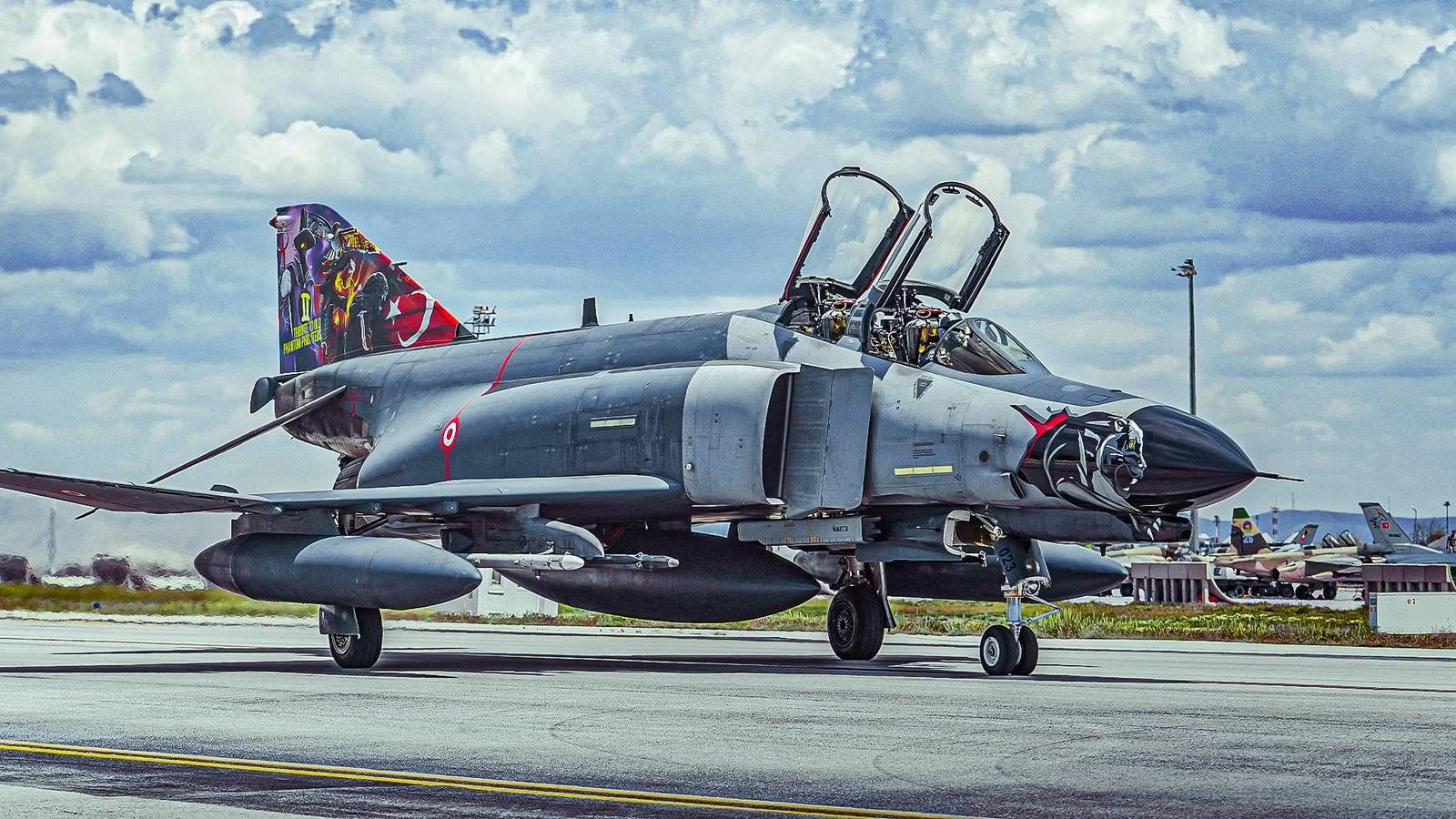
The McDonnell Douglas F-4 Phantom II first flew on May 27, 1958, entered service on December 30, 1960, and stayed in production until 1981, by which point 5,195 had been built. It was fast enough to set 16 world speed and altitude records between 1959 and 1962, with the capacity to carry a serious war load, and ungainly enough that Vietnam veteran Dick Anderegg joked it was proof you could make a brick fly if you put enough trust behind it. The Phantom went on to serve with the US Navy, Marine Corps, and Air Force, fight over Vietnam, hunt Iraqi radars during Desert Storm, fly reconnaissance missions into the 1990s, and finish its American military career as a QF-4 aerial target in 2016.
We will cover where the F-4 came from, why its export fleets eventually disappeared, why three air forces still keep the type in service in 2026, and the single privately owned Phantom that remains airworthy in the United States. One caveat runs throughout: published fleet figures are inventory estimates, based on the latest sources we could analyze.
From Vietnam To Boneyard: The Air Forces That Have Already Said Goodbye

The Phantom was conceived for the US Navy as a carrier-based fleet defense interceptor, with two crew members, two General Electric J79 turbojets, a large radar, and a missile-only armament reflecting the late-1950s belief that the gunfight was over. It was so capable that the Air Force adapted it as the F-4C and the Marine Corps followed, making it the only fighter flown by all three US services on such a scale. Vietnam put that concept to the test: from 1965, Phantoms flew escort, strike, and reconnaissance missions over Southeast Asia, often finding themselves in the close-range turning fights they were designed to avoid. Ground-controlled Mikoyan Gurevich MiG-17s and MiG-21s could engage on their own terms, while early AIM-7 and AIM-9 reliability problems and radar difficulties separating friend from foe forced visual identification, eroding the Phantom’s standoff advantage.
Kill-to-loss ratios slid to roughly 2:1, far below Korean War levels, a decline Simple Flying has traced in an article on USAF fighter markings and Vietnam-era air combat. The wind changed on January 2, 1967, when Colonel Robin Olds’ F-4Cs copied the routes, altitudes, formations, radio calls, and jamming configuration of Republic F-105 Thunderchief bombers, luring MiG-21s into combat and destroying seven in about twelve minutes with no American losses. The Phantom’s US career continued for decades: F-4G Wild Weasels hunted Iraqi radars during Operation Desert Storm in 1991, RF-4Cs served until 1995, and US combat use ended in 1996, followed by QF-4 target operations until 2016, closing out a run that Simple Flying charted in its survey of how many F-4s are left.
Outside the US, various countries operated the type: Australia, Egypt, Germany, Israel, Japan, South Korea, Spain, and the United Kingdom. As South Korea’s Ministry of National Defense documented at the time, the Republic of Korea Air Force retired the Phantom on June 7, 2024, at Suwon Air Base (SWU) after 55 years, with the 153rd Fighter Squadron of the 10th Fighter Wing flying the final pair. That leaves three flags and a total of 127 airframes as of September 2026, according to inventory data compiled by GlobalMilitary.net. Flug Revue reached the same conclusion in its own review of the shrinking operator list.
Greece Has Flown The Phantom For More Than Half A Century

Greece signed for 36 F-4Es in 1972 under the program name Peace Icarus, and as Key Aero has documented, the first four landed at Andravida Air Base (PYR) on the western Peloponnese on April 5, 1974. The Hellenic Air Force stood up 339 Mira “Aias” first, with 338 Mira “Ares” converting two months later. More followed: a second batch under Peace Icarus II, ex-USAF airframes in 1991, and a fleet of RF-4Es reconnaissance Phantoms bought secondhand from Germany.
By the late 1990s, the airframes were sound but the avionics were not, so in August 1997, Greece contracted the German firm then known as DASA for Peace Icarus 2000, the Avionics Upgrade Program. 36 aircraft went through it, the first delivered in December 2002. The Hellenic Air Force describes the results as a second-generation aircraft with an extended operational life, enabled by advanced electronics: an AN/APG-65-class radar comparable to that of the early McDonnell Douglas F/A-18 Hornet, new mission computers, a head-up display, multifunction displays, and an IFF interrogator. The upgrade turned an aging fighter-bomber into a credible multirole platform. The F-4E AUP carries AIM-120B AMRAAM and AIM-9M missiles, the full Paveway family of laser-guided bombs, and a Litening II targeting pod, and the fleet wears the distinctive “Aegean Ghost” gray camouflage. Hellenic Phantoms have spent years flying quick-reaction alert and armed patrols over the Aegean, and they remain regularly present at major exercises and airshows, including Iniochos and the NATO Tiger Meet that Simple Flying attended at Araxos in spring 2026.
The fleet stands at 16 today, after the loss of a 338 Mira aircraft during its display at Athens Flying Week at Tanagra on September 5, 2026, a crash that killed both crew members and prompted three days of mourning across the Greek armed forces. The accident occurred within the opening minutes of the routine, and an official Hellenic Air Force investigation is ongoing. Greece is building up its Dassault Rafale F3R squadrons and has ordered the Lockheed MartinF-35A, with deliveries expected toward the end of the decade, which places the Phantom’s Hellenic finale within the next year or two. It is part of a wider trend Simple Flying examined in its look at NATO allies retiring fighters without direct replacements. After more than 50 years, 338 Mira will be the unit that switches off the lights.
Turkey Flies The Most Capable Phantom Left Anywhere

The Turkish Air Force operates the largest Western Phantom force, listed at 48 airframes in 2026, although independent counts of active jets usually land between 30 and 40. Turkey received its first F-4Es in 1974 and kept buying, including ex-Luftwaffe RF-4Es in the 1990s, which at one point made it the third-largest Phantom operator in the world behind the United States and Germany. Nine Turkish squadrons have flown the type over the years.
What survives is the F-4E 2020 Terminator, rebuilt around the turn of the century with Israel Aerospace Industries, when both countries still had good relations. About half the work was carried out in Israel and the rest in Turkey, with the first upgraded aircraft delivered in January 2000. The package added an Elta EL/M-2032 radar, new mission computer and cockpit displays, updated navigation and electronic warfare systems, and structural reinforcement to extend airframe life. Armed with the AGM-142 Popeye, an electro-optically guided standoff weapon with an approximately 800-pound (360-kg) warhead and nearly 50-mile (80-km) range, plus EL/L-8222 jamming pods, the Terminator serves as a precision strike and electronic warfare platform alongside Lockheed Martin F-16s and unmanned aircraft. Turkish Terminators regularly appear at the Anatolian Eagle exercise in Konya and have deployed to NATO exercises abroad, including Poggio Dart 2025 in Italy.
The name implied a 2020 sunset, but Turkey’s exit from the F-35 program after it bought Russian S-400 air defense systems removed the obvious successor, and the indigenous TF KAAN remains far from squadron service. The War Zone covered the 50th anniversary celebrations there in November 2024, where F-4E 77-0303 appeared in a red-and-black commemorative scheme.
Iran Keeps The World’s Largest Phantom Fleet On Its Books

Iran’s Phantoms are an inheritance from Shah Mohammad Reza Pahlavi, who ordered a total of 225 airframes in the 1960s and 1970s: 32 F-4D, 177 F-4E, and 16 RF-4E, according to a source from the IIAF Museum. Those Phantoms earned their reputation during the Iran-Iraq War. A pair of them struck the Osirak nuclear reactor site near Baghdad in Operation Scorch Sword on September 30, 1980, nine months before the better-known Israeli raid, and on April 4, 1981, eight Iranian F-4s hit the H-3 airfield complex in far western Iraq, destroying or damaging a substantial number of Iraqi aircraft without losses. Iranian Phantoms were still flying combat missions against Islamic State targets as recently as 2014, and in November 2020 Tehran displayed a locally developed 1,984-pound (900 kg) Qased electro-optically guided bomb on the type.
The 2026 Iran Crisis affected the Iranian Air Force of course : Defence Blog reported that Israeli aircraft struck F-4 and F-5 fighters being prepared for takeoff at Tabriz on March 1, and US Centcom released footage the same day of American strikes that destroyed further F-4D/Es, though without specifying a number. GlobalMilitary.net’s loss tracker for the conflict records the Tabriz Phantom alongside dozens of other Iranian aircraft destroyed on the ground, and separately logs an F-4 lost in a night training crash near Hamedan on February 19, 2026, that killed one of the two pilots.
As noted by 19FortyFive in August 2026, before the current war, the Islamic Republic of Iran Air Force held 63 Phantoms, or just over 27 percent of its 231-strong fighter fleet. That still makes the F-4 Iran’s most numerous combat aircraft. The headline totals describe what exists rather than what flies, and the gap between those two numbers is the whole story. Decades of sanctions have closed every official spare parts channel, so Iranian Aircraft Industries is widely understood to cannibalize airframes to keep others airborne, with components also sourced through shell companies at high cost and uncertain reliability. As Simple Flying set out in its rundown of the Iranian fleet, the effective number of mission-capable jets at any moment sits well below the published inventory, and no credible public readiness figure exists. Even if the definitive number of surviving Iranian Phantoms is unclear, the surviving airframes are allegedly being kept hidden in underground shelters, which is a rational choice when the alternative is sending a third-generation fighter up against F-15s, F-16s, and F-35s.
One Phantom Still Flies In America, And It Is Privately Owned

No American military unit has flown a Phantom since the QF-4 program ended in 2016, yet one example remains airworthy in civilian hands. Getting it there took an Act of Congress, because the F-4 was, and still is, an operational fighter, requiring an amendment to the National Defense Authorization Act of 1999 before the Collings Foundation could take ownership of one and place it on the US civil register. Registered N749CF, the aircraft was built in 1965 as F-4D 65-0749 and served with the Air Force until 1996.
Its civilian career has been almost as unusual as its military one. Restoration returned it to flight in 1999, and it wears the markings of an aircraft associated with Colonel Robin Olds and Operation Bolo. For a period, it also flew as 66-7463, the Phantom flown by Steve Ritchie during Operation Linebacker in 1972.
Vintage Aviation News reported that former USAF Phantom pilot Harry “D-Day” Daye flew it with Jerod Flohr in the rear cockpit, the culmination of years of volunteer work. Keeping a 1960s interceptor airworthy without a national supply chain behind it is the hard part: two J79S and a structure built for carrier decks demand maintenance hours no warbird operator gets for free. The payoff is public. The Phantom is scheduled for the Wings Over Houston airshow on October 31 and November 1, its first major home-field appearances.
Where The Phantom Goes From Here

The Phantom’s military career is now measured in its final chapter, not years. Greece is preparing to hand its remaining F-4Es to the F-35A, Turkey is stretching the F-4E 2020 Terminator toward 2030 while it waits for KAAN, and Iran’s fleet survives under entirely different circumstances. What connects them is the fact that each has found a reason to keep an exceptionally old airframe useful.
That makes the Phantom’s longevity more than a matter of age. The F-4 entered service when radar-guided missiles were expected to transform air combat, then adapted to visual dogfights, precision strike, reconnaissance, electronic warfare, and successive generations of avionics. Its operators kept changing what the aircraft could do because replacing that capability was not always straightforward. Simple Flying has examined why the Phantom will not be retired anytime soon, but the remaining fleet is now clearly approaching its endpoint.
And when that endpoint arrives, the Phantom will leave behind something unusually tangible. Its successors will be stealthier and vastly more capable, but none will have flown from the Vietnam War era into the 2020s while remaining recognizable as the same basic aircraft. The last military F-4 may eventually shut down for good, but N749CF in Texas offers a different kind of afterlife: a Phantom that no longer has to fight to justify its existence, only to keep flying.