dailynewsnblog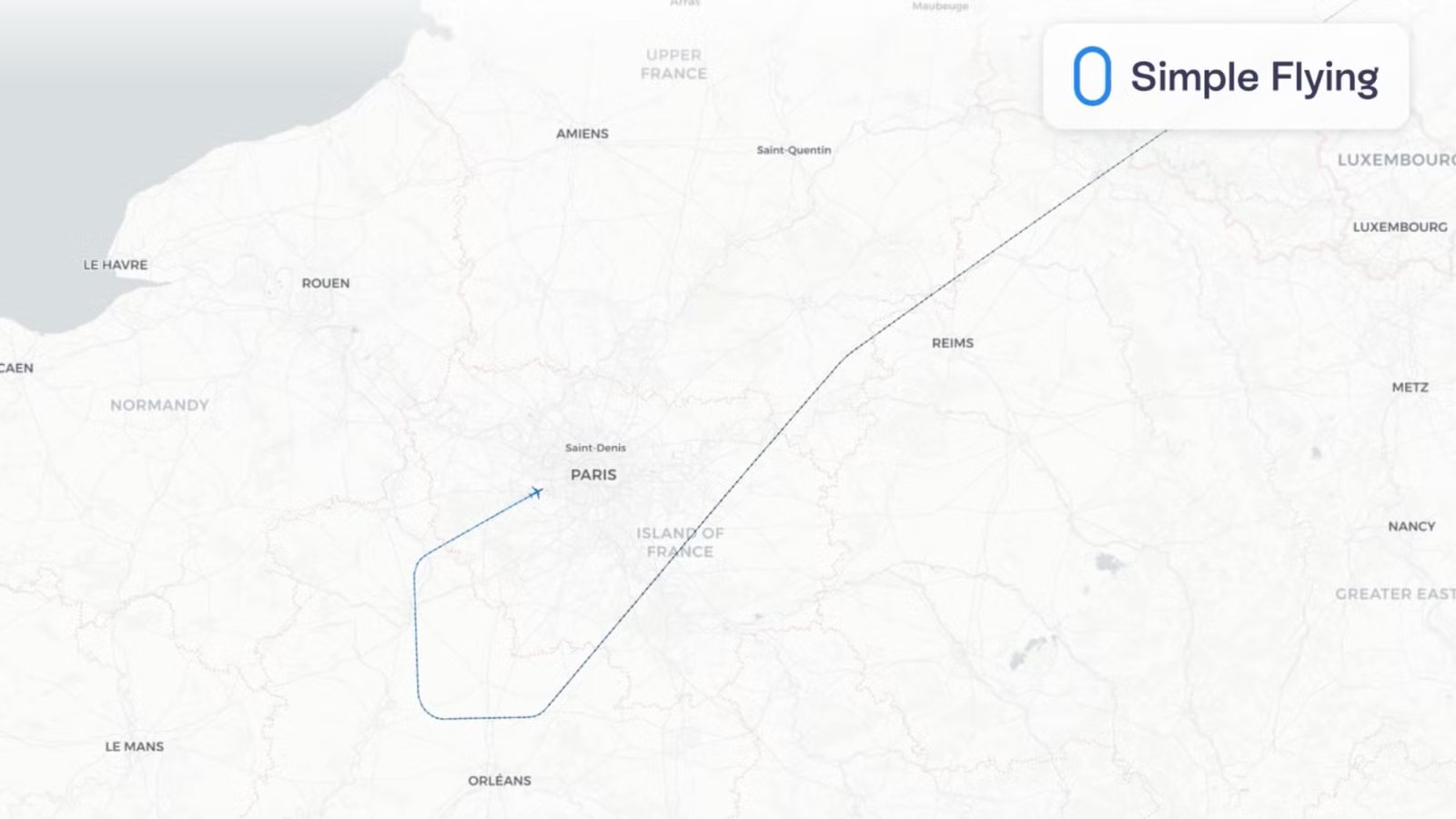
On August 29, 2026, Eurowings flight EW590 departed Cologne/Bonn Airport (CGN) at approximately 8:40 PM local time with 131 passengers bound for Palma de Mallorca (PMI). According to Aviation Direct, the aircraft was a Boeing 737-800 registered OK-TSU, operated by Czech carrier smartwings under a wet-lease arrangement for Eurowings. Roughly an hour into the flight, while cruising at approximately 26,000 feet over French airspace just south of Paris, the crew detected smoke in the aft galley. They squawked 7700, turned toward Paris Charles de Gaulle Airport (CDG), and landed safely at approximately 10:00 PM. No one was injured. The cause was steam from a galley oven.
If you were watching EW590 on Simple Flying’s Live Flight Tracker that evening, you would have seen the diversion unfold in real time through a sequence of data changes on the aircraft’s icon: the squawk code switching to 7700, the flight path breaking from its planned route, the altitude dropping steadily toward Paris, and the icon going static at CDG instead of continuing south to Mallorca. Each of those changes corresponds to a specific operational step happening inside the aircraft and on the ground. What follows is what you would have seen on the tracker at each stage of EW590’s diversion and what was actually happening behind each data point.
The 7700 Tag Appears

On the tracker, the first visible sign that something has changed on EW590 is the squawk code. The aircraft’s transponder tag switches from the standard four-digit code assigned by ATC to 7700, the international emergency designation. The tracker highlights the aircraft differently from every other flight on the screen. The timing in the tracking data shows the code change occurring at approximately 26,000 feet over French airspace south of Paris, roughly one hour after departure from Cologne.
Inside the aircraft at that moment, the crew is not deliberating over whether to squawk 7700. Smoke or fire in the cabin is one of the most extensively drilled emergency scenarios in airline training, and the response is procedural rather than discretionary.
The cabin crew’s immediate actions follow a memorized sequence: identify the source of the smoke, grab a fire extinguisher and smoke hood, isolate the galley equipment by cutting electrical power to the ovens and any other heat-producing units, and alert the flight deck through the interphone. These steps begin within seconds of the smoke being detected, before anyone knows whether the source is a malfunctioning oven element producing steam or the early stage of an electrical fire behind the galley panels.
The Flight Path Breaks From The Route

On the tracker, the next visible change is the aircraft’s ground track. EW590’s planned route from Cologne to Palma de Mallorca runs south-southeast across France toward the Mediterranean coast. The tracking data shows the aircraft deviating from that line with a turn toward the northeast, curving away from its filed route and toward Paris Charles de Gaulle Airport (CDG). The turn begins shortly after the 7700 squawk appears in the data. The planned route line and the actual track diverge on the map, and within a few minutes of watching, it becomes clear the aircraft is not continuing to Mallorca.
Inside the aircraft, two separate workstreams are running simultaneously. In the aft cabin, the crew is working on the smoke source. The galley ovens have been powered down. A flight attendant with a fire extinguisher is standing by at the galley while another monitors the area for any change in the smoke or any sign the situation is worsening. The senior cabin crew member is communicating with the flight deck through the interphone, providing updates on what they can see, smell, and hear. At this point, the cabin crew’s job is containment and monitoring. They are not making the diversion decision. They are providing the information the flight deck needs to make it.
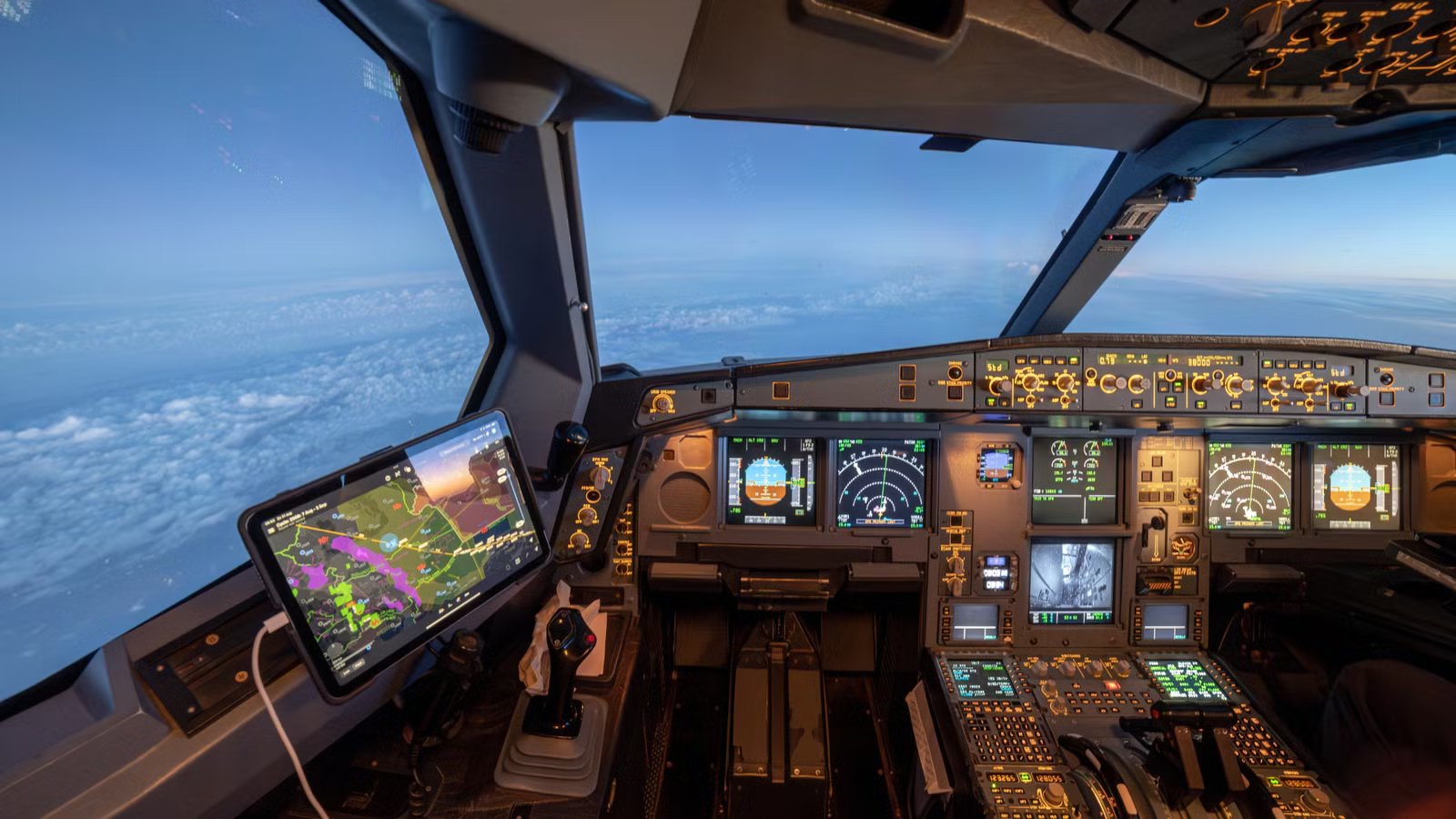
In the flight deck, the captain and first officer are running a parallel sequence the tracker cannot show. The captain is selecting the diversion airport. CDG is not the closest airfield to the aircraft’s position, but it is the nearest airport with the right combination of runway length, instrument approach availability, fire and rescue category, and ground handling infrastructure to receive a 737 squawking 7700 for a smoke event. Smaller French airports closer to the aircraft’s position may lack the emergency services category that a commercial diversion requires. While the captain communicates with French ATC to declare an emergency and receive vectors toward CDG, the first officer is programming the new destination into the FMS, pulling up the approach plates for the assigned runway, and briefing the approach procedure. ATC clears other traffic from EW590’s path and assigns a direct routing to CDG. On the tracker, this appears as a smooth curve toward Paris. In the cockpit, it is the product of simultaneous communication with ATC, FMS reprogramming, approach briefing, and continuous monitoring of the smoke situation through the cabin crew interphone.
The Descent Profile Into Paris

On the tracker, the altitude readout begins dropping steadily from 26,000 feet toward the Paris area. The descent is not the rapid emergency drop that a cabin depressurization would produce. The tracking data shows a controlled, continuous descent at a normal rate, consistent with a crew that has an emergency but does not need to get to a breathable altitude immediately. The aircraft is already at 26,000 feet rather than FL330 or FL400, which means the descent to the CDG approach altitude takes less time and distance than it would from a higher cruise level. The ground speed, altitude, and heading data on the tracker update every few seconds, and over the course of approximately 15-20 minutes, the aircraft transitions from its cruising altitude to the initial approach fix for the assigned runway at CDG.
Inside the aircraft during the descent, the cabin crew is preparing for the possibility of an emergency evacuation after landing, even though the smoke appears to be contained. This is standard procedure for any smoke event. The crew briefs passengers seated in exit rows on their responsibilities. Cabin crew members take their assigned positions at each exit door and review the evacuation commands. The crew secures loose items in the galley. The overhead bins are confirmed closed. The preparation happens regardless of whether the crew believes an evacuation will actually be necessary, because the time to prepare is during the descent, not after the aircraft has stopped on the runway and the situation demands an immediate decision.
On the flight deck, the captain is communicating with CDG approach control and the airport’s emergency coordination frequency. The crew relays exactly what CDG’s fire and rescue teams should expect on arrival: smoke reported in the aft galley, source believed to be a galley oven, smoke currently contained, 131 passengers on board, no injuries, no structural fire suspected. This information determines how the emergency services position themselves on the ground. A galley smoke event produces a different response configuration than an engine fire or a landing gear malfunction. The fire trucks and rescue vehicles will meet the aircraft, but their positioning, equipment readiness, and initial inspection focus are all shaped by what the crew has told them during the descent. On the tracker, the altitude number ticks downward in a steady progression. In the aircraft, the crew is running checklists, briefing passengers, coordinating with the ground, and preparing for an outcome they hope will be routine while planning for one that might not be.
The Icon Goes Static At CDG

On the tracker, EW590 touches down at Paris Charles de Gaulle Airport (CDG) at approximately 10:00 PM local time, and the aircraft’s icon stops moving. The ground speed reads zero. The altitude reads field elevation. The squawk remains 7700 until the crew resets the transponder after clearing the runway. The aircraft taxis to a stand and the icon goes static. For anyone watching the tracker, the event is over. The aircraft is on the ground. It does not move again that evening.
On the ground at CDG, the event is not over. Fire and rescue vehicles meet the aircraft as it exits the runway, following it to the assigned stand as standard procedure for any smoke-related emergency landing. Before passengers can deplane, a fire crew inspects the aft galley area to confirm the smoke source is fully secured and that there is no residual heat or fire risk. Eurowings confirmed the following day that the source was steam from a galley oven and that there was no fire. The emergency vehicles positioned alongside the aircraft were not required to intervene.
While the fire inspection is underway on the tarmac, the airline’s operations center is already working on passenger logistics. EW590 did not continue to Palma de Mallorca that night. The 131 passengers needed hotel accommodation in the Paris area, ground transportation from CDG to the hotels, and rebooking on the next available flights to Mallorca. Eurowings arranged all three. The airline’s statement confirmed that passengers were offered hotel rooms, transfers, and rebooking on subsequent services. For the passengers, the experience was an unexpected night in Paris instead of an evening in Mallorca. For the crew, it was a textbook execution of a smoke checklist that produced exactly the outcome the procedure is designed to deliver: the aircraft on the ground, the source confirmed, no injuries, and every passenger accounted for. On the tracker, the icon sits motionless at CDG. Behind that static dot, 131 rebookings, a fire inspection, a maintenance check, a crew duty-time assessment, and an aircraft repositioning are being coordinated simultaneously.