dailynewsnblog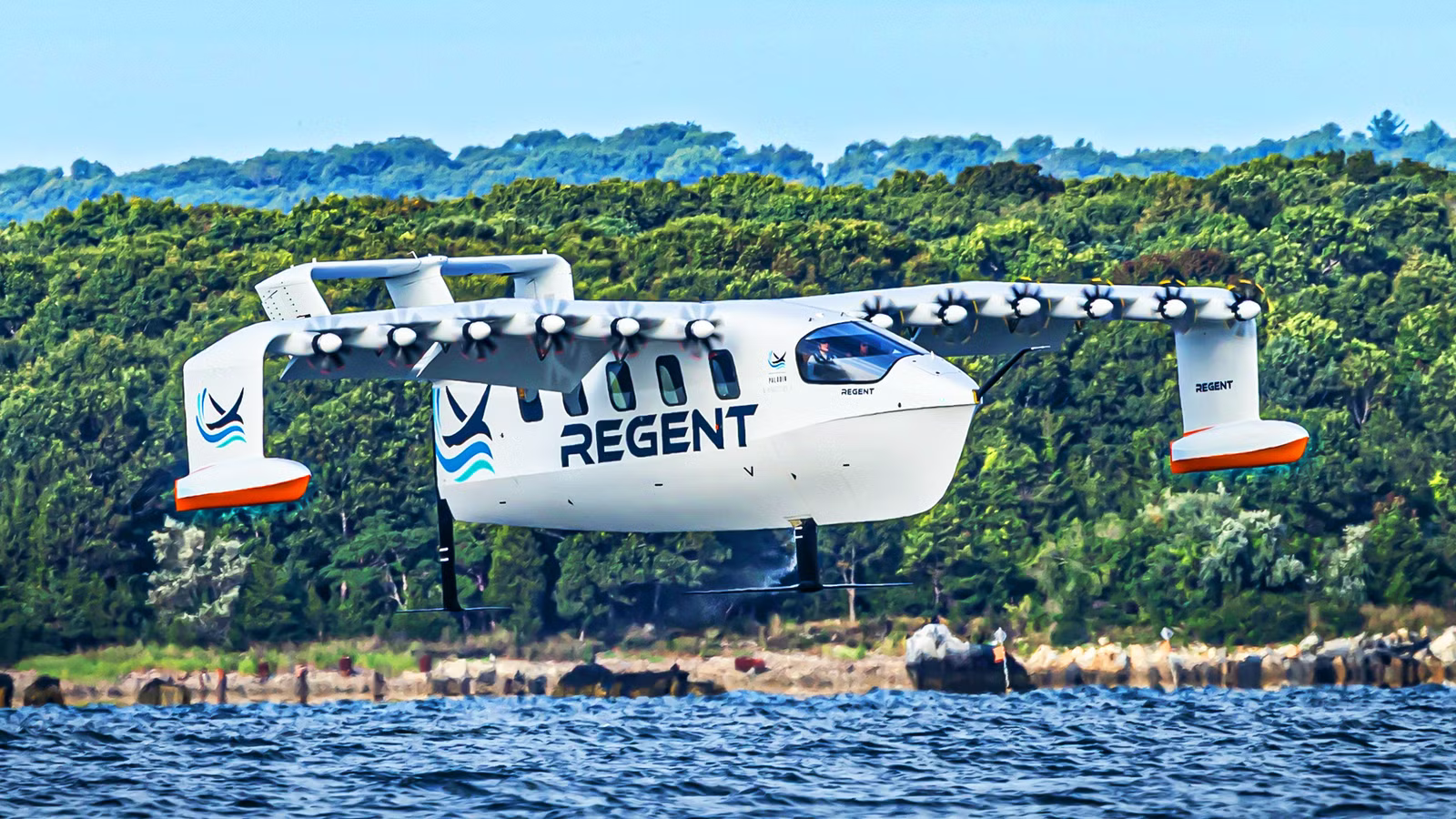
While tiltrotor aircraft blur the line between helicopters and turboprop aircraft, ekranoplans, also called ground effect vehicles or wing-in-ground-effect, blur the distinction between an airplane and a boat. This is not theoretical: the craft’s unique characteristics could attract both maritime and aviation regulations and encouraged Congress to pass a new law in 2024 clarifying what a boat is, what is an aircraft, and what the responsibilities of the US Coast Guard and FAA are.
Regent describes its WIG Seaglider vessels as “high-speed, hydrofoiling wing-in-ground effect craft that combine the speed of an aircraft with the convenience of a boat.” It also says that “The vessel operates in three modes — float, foil, and fly — starting on its hull at low speed, transitioning to hydrofoils once clear of the dock, and then taking flight within one wingspan of the water’s surface.” Let’s examine why this craft is a boat, but other ground effect vehicles may be aircraft.
How GEVs/Ekranoplans Blur Aircraft & Seacraft

Ekranoplans, or ground-effect vehicles, exploit the aerodynamic ground effect, where air trapped between the wing and the surface increases lift and reduces induced drag as they skim just above the water. This allows them to carry substantially heavier payloads than a similarly sized conventional aircraft could in free flight, provided they remain within ground effect.
They differ from hovercraft in that they do not use powered lift fans to create a pressurized air cushion. Some ekranoplans are much more ship-like. These include Soviet examples such as the Caspian Sea Monster and the Lun-class ekranoplan. The latter even entered service with the Soviet Navy as a fast missile carrier, although its operations were largely confined to the comparatively calm waters of the Caspian Sea.
Other designs are closer to high-speed ferries. The Singapore-based Wigetworks AirFish series, for example, cruises at around 80–90 knots while flying only a couple of meters above the water. At the opposite end of the spectrum, the now-canceled DARPA Liberty Lifter was conceived as a heavy transport that would operate efficiently in ground effect but could also climb to 10,000 feet (3,000 meters) when required. This made it somewhat comparable to a C-130 Hercules in some respects.
The Last Mile Of Resupply

As the US military readies for confrontation in the Asia Pacific, it is increasingly focused on how to logistically sustain such operations. It is now assumed that forward air bases will no longer be safe for traditional heavy transport aircraft, including Super Hercules. At the same time, ships and smaller vessels coming forward will become increasingly vulnerable.
This is creating an issue with the “last mile” of logistical resupply. For this, the US Marines are increasingly turning to drone aircraft: these are often hybrid electric. Aerospace companies like Anduril (in partnership with Archer Aviation) and Beta Technologies are two examples of companies developing autonomous flying cargo drone solutions for the US military and Marines especially. Regent Defense is a company that is working on a wing-in-ground-effect solution.
It is developing its Seaglider product line that includes the smaller, autonomous Squire (with 50 lbs or 22 kg of payload) and the much larger Viceroy. Viceroy is a militarized version of a commercial ferry-type design and will be optionally autonomous or crewed. It will come with a much larger 3,500 lbs payload (1,588 kg). This is from the same line of Seaglider ferries that can carry 12 passengers and two crew.
Regent’s First Crewed Seaglider Flight

On September 2, 2026, Regent Craft reported that its Seaglider prototype, Viceroy, had just successfully completed its first human-crewed flight. It said this made it the “largest-ever all-electric wing-in-ground effect craft to fly with people on board.” It also said that the development solidified the US’s leadership in ground effect flight. With that being said, China is known to be rapidly developing ground effect vehicles also to supply the islands in the Pacific.
The crewed Viceroy prototype flight took place at Regent’s headquarters on Narragansett Bay in Rhode Island with a crew of two captains. The vehicle flew a distance of 1,956 feet (596 meters) at a height of 33 feet (ten meters) above the water for 30 seconds. The milestone marks the start of the program’s final stage of sea trials.
Specifications | Viceroy (commercial) | Viceroy Hybrid (military) |
|---|---|---|
Role | Passenger/cargo ferry | Logistics, ISR, MEDEVAC, attack |
Crew | 2 | 2, optionally autonomous |
Passengers | 12 | 12 or cargo |
Payload | 3,500 lb (1,588 kg) | 3,500 lb (1,588 kg) |
Cruise speed | 160 knots | 160 knots |
Range | 160 nautical miles | 1,400 nautical miles |
Regulation | Type A (Coast Guard) | Type A (Coast Guard/military) |
Regent has previously demonstrated test flights of its autonomous Squire Seaglider drone. Billy Thalheimer, co-founder and CEO at Regent, stated that “we’re now moving quickly toward production to deliver Seagliders to coastlines around the world.” The hydrofoiling capabilities of Seaglider give it wave tolerance and maneuverability in harbors and near coastlines. The company also says that the captain drives Seaglider “like a boat.”
A Dual-Use High-Speed Ferry

Regent describes the Viceroy as a high-speed ferry. It says that “Seaglider vessels are captained by certified mariners and regulated in the U.S. by the U.S. Coast Guard and by maritime authorities in countries around the world.” Among other things, this enables them to avoid airport-style delays in check-in. Viceroy will be able to fly at speeds of up to 156 knots for up to 156 nautical miles while carrying a complement of 12 passengers and two crew.
Meanwhile, onboard, passengers can expect plenty of legroom, large windows, and a quiet ride. The launch customer is The Twenty Five, which is a luxury coastal travel operator and membership platform, and it has an order for up to 60 Viceroy Seagliders. Regent completed the construction of its first Seaglider Manufacturing Facility in June at Quonset, Rhode Island.
However, as stated, Regent is developing the Seaglider family as a dual-purpose craft. It plans to develop a full family of Seaglider systems for military missions including “contested logistics, MEDEVAC and CASEVAC, intelligence, surveillance, reconnaissance and launched effects.” Launched effects mean firing missiles or drones. Regent already has a $15 million contract with the Marine Corps Warfighting Lab and a CRADA with the US Special Operations Command.
Why The Seaglider Is A Flying Boat

The International Maritime Organization International Civil Aviation Organization jointly created three classes of wing-in-ground craft. One is Type A. These operate only in ground effect, and their design physically prevents them from climbing beyond the ground-effect envelope during normal operation. In other words, they can only skim. Examples include Regent’s Seaglider and Wigetworks’ AirFish.
The next category is Type B: these mostly operate in ground effect, but are able to temporarily climb to 500 feet (150 meters) to clear obstacles or in case of emergencies. These remain mostly under the maritime regime. The third category is Type C. These are able to fly above 500 feet (150 meters), and they become subject to ICAO aviation rules as well as maritime requirements for water operations.
As the Seaglider is Type A, its primary regulator is the US Coast Guard and not the FAA. Had the DARPA Liberty Lifter been developed, it would have fallen under FAA regulation. Congress’s 2024 FAA Reauthorization Act directed the FAA and US Coast Guard to sign a memorandum of understanding defining their respective roles. This new law specifically says operators of qualifying WIG craft are not to be regulated as air carriers just because they fly in ground effect over water.
From High-Speed Ferry To Marine Corps Defense

Besides its launch market as a commercial high-speed ferry for luxurious coastal destinations, its other primary use case is military. True to the blurriness of its role as a boat or aircraft, Regent markets its military Seagliders as being faster than an uncrewed surface vessel (USV), with the speed of a drone. It says that “Seagliders perform all the missions of uncrewed surface vessels: ISR, ad hoc communications, logistics – with a top speed of 160 kts. Unmatched rapid deployment capability.”
It also claims that “Seagliders perform all the missions of uncrewed aerial vehicles: ISR, contested logistics, ordinance delivery – with the ability to take off and land anywhere at sea in up to 5ft waves.” One of the advertised advantages of the Seaglider is one of the key reasons why the Soviets developed the Lun-class ekranoplan. Its low altitude gives it a low signature, flying below line-of-sight radar.
Its animations explicitly show its usefulness in defending the First Island Chain in the Pacific (Japan’s southern islands, Taiwan, the Philippines). One interesting use case that isn’t shown on its product page is whether variants of Seagliders will be made as kamikaze one-way attack munitions in an anti-shipping role. Given the role of USVs in the Ukraine and Russian conflict in the Black Sea and the conflict in the Strait of Hormuz, it would be almost strange if such a variant was not considered.
Catch what other trackers miss
Emergency squawks, holds, NOTAMs — live signals, no signup.
Open tracker
Catch what other trackers miss
Emergency squawks, holds, NOTAMs — live signals, no signup.
Open tracker