dailynewsnblog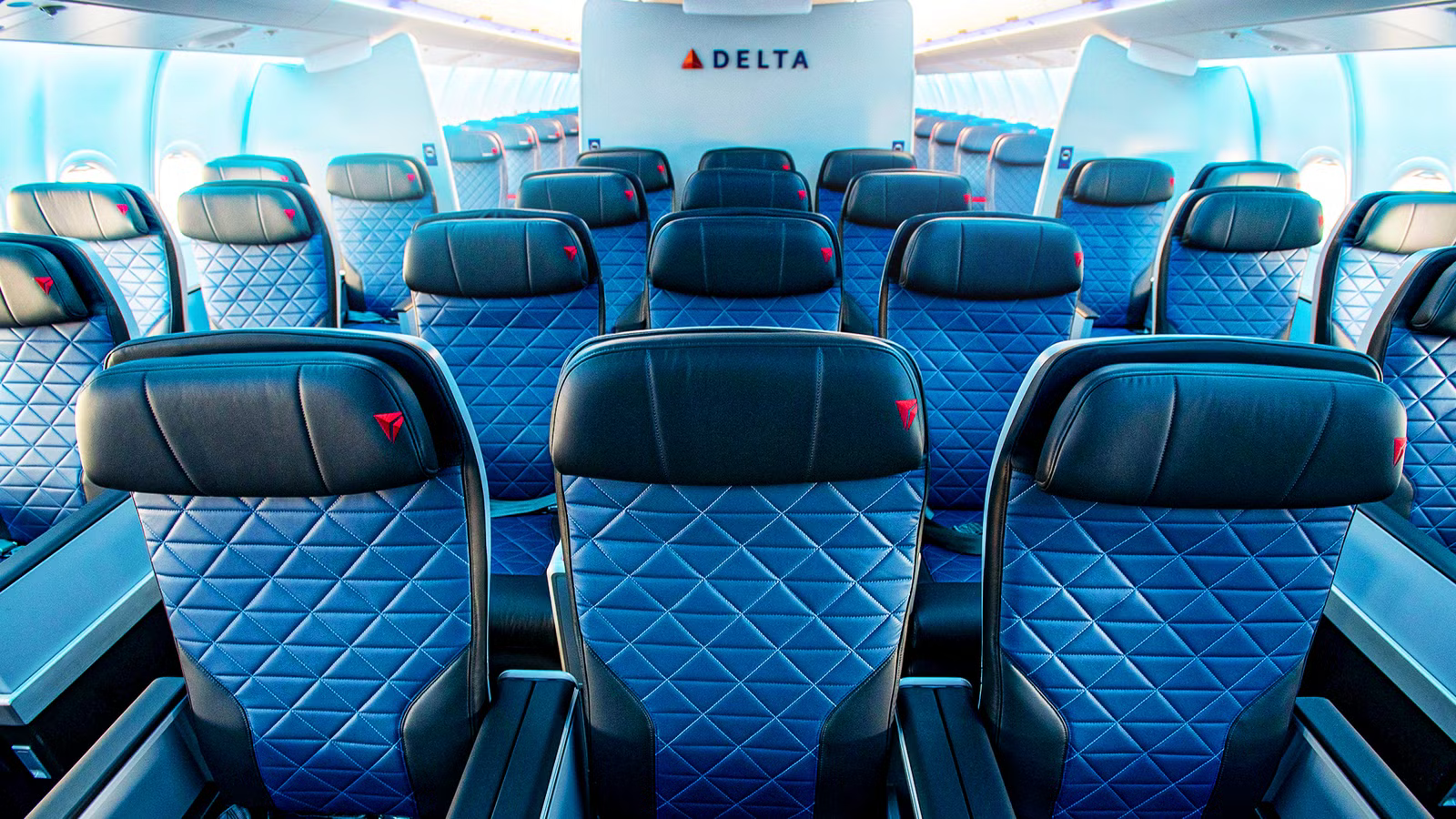
 Delta Air Lines is currently replacing many of its aging Boeing 767-300ERs with modern Airbus A330-900neos. The replacement is not just a straightforward one-for-one, like-for-like replacement. Not only are these aircraft larger, with a greater seating capacity, but they are also enabling Delta to upgrade its product on prestige routes with more premium seating options.
Delta had previously been worried that premium economy seats would compete with its lucrative business class seats and motivate people to downgrade rather than encourage economy passengers to upgrade. This is part of a larger trend among legacy airlines. For example, Emirates was skeptical of premium economy for years, but has now embraced it and is retrofitting its fleet.
Emirates President Sir Tim Clark has described customer response to the airline’s premium economy cabin as a surprise, stating that the airline has “been absolutely shocked at the demand for the seats” and passengers are now “clamoring to get into them.” With this in mind, let’s examine Delta’s premium-heavy Airbus A330-900neos.
The Shift Away From First Class & Economy

Perhaps counterintuitively to many, both the highest and lowest class seating options in legacy carriers are currently being squeezed. American Airlines is the final US-based carrier to phase out first class, joining a larger trend around the world away from first class seating.
Emirates now has as much as half of the world’s remaining first class seats. With that being said, this doesn’t particularly affect Delta, as it phased first class out in the late 1990s. A second trend is seemingly contradictory. The last few decades have seen the rise of low-cost carriers taking an increasingly large share of the market.
This includes Allegiant, Frontier, and formerly Spirit. However, the impact has been essentially the opposite for mainline carriers. The last decade or two has seen the rise of premium economy, with legacy airlines around the world currently rushing to install more premium economy options. Low-cost carriers cater to the large number of passengers interested in booking the cheapest possible fare.
Meanwhile, premium economy caters to a different market segment. Gone are the days of the glamor of air travel, and it is no longer much of a status symbol. It has become something everyone does. Many passengers are no longer interested in spending large amounts for business class, but are also reluctant to fly in discomfort in economy. For them, premium economy is the sweet spot.
Delta’s Premium Shift

In Fiscal 2025, Delta saw its premium revenue grow by 7% year over year, while its main cabin ticket sales fell. United even saw its premium revenue grow by 11%. For the first time in Delta’s history, premium revenue exceeded main cabin revenue in the fourth quarter of 2025.
In the final quarter of 2025, Delta took $5.62 billion in main cabin revenue (down from $6.05 billion) and $5.7 billion in premium cabin revenue (up from $5.22 billion). For the full year, main cabin revenue was $23.39 billion (down from $24.5 billion) and premium revenue was $22.1 billion (up from $20.6 billion).
This comes after Delta stated in 2024 that its margins in its premium cabins were 15% higher than those in its economy cabins. What is also notable is that the mixture of premium passengers has changed. Pre-pandemic, airlines assumed that the bulk of premium travelers were business flyers who were less sensitive to price and booked their fares late.
Now, an increasing share of premium passengers are leisure travelers, remote and hybrid workers, and customers willing to treat themselves to higher-class seats. This has blurred the lines between business and leisure travel as more passengers are booking premium seats based on personal preference.
Replacing Delta’s Old Boeing 767-300ERs

Delta Air Lines is in the process of phasing out its old Boeing 767-300ERs. Data from Planespotters.net shows Delta retired three 767-300ERs in 2025 and another one in April 2026. It has a remaining fleet of 36 Boeing 767-300ERs (and 21 Boeing 767-400ERs). These are being replaced, or partially replaced, by new Airbus A330-900neos, which offer around a 20% improvement in fuel economy, while also offering more capacity and better premium opportunities.
Catch what other flight trackers miss
Emergency squawks, holds, NOTAMs — live signals, no signup.
Open tracker
Catch what other flight trackers miss
Emergency squawks, holds, NOTAMs — live signals, no signup.
Open tracker
Delta’s 767-300ERs exist in two international configurations: of these, the one more directly being replaced by the A330-900neo is the 216-seat four-cabin (76K) variant. This is the version that Delta deploys on premium transatlantic routes and South American routes. These aircraft are configured with 26 business (Delta One) seats, 18 premium economy (Delta Premium Select), and 172 economy seats split between 29 seats in Delta Comfort and 143 seats in Delta Main.
Cabins | Boeing 767-300ER (76K) | Airbus A330-900neo |
|---|---|---|
Delta One | 26 | 29 |
Delta Premium Select | 18 | 28 |
Delta Comfort+ | 29 | 56 |
Delta Main | 143 | 168 |
Total | 216 | 281 |
The other 767-300ER configuration (76L) has 211 seats. These include 36 business class seats and 175 economy class seats (32 Comfort+ and 143 Main Cabin). They are not configured with any premium economy seats. The bulk of Delta’s remaining fleet of 36 Boeing 767-300ERs is the 76K configuration. The maximum certified seating for the -300ER is about 350 seats, while the maximum for the A330-900neo is 465 seats.
Delta’s Premium-Heavy Airbus A330-900neo Configuration

As the A330-900neo is certified to carry around 115 more seats, Delta could have added a lot more seating capacity. Instead, it has pivoted to adding premium options. Delta is configuring these aircraft with 281 seats, and they are arguably the most premium-heavy widebody aircraft in any major US airline fleet.
Instead of maximizing seat count, Delta has deliberately sacrificed around 30 to 50 economy seats versus many competitors to create a much larger premium cabin. The standardized four-cabin layout for these aircraft is 29 business class seats (Delta One Suites), 28 premium economy seats (Premium Select), 56 improved economy seats (Comfort+), and 168 standard economy seats (Main Cabin).
Comfort+ is particularly important as, with 56 seats, this cabin is almost double the size of what it is on some of Delta’s other widebodies. It is an enhanced economy product offering increased legroom, a dedicated cabin section, earlier boarding, and complimentary alcoholic drinks, but it is not premium economy and has the same seat width and similar recline as standard economy.
This is giving Delta a sizable inventory of moderately premium seats that it can sell to both leisure and corporate travelers. All of Delta’s 39 A330-900neos have the same configuration. Delta has another 16 A330-900neos on order, and these are expected to resume deliveries in 2029 and bring its fleet to 55 A330-900neos.
Delta’s A330-900neos Routes

It should be noted that the A330-900neo is not a direct replacement for the Boeing 767-300ER. For example, the Atlanta and New York-JFK routes to Buenos Aires now use A330-900neos, replacing the Boeing 767-400ER. These add around 20% more capacity to the route. However, the main routes are often transatlantic 767-300ER stronghold routes to destinations like London, Amsterdam, Paris, Milan, and Barcelona from hubs like Atlanta, Detroit, Minneapolis, and New York-JFK.
They can also be found on Asia-Pacific routes that would be unsuitable for the flagship A350-900, like Seattle to Tokyo. Overall, the A330-900neo is Delta’s workhorse premium widebody for transatlantic routes as well as some Pacific and South American routes. The Airbus A350-900 serves a different niche. It is used on Delta’s longest and highest-demand missions, including its ultra-long-haul flights to Asia and various flagship international routes.
The A330-900neo is officially certified for 465 seats, and Delta only configures them with 281 seats. In Delta service, the larger A350-900 is actually configured with just 275 seats, which is even less than the A330-900neo. These long-haul aircraft are configured with 40 Delta One Suites, 40 Premium Select seats, 36 Comfort+ seats, and 159 Main Cabin seats.
A Winning Delta Model & The Alaska Challenge

When counting the Comfort+ cabin, around 40% of seats in Delta’s A330-900neos are premium. This follows Delta’s strategy of maximizing revenue per flight, not the most passengers. It is also part of a broader premium push that will eventually take Delta’s incoming 787-10 Dreamliners and its large A350-1000s past the 50% premium-seat threshold. By comparison, older 767s are configured with around 30% premium seating.
It can be noted that Delta’s strategy has made it the most valuable publicly traded airline in the world (not all airlines are publicly traded). As of the time of writing, it has a market capitalization of around $53 billion, placing it notably ahead of the next-highest valued company, which is United at $36 billion. After that is Ryanair at $29 billion, showing that the ultra-low-cost model can also work. American Airlines only has a market capitalization of around $9 billion.
With a mainline fleet of around 1,000 aircraft, Delta is in the running to be the largest airline in the world. The largest depends on methodology. Separately, Delta’s former partner in Seattle, Alaska Airlines, is becoming its chief local rival. Alaska is currently working to develop its own widebody intercontinental network from its base in Seattle. Until now, Delta has dominated the intercontinental market from Seattle, and it is moving to do battle with Alaska, which is trying to pry that market away from Delta.